Iblasi Abdulkareem S, Aungsuroch Yupin, Gunawan Joko, Gede Juanamasta I, Carver Cheryl
Faculty of Nursing, Chulalongkorn University Bangkok, Thailand.
Nursing Program, STIKes Wira Medika Bali, Denpasar, Bali, Indonesia.
SAGE Open Nurs. 2022 Jun 13;8:23779608221106443. doi: 10.1177/23779608221106443. eCollection 2022 Jan-Dec.
Repositioning practice is an essential pressure ulcer prevention intervention that has emerged in the history of nursing. Numerous terms are employed to indicate its meaning, such as turning, positioning, or posturing. However, there is no available analysis that distinguishes these terms or analyzes repositioning practice attributes.
To analyze repositioning practice as a concept of bedridden patients in hospitals by combining methods from Foucault's archeology of knowledge and Rodger's concept analysis.
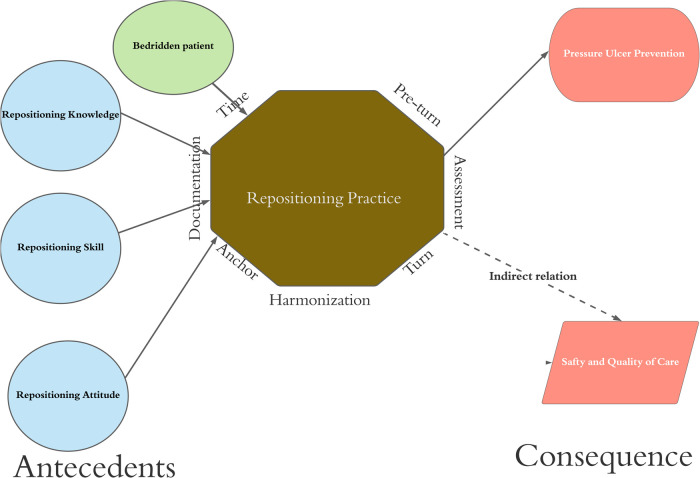
Repositioning practice passes through three eras: classical, modern, and research. The repositioning practice is "turn a bedridden patient in a harmonized way and ends with anchor and documentation." The analysis concludes seven attributes for the repositioning practice: pre-turn, assessment, turn, harmonization, anchor, documentation, and time. The analysis assumes bedridden patients, and assigned nurses on duty are the antecedents. Moreover, the main consequence is pressure ulcer prevention, while patient safety and quality of care are the secondary consequences.
Repositioning practice understanding has grown with time. Each era has added to or removed from nursing's understanding for repositioning practice until it appears as it now. The current analysis expects further development in repositioning practice understanding and applications.
Repositioning practice is an important nursing intervention and has shown a dynamic movement over history. It is expected that this dynamic will continue in the future.
体位变换实践是护理史上出现的一项重要的压疮预防干预措施。人们使用了许多术语来表示其含义,如翻身、摆放体位或姿势。然而,目前尚无分析来区分这些术语或剖析体位变换实践的属性。
通过结合福柯知识考古学方法和罗杰概念分析法,分析医院卧床患者的体位变换实践这一概念。
体位变换实践历经三个时代:经典时代、现代时代和研究时代。体位变换实践是“以协调的方式翻动卧床患者,并以固定和记录结束”。分析得出体位变换实践的七个属性:翻身前、评估、翻身、协调、固定、记录和时间。该分析以卧床患者为前提,且假定值班护士为实施者。此外,主要结果是预防压疮,而患者安全和护理质量是次要结果。
对体位变换实践的理解随时间不断发展。每个时代都在护理对体位变换实践的理解上有所增减,直至呈现出如今的样子。当前的分析期望在体位变换实践的理解和应用方面有进一步的发展。
体位变换实践是一项重要的护理干预措施,并且在历史上呈现出动态发展。预计这种动态性在未来将持续下去。