Ilyas Muhammad, Shah Sakhawat, Lai Ya-Wen, Sher Jan, Bai Tao, Zaman Fawad, Bibi Farkhanda, Koul Monika, Wani Shabir Hussain, Majrashi Ali, Alharby Hesham F, Hakeem Khalid Rehman, Wang Yong-Jian, Rather Shabir A
CAS Key Laboratory of Tropical Forest Ecology, Xishuangbanna Tropical Botanical Garden, Chinese Academy of Sciences, Menglun, China.
College of Horticulture and Forestry Sciences/Hubei Engineering Technology Research Centre for Forestry Information, Huazhong Agricultural University, Wuhan, China.
Front Plant Sci. 2022 Jun 1;13:869072. doi: 10.3389/fpls.2022.869072. eCollection 2022.
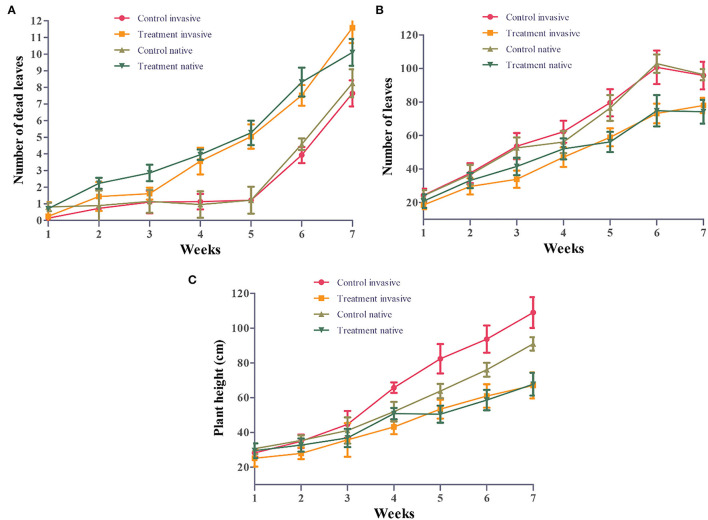
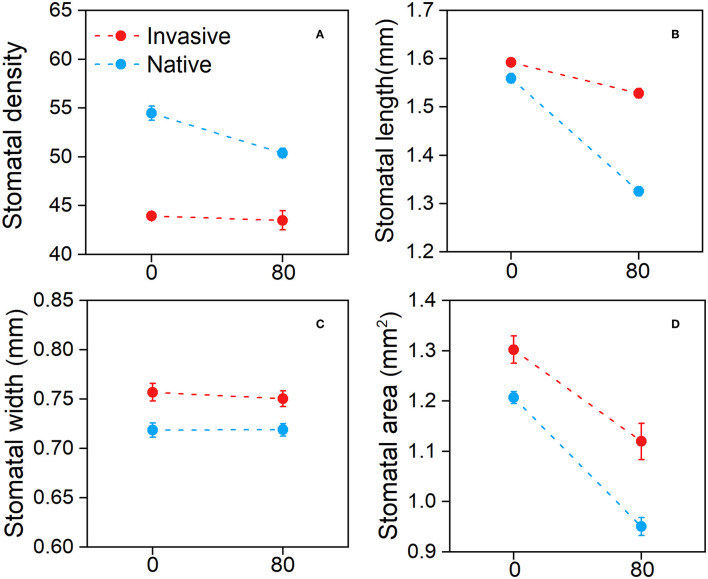
Heavy metal (HM) contamination resulting from industrialization and urbanization during the Anthropocene along with plant invasion can severely threaten the growth and adaptation of local flora. Invasive alien plant species generally exhibit a growth pattern consistent with their functional traits in non-contaminated environments in the introduced range. However, it remains unclear whether invasive alien plants have an advantage over native plants in contaminated environments and whether this growth pattern is dependent on the adaptation of their leaf functional traits. Here, we selected two congeneric pairs of invasive alien and native grasses that naturally co-exist in China and are commonly found growing in contaminated soil. To evaluate the effect of cadmium (Cd) on the structural and physiological leaf traits, we grew all four species in soil contaminated without or with 80 mg/kg Cd. Invasive plants contained significantly higher concentrations of Cd in all three organs (leaf, stem, and root). They displayed a higher transfer factor and bioconcentration factor (BCF) of shoot and root than natives, indicating that invasive species are potential Cd hyperaccumulators. Invasive plants accumulated polyphenol oxidase (PPO) to higher levels than natives and showed similar patterns of leaf structural and physiological traits in response to changes in Cd bioconcentration. The quantifiable leaf structural traits of invasive plants were significantly greater (except for stomatal density and number of dead leaves) than native plants. Leaf physiological traits, chlorophyll content, and flavonoid content were also significantly higher in invasive plants than in natives under Cd stress conditions after 4 weeks, although nitrogen balance index (NBI) showed no significant difference between the two species. Chlorophyll fluorescence parameters decreased, except for the quantum yield of photosystem II (ΦPSII) and the proportion of open photosystem II (qP), which increased under Cd stress conditions in both species. However, invasive plants exhibited higher fluorescence parameters than natives under Cd stress, and the decrement observed in invasive plants under Cd stress was greater than that in natives. High Cd adaptation of invasive grasses over natives suggests that invasive plants possess optimal leaf structural and physiological traits, which enable them to adapt to stressful conditions and capture resources more quickly than natives. This study further emphasizes the potential invasion of alien plants in contaminated soil environments within the introduced range. To a certain extent, some non-invasive alien plants might adapt to metalliferous environments and serve as hyperaccumulator candidates in phytoremediation projects in contaminated environments.
在人类世期间,工业化和城市化以及植物入侵所导致的重金属(HM)污染,会严重威胁当地植物群落的生长和适应性。外来入侵植物物种在引入范围内的非污染环境中,其生长模式通常与其功能性状一致。然而,尚不清楚外来入侵植物在污染环境中是否比本地植物具有优势,以及这种生长模式是否依赖于其叶片功能性状的适应性。在此,我们选择了在中国自然共存且常见于污染土壤中的两对同属的外来入侵草和本地草。为了评估镉(Cd)对叶片结构和生理性状的影响,我们将这四个物种种植在未添加或添加了80 mg/kg Cd的污染土壤中。入侵植物的所有三个器官(叶、茎和根)中的Cd浓度均显著更高。它们地上部和根部的转运系数和生物富集系数(BCF)均高于本地植物,这表明入侵物种是潜在的Cd超积累植物。入侵植物积累的多酚氧化酶(PPO)水平高于本地植物,并且在响应Cd生物富集变化时表现出相似的叶片结构和生理性状模式。入侵植物可量化的叶片结构性状(除气孔密度和枯叶数外)显著大于本地植物。在Cd胁迫4周后,入侵植物的叶片生理性状、叶绿素含量和类黄酮含量也显著高于本地植物,尽管两种植物的氮平衡指数(NBI)没有显著差异。叶绿素荧光参数下降,除了光系统II的量子产率(ΦPSII)和开放光系统II的比例(qP),这两个参数在两种植物的Cd胁迫条件下均增加。然而,在Cd胁迫下,入侵植物的荧光参数高于本地植物,并且入侵植物在Cd胁迫下观察到的下降幅度大于本地植物。入侵草对Cd的高适应性超过本地草,这表明入侵植物具有最佳的叶片结构和生理性状,使其能够适应胁迫条件并比本地植物更快地获取资源。本研究进一步强调了外来植物在引入范围内污染土壤环境中的潜在入侵性。在一定程度上,一些非入侵性外来植物可能适应含金属环境,并可作为污染环境植物修复项目中的超积累植物候选者。