Bender Kathryn E, Badiger Aishwarya, Roe Brian E, Shu Yiheng, Qi Danyi
Department of Business and Economics, Allegheny College, Meadville, PA, USA.
Department of Food Science and Technology, The Ohio State University, Columbus, OH, USA.
Socioecon Plann Sci. 2022 Aug;82:101107. doi: 10.1016/j.seps.2021.101107. Epub 2021 Jun 26.
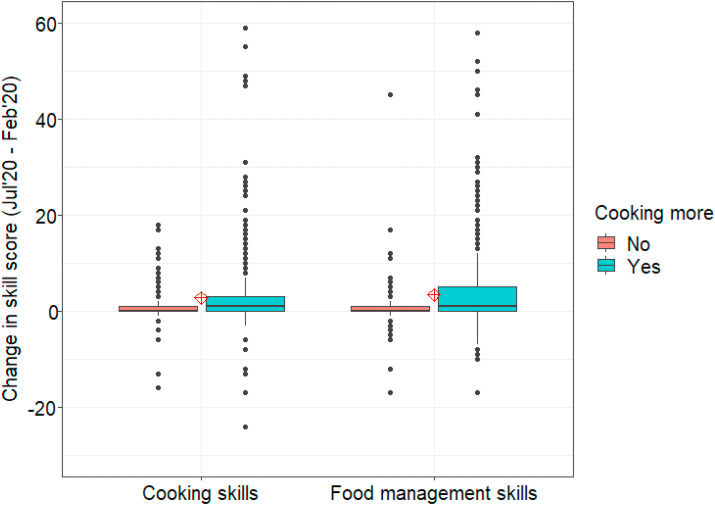
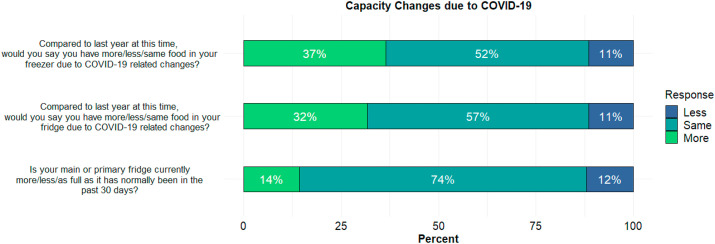
The COVID-19 pandemic has stimulated considerable interest in the resilience of the U.S. food system. Less attention has been paid to the resiliency characteristics of the final link in the food system - individual households. We use national survey data from July 2020 to understand the food acquisition, preparation, and management strategies that households implemented in response to the pandemic. We find a substantial increase in the amount of food prepared and consumed at home which scales with respondents' time availability, perceived risks of dining out, and pandemic-induced income disruption. We then identify several household responses to support this increase in home food consumption that are in line with practices suggested to enhance resiliency at other links in the food supply chain, including increased cold storage capacity and enhanced in-house capability via improved cooking and food management skills. We discuss how responses such as improved food skills can reduce the propagation of shocks through the supply chain by allowing greater flexibility and less waste, while actions such as increased home cold storage capacity could undermine system resilience by exacerbating bullwhip effects, i.e., amplifying consumer demand shocks that are propagated to upstream food supply chain actors.
新冠疫情激发了人们对美国食品系统韧性的极大兴趣。而食品系统最后一环——家庭个体的韧性特征却较少受到关注。我们利用2020年7月的全国调查数据来了解家庭为应对疫情而采取的食品采购、准备和管理策略。我们发现,家庭自制和食用的食物量大幅增加,且这与受访者的时间可利用性、外出就餐的感知风险以及疫情导致的收入中断情况相关。然后,我们确定了家庭为支持家庭食品消费增加而采取的几种应对措施,这些措施与为增强食品供应链其他环节的韧性而建议的做法一致,包括增加冷藏能力以及通过提高烹饪和食品管理技能来增强家庭内部能力。我们讨论了诸如提高食品技能等应对措施如何通过提供更大的灵活性和减少浪费来减少冲击在供应链中的传播,而增加家庭冷藏能力等行动可能会通过加剧牛鞭效应(即放大传播到上游食品供应链参与者的消费者需求冲击)来破坏系统韧性。