Shahidi Siamak, Mahmoodi Monireh Sufi, Komaki Alireza, Sadeghian Reihaneh
Neurophysiology Research Center, Hamadan University of Medical Sciences, Hamadan, Iran.
School of Medicine, Hamadan University of Medical Sciences, Hamadan, Iran.
Heliyon. 2022 Jun 7;8(6):e09662. doi: 10.1016/j.heliyon.2022.e09662. eCollection 2022 Jun.
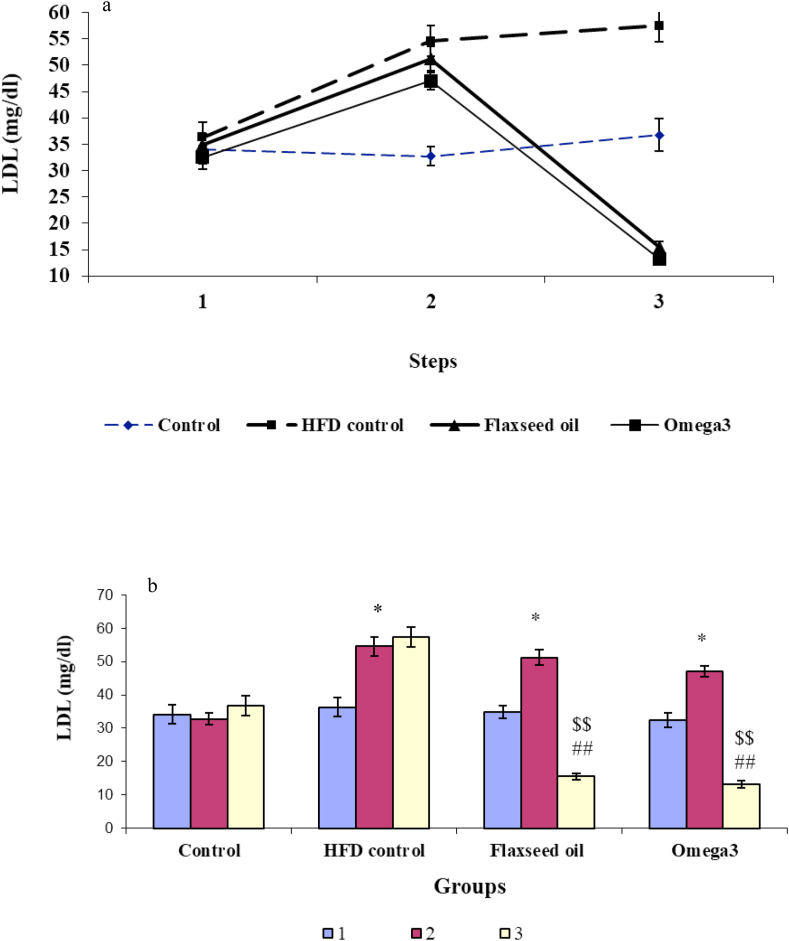
Hyperlipidemia affects a significant number of patients despite treatment with cholesterol-lowering drugs. Due to the low efficacy of synthetic drugs, there is a need for new agents with low side effects. Therefore, the effects of flaxseeds oil and animal omega-3 on the hyperlipidemic rats were investigated. Forty male Wistar rats were assigned to four groups (n = 10): 1) control group that was fed with a standard diet (pallets). 2) high-fat diet (HFD) control group that was fed with high-fat food for 42 days, 3) Omega-3 group that received HFD for 21 days, followed by HFD + omega-3 capsule (600 mg/kg; 21 days/gavage), and 4) flaxseed oil group that received HFD for 21 days, followed by HFD + flaxseed oil (10 ml/kg; 21 days/gavage). Blood samples were collected three times and at the stages one to third of the experiment from the rats' tail. The results showed that high levels of fat significantly increased cholesterol, triglyceride (TG), and low-density lipoprotein (LDL) in the flaxseed, HFD control, and omega-3 groups in the second stages of the experiment. Inverse, omega-3 or flaxseed oil supplementation decreased cholesterol, TG, and LDL levels and increased high-density lipoprotein (HDL) level in comparison with the HFD control group in the third stages of the experiment. There was no significant difference in the studied parameters between the flaxseed- and omega-3-treated groups. It can be concluded that flaxseed oil similar to omega-3 is effective in the treatment of hyperlipidemia.
尽管使用了降胆固醇药物,但仍有相当数量的患者受到高脂血症的影响。由于合成药物疗效较低,因此需要副作用小的新型药物。因此,研究了亚麻籽油和动物源ω-3对高脂血症大鼠的影响。将40只雄性Wistar大鼠分为四组(n = 10):1)喂食标准饮食(颗粒饲料)的对照组。2)喂食高脂食物42天的高脂饮食(HFD)对照组,3)先接受21天HFD,然后接受HFD + ω-3胶囊(600 mg/kg;每天灌胃)21天的ω-3组,4)先接受21天HFD,然后接受HFD + 亚麻籽油(10 ml/kg;每天灌胃)21天的亚麻籽油组。在实验的第一至第三阶段,从大鼠尾部三次采集血样。结果显示,在实验的第二阶段,高脂饮食显著增加了亚麻籽组、HFD对照组和ω-3组中的胆固醇、甘油三酯(TG)和低密度脂蛋白(LDL)水平。相反,在实验的第三阶段,与HFD对照组相比,补充ω-3或亚麻籽油可降低胆固醇、TG和LDL水平,并提高高密度脂蛋白(HDL)水平。亚麻籽治疗组和ω-3治疗组之间的研究参数没有显著差异。可以得出结论,亚麻籽油与ω-3一样对高脂血症具有治疗效果。