Zhu Qing-Zeng, Wegener Gunter, Hinrichs Kai-Uwe, Elvert Marcus
MARUM - Center for Marine Environmental Sciences, University of Bremen, Bremen, Germany.
Max Planck Institute for Marine Microbiology, Bremen, Germany.
Front Microbiol. 2022 Jun 2;13:912299. doi: 10.3389/fmicb.2022.912299. eCollection 2022.
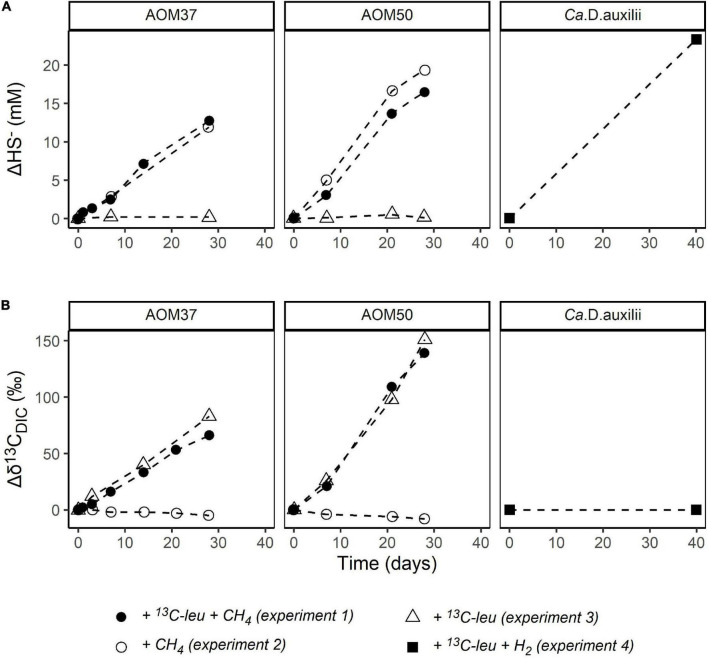
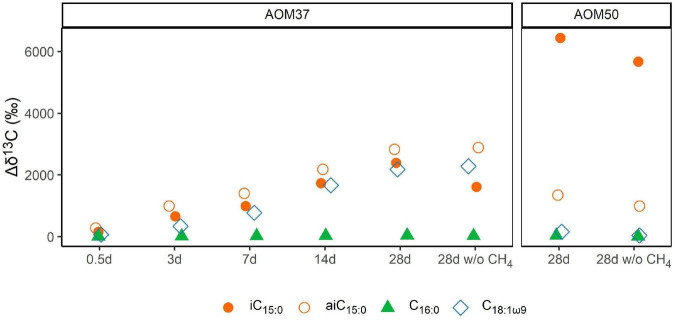
Consortia of anaerobic methanotrophic archaea (ANME) and sulfate-reducing bacteria mediate the anaerobic oxidation of methane (AOM) in marine sediments. However, even sediment-free cultures contain a substantial number of additional microorganisms not directly related to AOM. To track the heterotrophic activity of these community members and their possible relationship with AOM, we amended meso- (37°C) and thermophilic (50°C) AOM cultures (dominated by ANME-1 archaea and their partner bacteria of the Seep-SRB2 clade or Desulfofervidus auxilii) with L-leucine-3-C (C-leu). Various microbial lipids incorporated the labeled carbon from this amino acid, independent of the presence of methane as an energy source, specifically bacterial fatty acids, such as and -branched C and C, as well as unsaturated C and C. In natural methane-rich environments, these bacterial fatty acids are strongly C-depleted. We, therefore, suggest that those fatty acids are produced by ancillary bacteria that grow on C-depleted necromass or cell exudates/lysates of the AOM core communities. Candidates that likely benefit from AOM biomass are heterotrophic bacterial members of the Spirochetes and Anaerolineae-known to produce abundant branched fatty acids and present in all the AOM enrichment cultures. For archaeal lipids, we observed minor C-incorporation, but still suggesting some C-leu anabolism. Based on their relatively high abundance in the culture, the most probable archaeal candidates are Bathyarchaeota, Thermoplasmatales, and Lokiarchaeota. The identified heterotrophic bacterial and archaeal ancillary members are likely key players in organic carbon recycling in anoxic marine sediments.
厌氧甲烷氧化古菌(ANME)和硫酸盐还原细菌的聚集体介导了海洋沉积物中甲烷的厌氧氧化(AOM)。然而,即使是无沉积物培养物也包含大量与AOM无直接关系的其他微生物。为了追踪这些群落成员的异养活性及其与AOM的可能关系,我们用L-亮氨酸-3-C(C-亮氨酸)对中温(37°C)和嗜热(50°C)的AOM培养物(以ANME-1古菌及其Seep-SRB2分支或辅助脱硫弧菌的伙伴细菌为主)进行了修正。各种微生物脂质都掺入了来自这种氨基酸的标记碳,这与甲烷作为能源的存在无关,特别是细菌脂肪酸,如 和 -支链C和C,以及不饱和C和C。在天然富含甲烷的环境中,这些细菌脂肪酸的C含量极低。因此,我们认为这些脂肪酸是由在AOM核心群落的C含量低的坏死物质或细胞分泌物/裂解物上生长的辅助细菌产生的。可能从AOM生物量中受益的候选者是螺旋体属和厌氧绳菌属的异养细菌成员,已知它们会产生大量支链脂肪酸,并且存在于所有AOM富集培养物中。对于古菌脂质,我们观察到少量的C掺入,但仍表明存在一些C-亮氨酸合成代谢。基于它们在培养物中相对较高的丰度,最有可能的古菌候选者是深海古菌、嗜热栖热菌和洛基古菌。已鉴定出的异养细菌和古菌辅助成员可能是缺氧海洋沉积物中有机碳循环的关键参与者。