• 文献检索
  • 文档翻译
  • 深度研究
  • 学术资讯
  • Suppr Zotero 插件Zotero 插件
  • 邀请有礼
  • 套餐&价格
  • 历史记录
应用&插件
Suppr Zotero 插件Zotero 插件浏览器插件Mac 客户端Windows 客户端微信小程序
定价
高级版会员购买积分包购买API积分包
服务
文献检索文档翻译深度研究API 文档MCP 服务
关于我们
关于 Suppr公司介绍联系我们用户协议隐私条款
关注我们

Suppr 超能文献

核心技术专利:CN118964589B侵权必究
粤ICP备2023148730 号-1Suppr @ 2026

文献检索

告别复杂PubMed语法,用中文像聊天一样搜索,搜遍4000万医学文献。AI智能推荐,让科研检索更轻松。

立即免费搜索

文件翻译

保留排版,准确专业,支持PDF/Word/PPT等文件格式,支持 12+语言互译。

免费翻译文档

深度研究

AI帮你快速写综述,25分钟生成高质量综述,智能提取关键信息,辅助科研写作。

立即免费体验

使用概率主成分分析(PPCA)和基于莱维飞行的长短期记忆网络(LSTM)实现假新闻检测自动化。

Automating fake news detection using PPCA and levy flight-based LSTM.

作者信息

Dixit Dheeraj Kumar, Bhagat Amit, Dangi Dharmendra

机构信息

Department of Computer Applications, MANIT, Bhopal, India.

出版信息

Soft comput. 2022;26(22):12545-12557. doi: 10.1007/s00500-022-07215-4. Epub 2022 Jun 16.

DOI:10.1007/s00500-022-07215-4
PMID:35729952
原文链接:https://pmc.ncbi.nlm.nih.gov/articles/PMC9202495/
Abstract

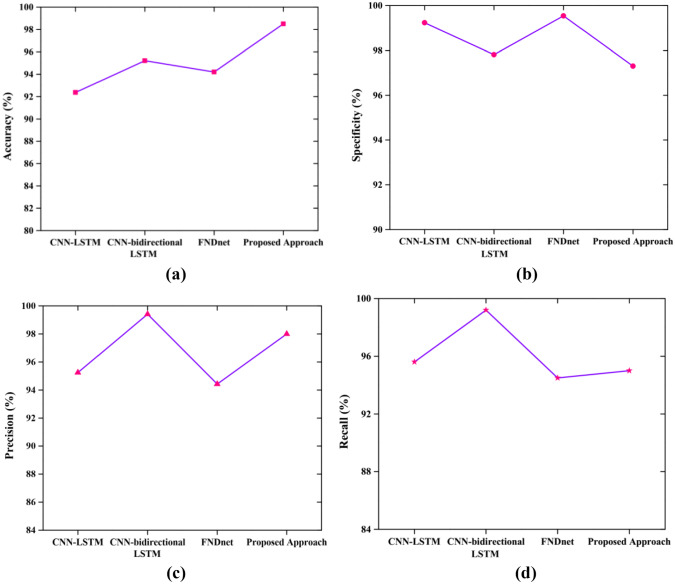
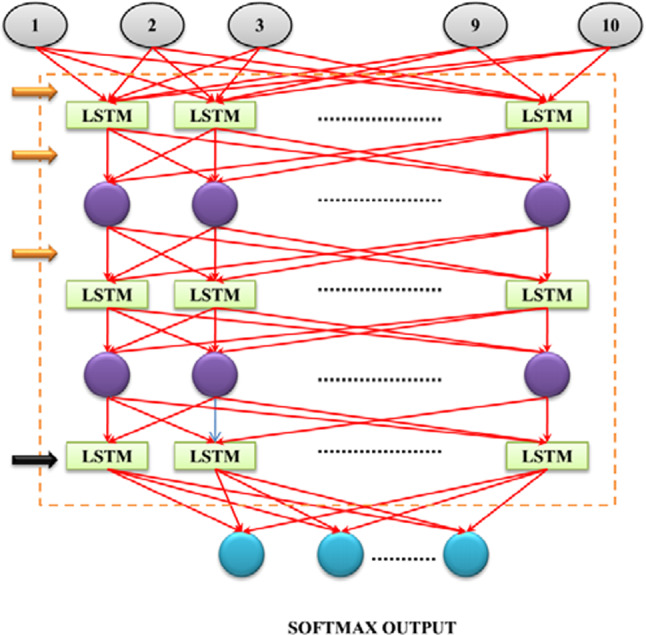
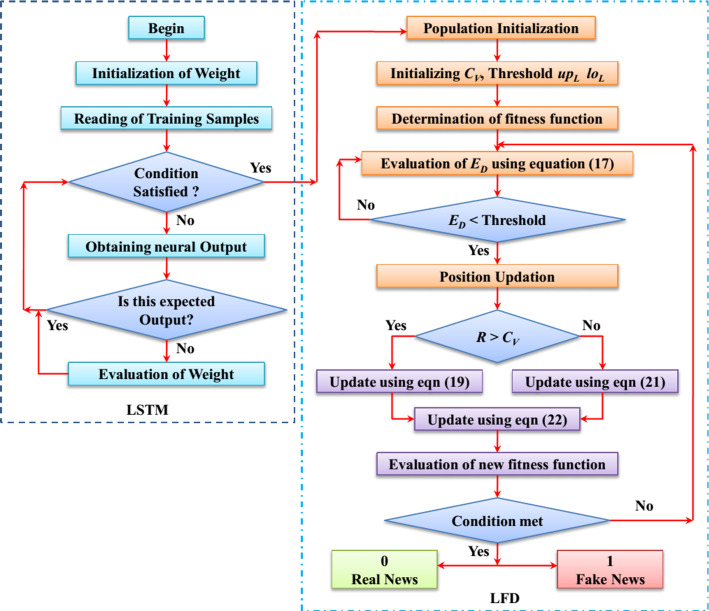
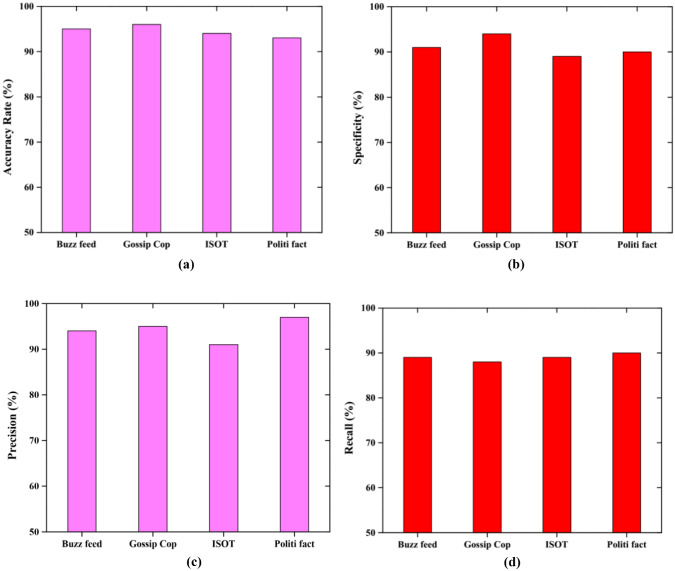
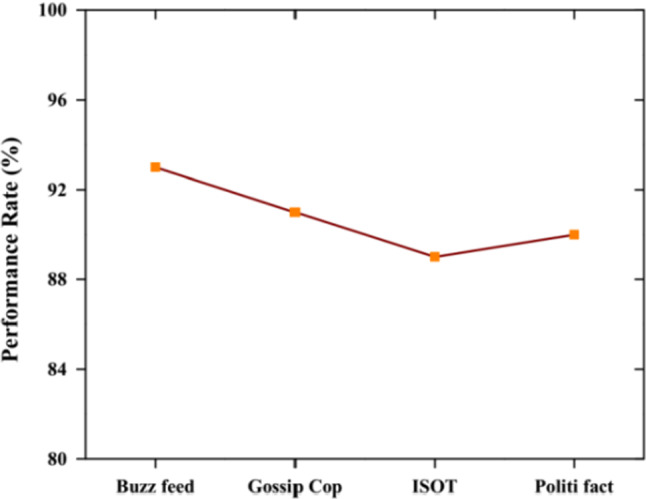
In recent years, rumours and fake news are spreading widely and very rapidly all over the world. Such circumstances lead to the propagation and production of an inaccurate news article. Also, misinformation and fake news are increased by the user without proper verification. Hence, it is necessary to restrict the spreading of fake information on mass media and to promote confidence all over the world. For this purpose, this paper recognizes the detection of fake news in an effective manner. The proposed methodology in detecting fake news consists of four different phases namely the data pre-processing phase, feature reduction phase, feature extraction phase as well as the classification phase. During data pre-processing, the input data are pre-processed by employing tokenization, stop-words deletion as well as stemming. In the second phase, the features are reduced by employing PPCA to enhance accuracy. Then the extracted feature is provided to the classification phase where LSTM-LF algorithm is utilized to classify the news as fake or real optimally. Furthermore, this paper utilizes four different datasets namely the Buzzfeed dataset, GossipCop dataset, ISOT dataset as well as Politifact dataset for evaluation. The performance evaluation and the comparative analysis are conducted and the analysis reveals that the proposed approach provides better performances when compared to other fake detection-based approaches.

摘要

近年来,谣言和假新闻在全球范围内广泛且迅速地传播。这种情况导致了不准确新闻文章的传播和产生。此外,未经适当核实,用户传播的错误信息和假新闻也在增加。因此,有必要限制假信息在大众媒体上的传播,并在全球范围内增强信心。为此,本文致力于有效地检测假新闻。所提出的检测假新闻的方法包括四个不同阶段,即数据预处理阶段、特征约简阶段、特征提取阶段以及分类阶段。在数据预处理过程中,通过采用词法分析、停用词删除以及词干提取对输入数据进行预处理。在第二阶段,采用概率主成分分析(PPCA)来减少特征以提高准确性。然后将提取的特征提供给分类阶段,在该阶段利用长短期记忆网络 - 局部特征(LSTM - LF)算法对新闻进行最优分类,判断其为假新闻还是真实新闻。此外,本文利用四个不同的数据集,即Buzzfeed数据集、GossipCop数据集、ISOT数据集以及Politifact数据集进行评估。进行了性能评估和对比分析,分析表明与其他基于假新闻检测的方法相比,所提出的方法具有更好的性能。

https://cdn.ncbi.nlm.nih.gov/pmc/blobs/9ac5/9202495/65d837b9afd3/500_2022_7215_Fig7_HTML.jpg
https://cdn.ncbi.nlm.nih.gov/pmc/blobs/9ac5/9202495/0d60f26b97a7/500_2022_7215_Fig1_HTML.jpg
https://cdn.ncbi.nlm.nih.gov/pmc/blobs/9ac5/9202495/2f52b5024b34/500_2022_7215_Fig2_HTML.jpg
https://cdn.ncbi.nlm.nih.gov/pmc/blobs/9ac5/9202495/3b7871cb0263/500_2022_7215_Fig3_HTML.jpg
https://cdn.ncbi.nlm.nih.gov/pmc/blobs/9ac5/9202495/774fc5bffb67/500_2022_7215_Fig4_HTML.jpg
https://cdn.ncbi.nlm.nih.gov/pmc/blobs/9ac5/9202495/db75bc92e3f4/500_2022_7215_Fig5_HTML.jpg
https://cdn.ncbi.nlm.nih.gov/pmc/blobs/9ac5/9202495/4c6b51cf08ad/500_2022_7215_Fig6_HTML.jpg
https://cdn.ncbi.nlm.nih.gov/pmc/blobs/9ac5/9202495/65d837b9afd3/500_2022_7215_Fig7_HTML.jpg
https://cdn.ncbi.nlm.nih.gov/pmc/blobs/9ac5/9202495/0d60f26b97a7/500_2022_7215_Fig1_HTML.jpg
https://cdn.ncbi.nlm.nih.gov/pmc/blobs/9ac5/9202495/2f52b5024b34/500_2022_7215_Fig2_HTML.jpg
https://cdn.ncbi.nlm.nih.gov/pmc/blobs/9ac5/9202495/3b7871cb0263/500_2022_7215_Fig3_HTML.jpg
https://cdn.ncbi.nlm.nih.gov/pmc/blobs/9ac5/9202495/774fc5bffb67/500_2022_7215_Fig4_HTML.jpg
https://cdn.ncbi.nlm.nih.gov/pmc/blobs/9ac5/9202495/db75bc92e3f4/500_2022_7215_Fig5_HTML.jpg
https://cdn.ncbi.nlm.nih.gov/pmc/blobs/9ac5/9202495/4c6b51cf08ad/500_2022_7215_Fig6_HTML.jpg
https://cdn.ncbi.nlm.nih.gov/pmc/blobs/9ac5/9202495/65d837b9afd3/500_2022_7215_Fig7_HTML.jpg

相似文献

1
Automating fake news detection using PPCA and levy flight-based LSTM.使用概率主成分分析(PPCA)和基于莱维飞行的长短期记忆网络(LSTM)实现假新闻检测自动化。
Soft comput. 2022;26(22):12545-12557. doi: 10.1007/s00500-022-07215-4. Epub 2022 Jun 16.
2
Deep Ensemble Fake News Detection Model Using Sequential Deep Learning Technique.基于序列深度学习技术的深度集成假新闻检测模型。
Sensors (Basel). 2022 Sep 15;22(18):6970. doi: 10.3390/s22186970.
3
DeepFND: an ensemble-based deep learning approach for the optimization and improvement of fake news detection in digital platform.深度虚假新闻检测(DeepFND):一种基于集成学习的深度学习方法,用于优化和改进数字平台中的虚假新闻检测。
PeerJ Comput Sci. 2023 Dec 7;9:e1666. doi: 10.7717/peerj-cs.1666. eCollection 2023.
4
EchoFakeD: improving fake news detection in social media with an efficient deep neural network.回声假新闻检测(EchoFakeD):利用高效深度神经网络改进社交媒体中的假新闻检测
Neural Comput Appl. 2021;33(14):8597-8613. doi: 10.1007/s00521-020-05611-1. Epub 2021 Jan 2.
5
CB-Fake: A multimodal deep learning framework for automatic fake news detection using capsule neural network and BERT.CB-Fake:一种使用胶囊神经网络和BERT进行自动假新闻检测的多模态深度学习框架。
Multimed Tools Appl. 2022;81(4):5587-5620. doi: 10.1007/s11042-021-11782-3. Epub 2021 Dec 28.
6
A novel approach to fake news classification using LSTM-based deep learning models.一种使用基于长短期记忆网络(LSTM)的深度学习模型进行假新闻分类的新方法。
Front Big Data. 2024 Jan 8;6:1320800. doi: 10.3389/fdata.2023.1320800. eCollection 2023.
7
Spatio-temporal approach for classification of COVID-19 pandemic fake news.用于新冠疫情虚假新闻分类的时空方法
Soc Netw Anal Min. 2022;12(1):68. doi: 10.1007/s13278-022-00887-8. Epub 2022 Jun 27.
8
Fake news detection: deep semantic representation with enhanced feature engineering.假新闻检测:具有增强特征工程的深度语义表示
Int J Data Sci Anal. 2023 Mar 9:1-12. doi: 10.1007/s41060-023-00387-8.
9
Stance detection with BERT embeddings for credibility analysis of information on social media.基于BERT嵌入的立场检测用于社交媒体信息可信度分析
PeerJ Comput Sci. 2021 Apr 14;7:e467. doi: 10.7717/peerj-cs.467. eCollection 2021.
10
Detecting COVID-19-Related Fake News Using Feature Extraction.利用特征提取检测与 COVID-19 相关的假新闻。
Front Public Health. 2022 Jan 4;9:788074. doi: 10.3389/fpubh.2021.788074. eCollection 2021.

引用本文的文献

1
Class-weighted Dempster-Shafer in dual-level fusion for multimodal fake real estate listings detection.用于多模态虚假房地产列表检测的双层融合中的类加权邓普斯特-谢弗方法
PeerJ Comput Sci. 2025 May 27;11:e2797. doi: 10.7717/peerj-cs.2797. eCollection 2025.
2
Use of Retrieval-Augmented Large Language Model for COVID-19 Fact-Checking: Development and Usability Study.使用检索增强大语言模型进行COVID-19事实核查:开发与可用性研究。
J Med Internet Res. 2025 Apr 30;27:e66098. doi: 10.2196/66098.
3
Real-time fake news detection in online social networks: FANDC Cloud-based system.

本文引用的文献

1
SemSeq4FD: Integrating global semantic relationship and local sequential order to enhance text representation for fake news detection.SemSeq4FD:整合全局语义关系和局部顺序以增强用于假新闻检测的文本表示
Expert Syst Appl. 2021 Mar 15;166:114090. doi: 10.1016/j.eswa.2020.114090. Epub 2020 Oct 3.
2
Information Management in Healthcare and Environment: Towards an Automatic System for Fake News Detection.医疗保健和环境中的信息管理:迈向假新闻自动检测系统。
Int J Environ Res Public Health. 2020 Feb 8;17(3):1066. doi: 10.3390/ijerph17031066.
3
Datasets on statistical analysis and performance evaluation of backtracking search optimisation algorithm compared with its counterpart algorithms.
在线社交网络中的实时假新闻检测:基于FANDC云的系统。
Sci Rep. 2024 Oct 29;14(1):25954. doi: 10.1038/s41598-024-76102-9.
与回溯搜索优化算法的对应算法相比,关于回溯搜索优化算法的统计分析和性能评估的数据集。
Data Brief. 2019 Dec 23;28:105046. doi: 10.1016/j.dib.2019.105046. eCollection 2020 Feb.