Laboratory of Mitochondria and Metabolism, Department of Burn and Plastic Surgery, National Clinical Research Center for Geriatrics, West China Hospital, Sichuan University, Chengdu, China.
Harvard Reproductive Endocrine Science Center and Reproductive Endocrine Unit of the Department of Medicine, Massachusetts General Hospital, Harvard Medical School, Boston, Massachusetts, USA.
Environ Health Perspect. 2022 Jun;130(6):67007. doi: 10.1289/EHP10393. Epub 2022 Jun 22.
Per- and polyfluoroalkyl substances (PFAS) are widespread environmental contaminants associated with diseases such as cancer and dyslipidemia. However, few studies have investigated the association between PFAS mixture exposure and mortality in general populations.
This study aimed to explore the association between PFAS mixture, perfluorooctanoic acid (PFOA), and perfluorooctane sulfonic acid (PFOS) and mortality in U.S. adults by a nationally representative cohort.
Adults of age who were enrolled in the National Health and Nutrition Examination Survey (NHANES) (1999-2014) were included in our study. Baseline serum concentrations of seven PFAS were measured and individuals were followed up to 31 December 2015. Hazard ratios (HRs) and confidence intervals (CIs) were estimated using Cox proportional hazards models. Association between PFAS mixture exposure and mortality was analyzed using the -means method by clustering PFAS mixtures into subgroups. Association between PFOA/PFOS exposure and mortality was subsequently analyzed in both continuous and categorical models.
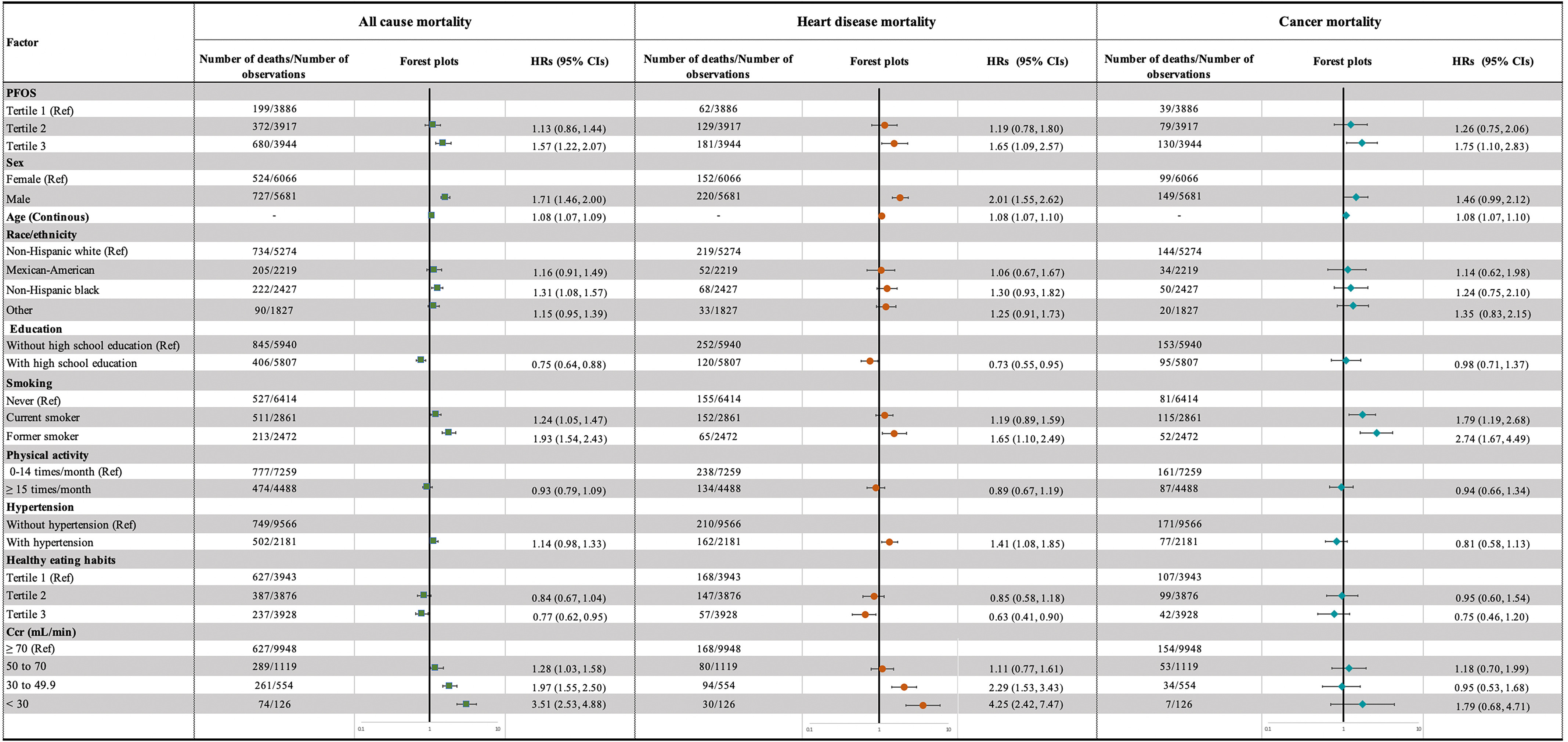
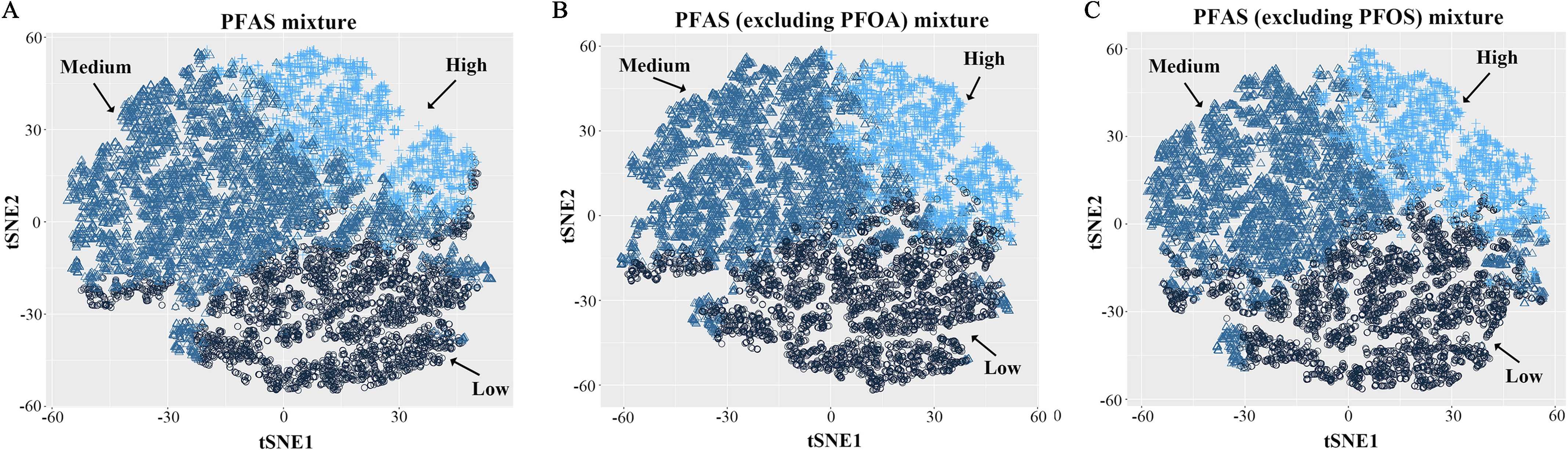
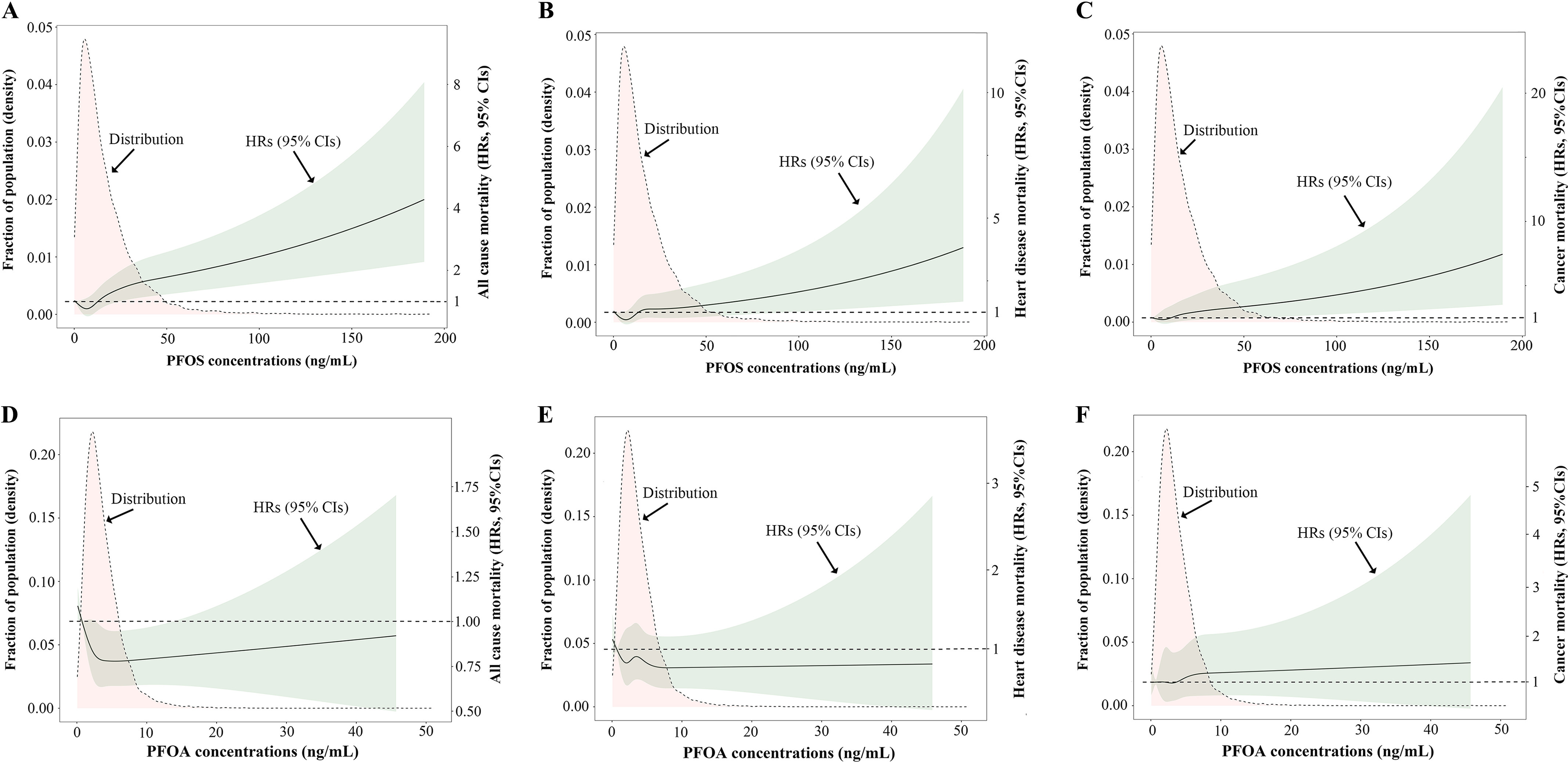
During the follow-up period, 1,251 participants died. In the mixture analysis, the -means algorithm clustered participants into low-, medium-, and high-exposure groups. Compared with the low-exposure group, participants in the high-exposure group showed significantly higher risks for all-cause mortality (; 95% CI: 1.07, 1.80), heart disease mortality (; 95% CI: 1.05, 2.51), and cancer mortality (; 95% CI: 1.08, 2.84). In single PFAS analysis, PFOS was found to be positively associated with all-cause mortality (third vs. first tertile ; 95% CI: 1.22, 2.07), heart disease mortality (third vs. first tertile ; 95% CI: 1.09, 2.57), and cancer mortality (third vs. first tertile ; 95% CI: 1.10, 2.83), whereas PFOA exposure had no significant association with mortality. Assuming the observed association is causal, the number of deaths associated with PFOS exposure ( vs. ) was (95% CI: 176,000, 588,000) annually between 1999 and 2015, and it decreased to 69,000 (95% CI: 28,000, 119,000) annually between 2015 and 2018. The association between PFOS and mortality was stronger among women and people without diabetes.
We observed a positive association between PFAS mixture exposure and mortality among U.S. adults. Limitations of this study include the potential for unmeasured confounding, selection bias, a relatively small number of deaths, and only measuring PFAS at one point in time. Further studies with serial measures of PFAS concentrations and longer follow-ups are necessary to elucidate the association between PFAS and mortality from specific causes. https://doi.org/10.1289/EHP10393.
全氟和多氟烷基物质(PFAS)是广泛存在的环境污染物,与癌症和血脂异常等疾病有关。然而,很少有研究调查 PFAS 混合物暴露与一般人群死亡率之间的关系。
本研究旨在通过一项具有全国代表性的队列研究,探讨 PFAS 混合物、全氟辛酸(PFOA)和全氟辛烷磺酸(PFOS)与美国成年人死亡率之间的关系。
本研究纳入了参加国家健康和营养检查调查(NHANES)(1999-2014 年)的年龄在 18 岁及以上的成年人。测量了基线时的七种 PFAS 血清浓度,并对参与者进行了 31 日的随访。采用 Cox 比例风险模型估计风险比(HRs)和置信区间(CIs)。采用 -均值法通过聚类 PFAS 混合物成亚组来分析 PFAS 混合物暴露与死亡率之间的关系。随后在连续和分类模型中分析了 PFOA/PFOS 暴露与死亡率之间的关系。
在随访期间,有 1251 名参与者死亡。在混合物分析中,-均值算法将参与者聚类为低、中、高暴露组。与低暴露组相比,高暴露组的全因死亡率(HR:1.07,95%CI:1.00,1.80)、心脏病死亡率(HR:1.05,95%CI:1.00,2.51)和癌症死亡率(HR:1.08,95%CI:1.00,2.84)均显著升高。在单 PFAS 分析中,PFOS 与全因死亡率(第三与第一三分位数;95%CI:1.22,2.07)、心脏病死亡率(第三与第一三分位数;95%CI:1.09,2.57)和癌症死亡率(第三与第一三分位数;95%CI:1.10,2.83)呈正相关,而 PFOA 暴露与死亡率无显著相关性。假设观察到的关联是因果关系的,那么 1999 年至 2015 年间,PFOS 暴露(与)每年与死亡率相关的死亡人数为 (95%CI:176000,588000),而 2015 年至 2018 年间,这一数字每年减少到 69000(95%CI:28000,119000)。PFOS 与死亡率之间的关系在女性和无糖尿病患者中更强。
我们观察到美国成年人 PFAS 混合物暴露与死亡率之间存在正相关。本研究的局限性包括潜在的未测量混杂、选择偏倚、死亡人数相对较少,以及仅在一个时间点测量 PFAS。需要进一步研究 PFAS 浓度的连续测量和更长时间的随访,以阐明 PFAS 与特定原因死亡率之间的关系。https://doi.org/10.1289/EHP10393.