Interdisciplinary Program in Precision Public Health, Graduate School of Korea University, Seoul, Republic of Korea.
Division of Health Policy and Management, College of Health Science, Korea University, Seoul, Republic of Korea.
JAMA Netw Open. 2022 Jun 1;5(6):e2218297. doi: 10.1001/jamanetworkopen.2022.18297.
Few studies have examined the dietary trends in Korea beyond evaluating selected food groups. To help prevent cardiometabolic disease burdens, a comprehensive investigation of the trends in overall diet quality and identification of possible contributing factors would be useful.
To investigate the trends and independent associations of age, period, and birth cohort with diet quality and cardiometabolic risk factors among Korean adults.
DESIGN, SETTING, AND PARTICIPANTS: Serial cross-sectional and age-period-cohort analyses were conducted of nationally representative 24-hour dietary recall data from the Korea National Health and Nutrition Examination Survey 2007-2018. The study population included 65 416 Korean adults aged 19 to 79 years. Data analyses were conducted from March 1, 2020, through April 30, 2021.
Age, calendar year, birth cohort, and population sociodemographic characteristics.
Korean Healthy Eating Index (KHEI), a validated diet quality score (range, 0-90, with higher scores indicating greater diet quality), and 8 cardiometabolic risk factors (waist circumference and systolic blood pressure, diastolic blood pressure, serum total cholesterol, low-density lipoprotein cholesterol, high-density lipoprotein cholesterol, triglyceride, and fasting blood glucose levels).
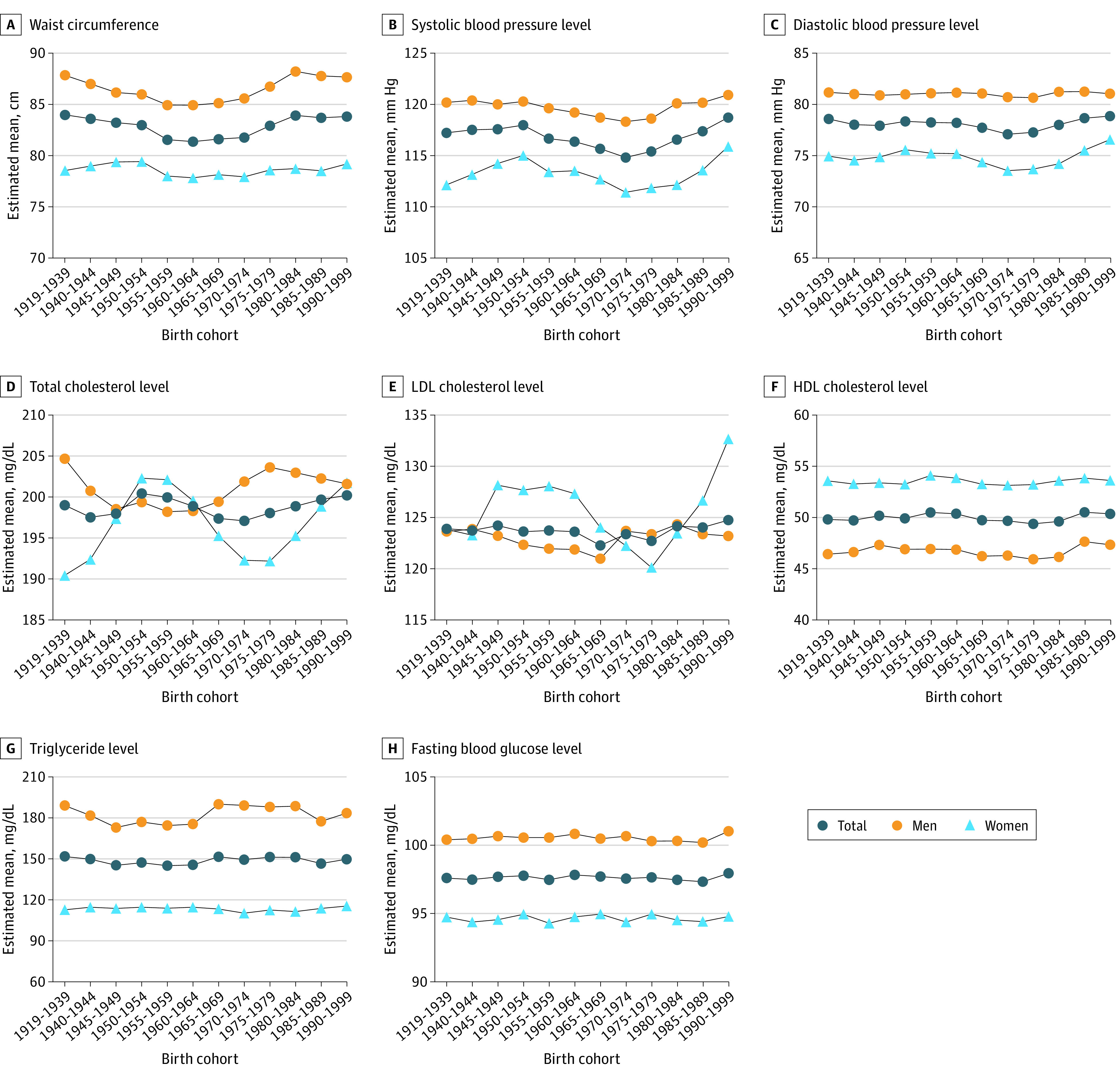
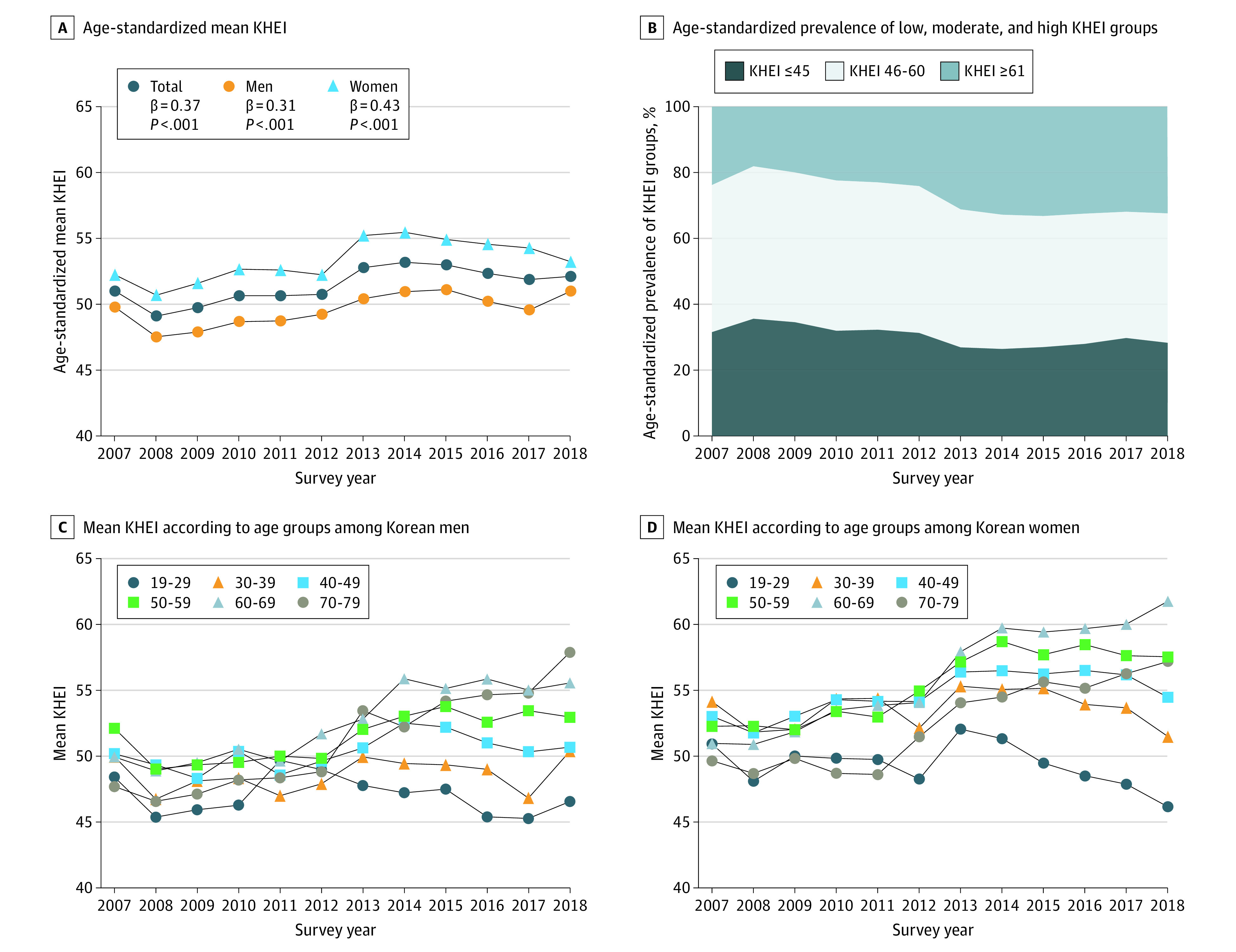
Among 65 416 participants, mean age (SD) was 44.5 (0.1) years and 36 631 were women (55.8%). In 2007-2018, the age-standardized mean (SE) KHEI score increased from 51.0 (0.4) to 52.1 (0.5), which was associated with reduced sodium intake and increased whole grain, dairy, and protein-rich food intakes. The mean (SE) KHEI score was lowest at age 39 years (50.1 [0.3]) and increased at older ages (58.0 [0.3] at 79 years). Controlling for age and period effects, the highest KHEI score was observed among the birth cohorts of 1960-1964 (53.6 [0.9]) and decreased in subsequent cohorts (45.5 [1.2] in the 1990-1999 birth cohort). Similar cohort effects in cardiometabolic risk factors were observed, showing the lowest waist circumference, blood pressure, and total cholesterol levels among the birth cohorts of the 1960s and 1970s and higher levels among more recent birth cohorts (1990-1999 vs 1960-1964: waist circumference, 83.8 [0.5] vs 81.4 [0.4] cm; systolic blood pressure, 118.7 [0.7] vs 116.4 [0.4] mm Hg; total cholesterol, 200.2 [0.9] vs 198.9 [0.7] mg/dL). At most ages, periods, and birth cohorts, the mean KHEI score was consistently higher in adults living in urban areas (at age 45 years: 50.5 [1.0] vs 49.7 [0.9] rural) and among high-income (at age 45 years: 50.7 [1.1] vs 49.3 [0.9] low income) and educational levels (at age 45 years: 53.1 [0.9] vs 49.1 [1.0] low educational level).
The findings of this study suggest that, from 2007 to 2018, the diet quality of Korean adults modestly improved. Despite the improvement, inequalities in diet among age, birth cohort, and socioeconomic subgroups persisted, suggesting that more intense interventions may be needed to target the susceptible groups.
很少有研究除了评估特定食物组之外,还研究过韩国的饮食趋势。为了帮助预防心血管代谢疾病负担,全面调查整体饮食质量的趋势并确定可能的促成因素将是有用的。
调查韩国成年人饮食质量和心血管代谢风险因素的年龄、时期和出生队列趋势及其独立关联。
设计、地点和参与者:对韩国全国健康和营养调查 2007-2018 年的 24 小时饮食回忆数据进行了连续的横断面和年龄-时期-队列分析。研究人群包括 65416 名年龄在 19 至 79 岁的韩国成年人。数据分析于 2020 年 3 月 1 日至 2021 年 4 月 30 日进行。
年龄、日历年份、出生队列和人口社会经济特征。
韩国健康饮食指数(KHEI),一种经过验证的饮食质量评分(范围为 0-90,分数越高表示饮食质量越高),以及 8 种心血管代谢风险因素(腰围和收缩压、舒张压、血清总胆固醇、低密度脂蛋白胆固醇、高密度脂蛋白胆固醇、甘油三酯和空腹血糖水平)。
在 65416 名参与者中,平均年龄(标准差)为 44.5(0.1)岁,36631 名为女性(55.8%)。在 2007-2018 年期间,标准化平均(SE)KHEI 评分从 51.0(0.4)增加到 52.1(0.5),这与钠摄入量减少和全谷物、乳制品和富含蛋白质的食物摄入量增加有关。平均(SE)KHEI 评分在 39 岁时最低(50.1[0.3]),随着年龄的增长而增加。在控制年龄和时期效应后,出生队列中 KHEI 评分最高的是 1960-1964 年出生的队列(53.6[0.9]),随后的队列评分下降。在心血管代谢风险因素中也观察到类似的队列效应,在 20 世纪 60 年代和 70 年代出生的队列中观察到最低的腰围、血压和总胆固醇水平,而在最近的出生队列中观察到更高的水平(1990-1999 年与 1960-1964 年相比:腰围,83.8[0.5] vs 81.4[0.4]cm;收缩压,118.7[0.7] vs 116.4[0.4]mm Hg;总胆固醇,200.2[0.9] vs 198.9[0.7]mg/dL)。在大多数年龄、时期和出生队列中,城市地区成年人的平均 KHEI 评分始终较高(在 45 岁时:50.5[1.0] vs 49.7[0.9]农村),高收入(在 45 岁时:50.7[1.1] vs 49.3[0.9]低收入)和教育水平(在 45 岁时:53.1[0.9] vs 49.1[1.0]低教育水平)。
本研究结果表明,从 2007 年到 2018 年,韩国成年人的饮食质量略有改善。尽管有所改善,但年龄、出生队列和社会经济亚组之间的饮食不平等仍然存在,这表明可能需要更强烈的干预措施来针对易感群体。