Wang Yuqi, Zhang Lijun, Xia Pan, Wang Peng, Chen Xianxiang, Du Lidong, Fang Zhen, Du Mingyan
Institute of Microelectronics of Chinese Academy of Sciences, Beijing 100029, China.
University of Chinese Academy of Sciences, Beijing 100049, China.
Bioengineering (Basel). 2022 May 26;9(6):231. doi: 10.3390/bioengineering9060231.
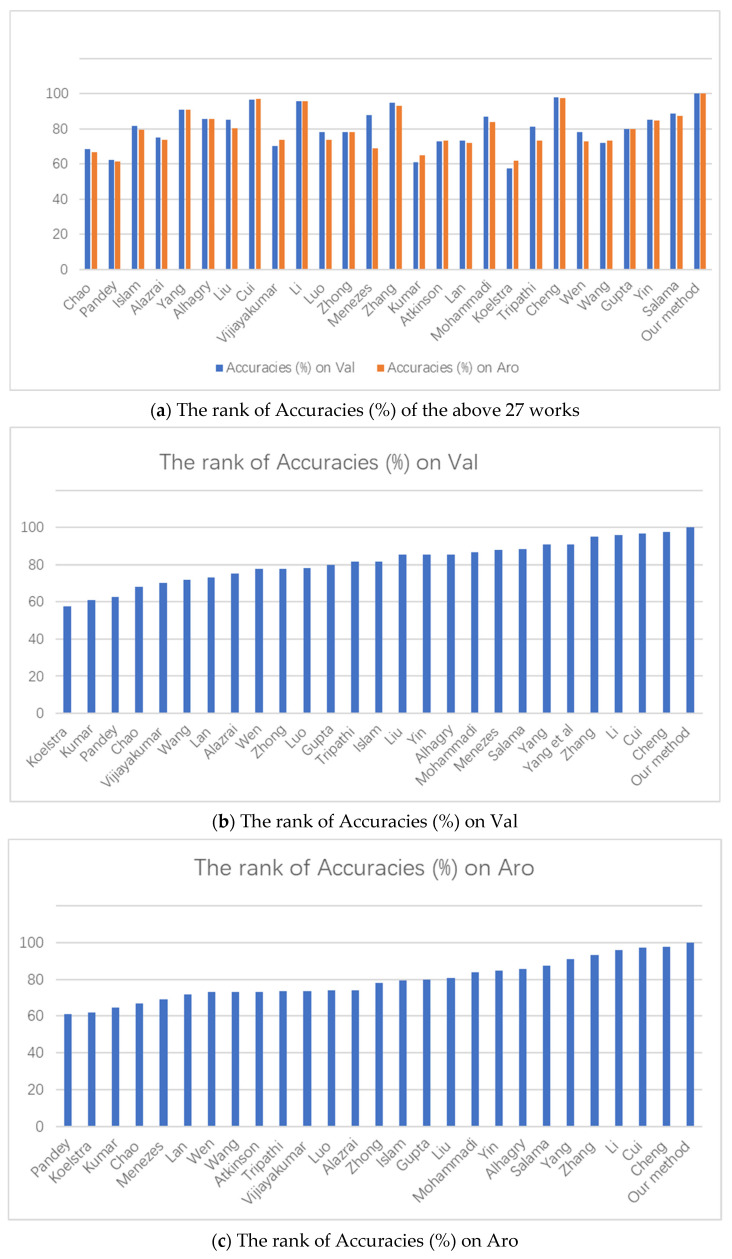
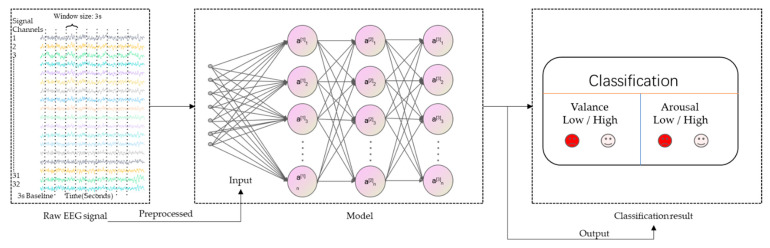
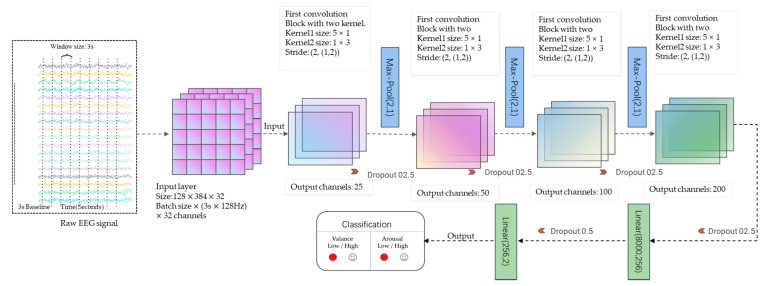
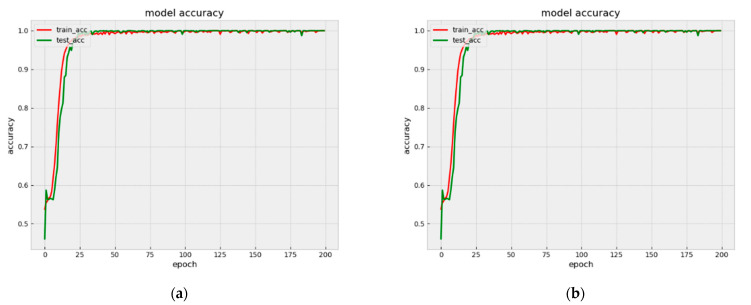
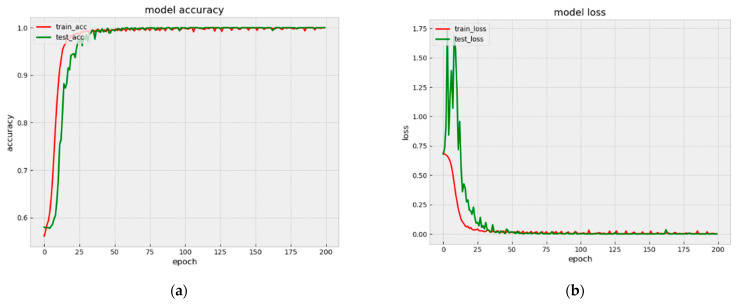
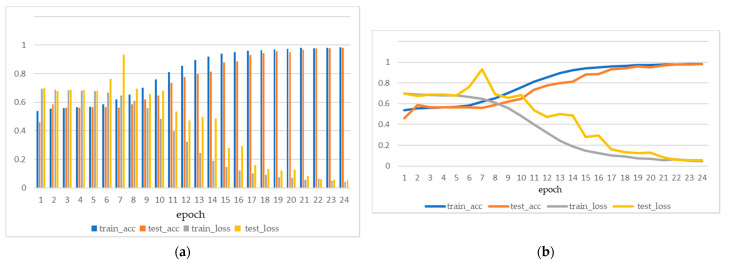
Emotion recognition is receiving significant attention in research on health care and Human-Computer Interaction (HCI). Due to the high correlation with emotion and the capability to affect deceptive external expressions such as voices and faces, Electroencephalogram (EEG) based emotion recognition methods have been globally accepted and widely applied. Recently, great improvements have been made in the development of machine learning for EEG-based emotion detection. However, there are still some major disadvantages in previous studies. Firstly, traditional machine learning methods require extracting features manually which is time-consuming and rely heavily on human experts. Secondly, to improve the model accuracies, many researchers used user-dependent models that lack generalization and universality. Moreover, there is still room for improvement in the recognition accuracies in most studies. Therefore, to overcome these shortcomings, an EEG-based novel deep neural network is proposed for emotion classification in this article. The proposed 2D CNN uses two convolutional kernels of different sizes to extract emotion-related features along both the time direction and the spatial direction. To verify the feasibility of the proposed model, the pubic emotion dataset DEAP is used in experiments. The results show accuracies of up to 99.99% and 99.98 for arousal and valence binary classification, respectively, which are encouraging for research and applications in the emotion recognition field.
情绪识别在医疗保健和人机交互(HCI)研究中受到了广泛关注。由于与情绪高度相关且能够影响声音和面部等欺骗性外部表现,基于脑电图(EEG)的情绪识别方法已被全球认可并广泛应用。最近,基于EEG的情绪检测的机器学习发展取得了很大进展。然而,以往的研究仍存在一些主要缺点。首先,传统的机器学习方法需要手动提取特征,这既耗时又严重依赖人类专家。其次,为了提高模型精度,许多研究人员使用了依赖用户的模型,这些模型缺乏泛化性和通用性。此外,大多数研究中的识别精度仍有提升空间。因此,为了克服这些缺点,本文提出了一种基于EEG的新型深度神经网络用于情绪分类。所提出的二维卷积神经网络(2D CNN)使用两个不同大小的卷积核,沿时间方向和空间方向提取与情绪相关的特征。为了验证所提模型的可行性,实验中使用了公开的情绪数据集DEAP。结果表明,在唤醒度和效价二元分类中,准确率分别高达99.99%和99.98%,这对于情绪识别领域的研究和应用来说是令人鼓舞的。