Lopez-Reyes Karla, Armstrong Karen F, Teulon David A J, Butler Ruth C, van Dooremalen Coby, Roher Monika, van Tol Robert W H M
Bio-Protection Research Centre, Lincoln University, Lincoln 7647, New Zealand.
New Zealand Institute for Plant and Food Research Limited, Private Bag 4704, Christchurch 8140, New Zealand.
Insects. 2022 Jun 10;13(6):538. doi: 10.3390/insects13060538.
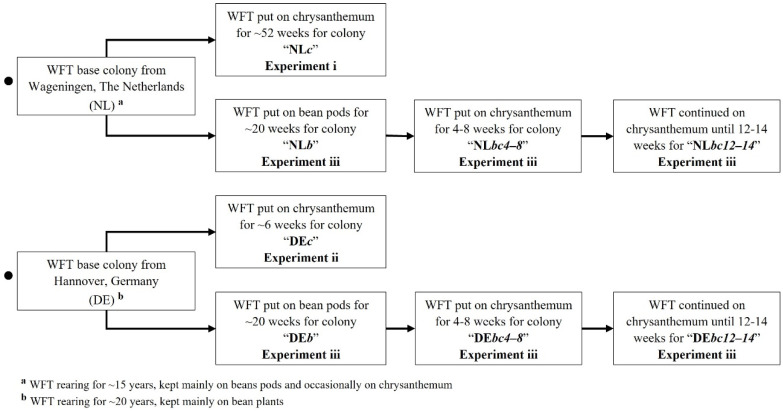
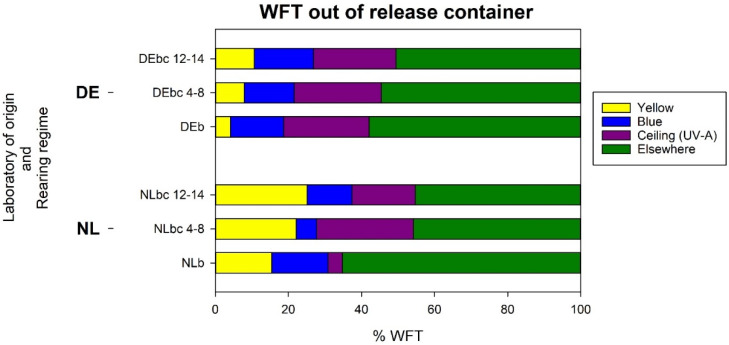
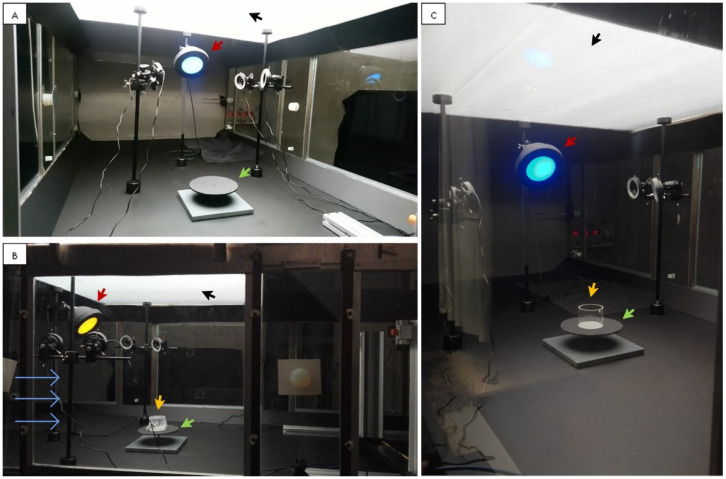
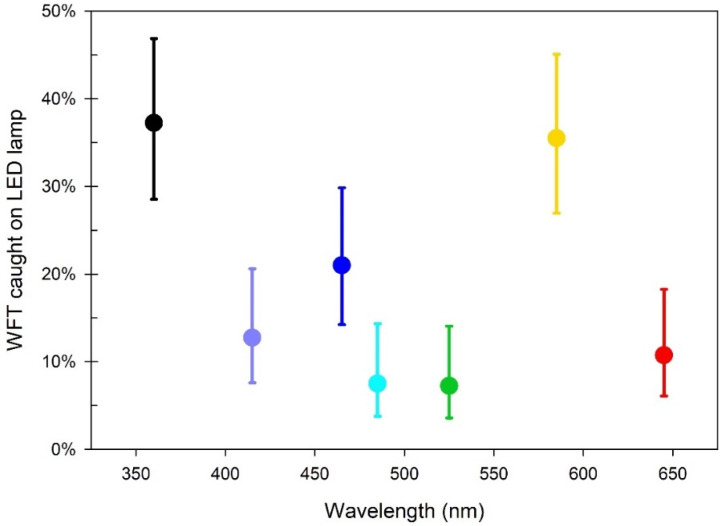
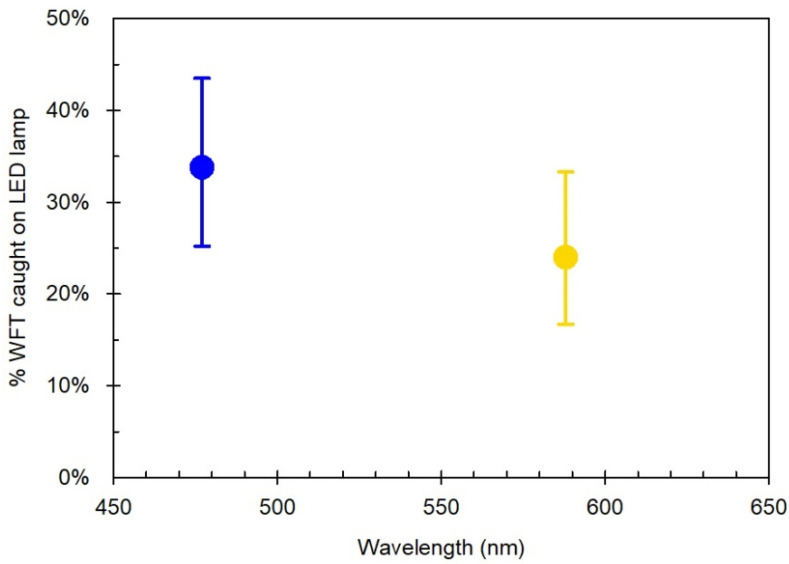
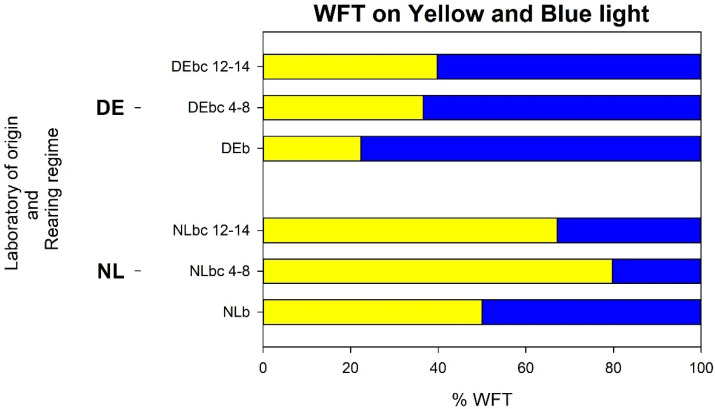
Discrepancies in the published research as to the attraction of the economically important pest western flower thrips (WFT) to different colours confounds the optimisation of field traps for pest management purposes. We considered whether the different experimental conditions of independent studies could have contributed to this. Therefore, the behavioural response (i.e., landings) to different colour cues of two WFT laboratory populations from Germany (DE) and The Netherlands (NL), which had previously been independently shown to have different colour preferences, were tested in the same place, and under the same experimental conditions. Single-choice wind tunnel bioassays supported previous independent findings, with more of a NL population landing on the yellow LED lamp (588 nm) than the blue (470 nm) (p = 0.022), and a not-statistically significant trend observed in a DE population landing more on blue compared to yellow (p = 0.104). To account for potential original host rearing influences, both populations were subsequently established on bean for ~20 weeks, then yellow chrysanthemum for 4−8 and 12−14 weeks and tested in wind tunnel choice bioassays. Laboratory of origin, irrespective of the host plant rearing regime, remained a significant effect (p < 0.001), with 65% of the NL WFT landing on yellow compared to blue (35%), while 66% of the DE WFT landed on blue compared to yellow (34%). There was also a significant host plant effect (p < 0.001), with increased response to yellow independent of laboratory of origin after rearing on chrysanthemum for 12−14 weeks. Results suggest that differing responses of WFT populations to colour is, in this case, independent of the experimental situation. Long-term separate isolation from the wild cannot be excluded as a cause, and the implications of this for optimising the trap colour is discussed.
已发表的关于经济上重要的害虫西花蓟马(WFT)对不同颜色的吸引力的研究存在差异,这使得用于害虫管理目的的田间诱捕器的优化变得复杂。我们思考了独立研究的不同实验条件是否可能导致了这种情况。因此,在同一地点、相同实验条件下,对来自德国(DE)和荷兰(NL)的两个WFT实验室种群对不同颜色线索的行为反应(即着陆情况)进行了测试,这两个种群此前已被独立证明具有不同的颜色偏好。单选择风洞生物测定法支持了之前的独立研究结果,NL种群中有更多个体降落在黄色LED灯(588纳米)上,而不是蓝色(470纳米)(p = 0.022),并且在DE种群中观察到一种非统计学显著趋势,即与黄色相比,更多个体降落在蓝色上(p = 0.104)。为了考虑潜在的原始寄主饲养影响,随后两个种群都在菜豆上饲养约20周,然后在黄色菊花上饲养4 - 8周和12 - 14周,并在风洞选择生物测定中进行测试。无论寄主植物饲养方式如何,起源实验室仍然是一个显著因素(p < 0.001),与蓝色(35%)相比,65%的NL WFT降落在黄色上,而与黄色(34%)相比,66%的DE WFT降落在蓝色上。寄主植物也有显著影响(p < 0.001),在菊花上饲养12 - 14周后,无论起源实验室如何,对黄色的反应都有所增加。结果表明,在这种情况下,WFT种群对颜色的不同反应与实验情况无关。不能排除长期与野外隔离作为一个原因,并讨论了这对优化诱捕器颜色的影响。