Routsi Christina, Meletiadis Joseph, Charitidou Efstratia, Gkoufa Aikaterini, Kokkoris Stelios, Karageorgiou Stavros, Giannopoulos Charalampos, Koulenti Despoina, Andrikogiannopoulos Petros, Perivolioti Efstathia, Argyropoulou Athina, Vasileiadis Ioannis, Vrioni Georgia, Paramythiotou Elizabeth
First Department of Intensive Care, School of Medicine, National and Kapodistrian University of Athens, Evangelismos Hospital, 10676 Athens, Greece.
Clinical Microbiology Laboratory, School of Medicine, National and Kapodistrian University of Athens, Attikon University Hospital, 12461 Athens, Greece.
Antibiotics (Basel). 2022 Jun 4;11(6):771. doi: 10.3390/antibiotics11060771.
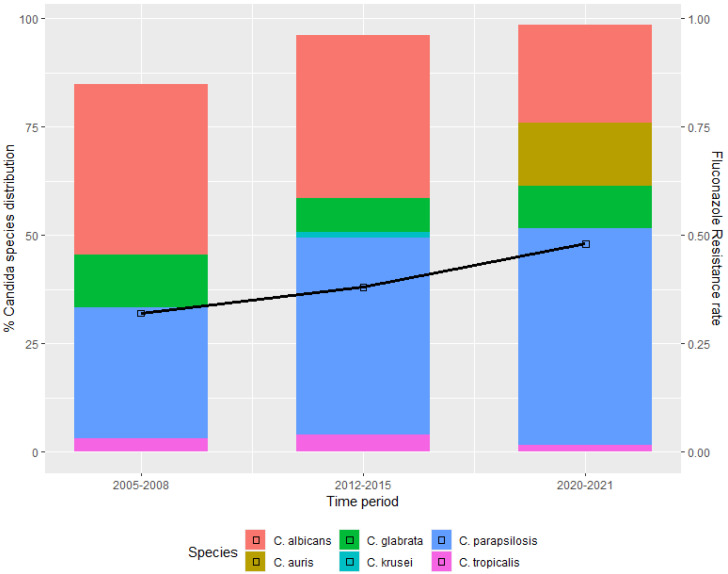
The objectives of this study were to investigate the incidence of candidemia, as well as the factors associated with species distribution and fluconazole resistance, among patients admitted to the intensive care unit (ICU) during the COVID-19 pandemic, as compared to two pre-pandemic periods. All patients admitted to the ICU due to COVID-19 from March 2020 to October 2021, as well as during two pre-pandemic periods (2005-2008 and 2012-2015), who developed candidemia, were included. During the COVID-19 study period, the incidence of candidemia was 10.2%, significantly higher compared with 3.2% and 4.2% in the two pre-pandemic periods, respectively. The proportion of non- species increased (from 60.6% to 62.3% and 75.8%, respectively), with a predominance of A marked increase in fluconazole resistance (from 31% to 37.7% and 48.4%, respectively) was also observed. Regarding the total patient population with candidemia ( = 205), fluconazole resistance was independently associated with ICU length of stay (LOS) before candidemia (OR 1.03; CI: 1.01-1.06, = 0.003), whereas the presence of shock at candidemia onset was associated with (OR 6.89; CI: 2.2-25, = 0.001), and with fluconazole-susceptible species (OR 0.23; CI: 0.07-0.64, = 0.006). In conclusion, substantial increases in the incidence of candidemia, in non- species, and in fluconazole resistance were found in patients admitted to the ICU due to COVID-19, compared to pre-pandemic periods. At candidemia onset, prolonged ICU LOS was associated with fluconazole-resistant and the presence of shock with fluconazole-susceptible species.
本研究的目的是调查在新型冠状病毒肺炎(COVID-19)大流行期间,与两个大流行前时期相比,重症监护病房(ICU)收治患者的念珠菌血症发病率,以及与菌种分布和氟康唑耐药性相关的因素。纳入了2020年3月至2021年10月因COVID-19入住ICU以及在两个大流行前时期(2005 - 2008年和2012 - 2015年)发生念珠菌血症的所有患者。在COVID-19研究期间,念珠菌血症的发病率为10.2%,与两个大流行前时期分别为3.2%和4.2%相比显著更高。非白色念珠菌属的比例增加(分别从60.6%增至62.3%和75.8%),以近平滑念珠菌为主。还观察到氟康唑耐药性显著增加(分别从31%增至37.7%和48.4%)。对于发生念珠菌血症的全部患者群体(n = 205),氟康唑耐药性与念珠菌血症发生前的ICU住院时间(LOS)独立相关(比值比[OR] 1.03;置信区间[CI]:1.01 - 1.06,P = 0.003),而念珠菌血症发作时存在休克与近平滑念珠菌相关(OR 6.89;CI:2.2 - 25,P = 0.001),且与氟康唑敏感菌种相关(OR 0.23;CI:0.07 - 0.64,P = 0.006)。总之,与大流行前时期相比,因COVID-19入住ICU的患者中,念珠菌血症发病率、非白色念珠菌属菌种比例及氟康唑耐药性均大幅增加。在念珠菌血症发作时,ICU住院时间延长与氟康唑耐药菌种相关,而休克的存在与氟康唑敏感菌种相关。