Division of Hematology/Oncology, Department of Internal Medicine, Brody School of Medicine, East Carolina University, Greenville, NC 27834, USA.
Department of Biological Sciences, Tennessee State University, Nashville, TN 37209, USA.
Cells. 2022 Jun 11;11(12):1900. doi: 10.3390/cells11121900.
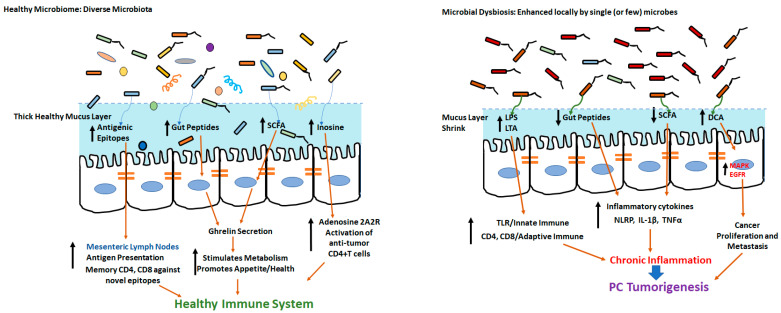
Pancreatic cancer (PC) is the fourth leading cause of cancer-related mortality with limited diagnostic and therapeutic options. Although immunotherapy has shown promise in the treatment of several cancers, its role in pancreatic cancer is rather limited. Several studies have focused on determining the role of the tumor microenvironment with cancer-cell-intrinsic events and tumor-infiltrating immune cellular properties. However, in the past decade, there has been emerging research aimed at delineating the role of the host microbiome, including the metabolites from microbes and host responses, on pancreatic tumorigenesis. Importantly, there is emerging evidence suggesting the beneficial role of a gut microbiome transplant to improve immunotherapeutic outcomes in cancer patients. In this review, we summarize the recent understanding of the role of the microbiome in pancreatic cancer progression, along with its clinical diagnostic and therapeutic implications.
胰腺癌(PC)是癌症相关死亡的第四大主要原因,其诊断和治疗选择有限。尽管免疫疗法在治疗多种癌症方面显示出了希望,但在胰腺癌中的作用相当有限。多项研究集中于确定肿瘤微环境与癌细胞内在事件和肿瘤浸润免疫细胞特性的关系。然而,在过去十年中,人们越来越关注宿主微生物组的作用,包括微生物代谢产物和宿主反应,以阐明其在胰腺癌发生中的作用。重要的是,有新的证据表明,肠道微生物组移植有助于改善癌症患者的免疫治疗效果。在这篇综述中,我们总结了微生物组在胰腺癌进展中的作用及其临床诊断和治疗意义的最新认识。