Heider Camren G, Itenberg Sasha A, Rao Jiajia, Ma Hang, Wu Xian
Department of Kinesiology, Nutrition, and Health, Miami University, Oxford, OH 45056, USA.
Department of Plant Sciences, North Dakota State University, Fargo, ND 58102, USA.
Biology (Basel). 2022 May 26;11(6):817. doi: 10.3390/biology11060817.
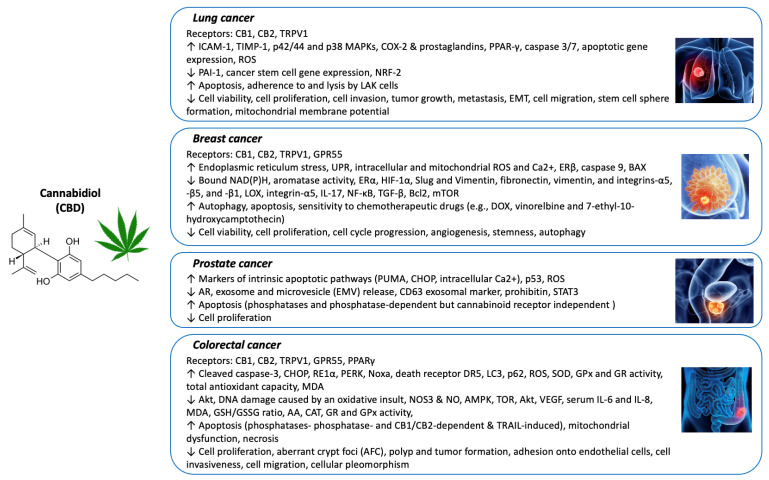
L. () and its bioactive compounds, including cannabinoids and non-cannabinoids, have been extensively studied for their biological effects in recent decades. Cannabidiol (CBD), a major non-intoxicating cannabinoid in , has emerged as a promising intervention for cancer research. The purpose of this review is to provide insights into the relationship between CBD and cancer based on recent research findings. The anticancer effects of CBD are mainly mediated via its interaction with the endocannabinoid system, resulting in the alleviation of pain and the promotion of immune regulation. Published reviews have focused on the applications of CBD in cancer pain management and the possible toxicological effects of its excessive consumption. In this review, we aim to summarize the mechanisms of action underlying the anticancer activities of CBD against several common cancers. Studies on the efficacy and mechanisms of CBD on cancer prevention and intervention in experimental models (i.e., cell culture- and animal-based assays) and human clinical studies are included in this review.
近几十年来,大麻及其生物活性化合物,包括大麻素和非大麻素,因其生物学效应而受到广泛研究。大麻二酚(CBD)是大麻中的一种主要非致醉性大麻素,已成为癌症研究中一种有前景的干预措施。本综述的目的是基于最近的研究结果,深入探讨CBD与癌症之间的关系。CBD的抗癌作用主要通过其与内源性大麻素系统的相互作用介导,从而减轻疼痛并促进免疫调节。已发表的综述主要关注CBD在癌症疼痛管理中的应用及其过量消费可能产生的毒理学效应。在本综述中,我们旨在总结CBD对几种常见癌症的抗癌活性的作用机制。本综述纳入了关于CBD在实验模型(即基于细胞培养和动物的试验)和人体临床研究中对癌症预防和干预的疗效及机制的研究。