Ceccarelli Fulvia, Olivieri Giulio, Pirone Carmelo, Ciccacci Cinzia, Picciariello Licia, Natalucci Francesco, Perricone Carlo, Spinelli Francesca Romana, Alessandri Cristiano, Borgiani Paola, Conti Fabrizio
Reumatologia, Dipartimento di Scienze Cliniche Internistiche, Anestesiologiche e Cardiovascolari, Sapienza University of Rome, Viale del Policlnico 155, 00161 Rome, Italy.
Università UniCamillus-Saint Camillus International University of Health and Medical Sciences, 00131 Rome, Italy.
J Clin Med. 2022 Jun 12;11(12):3368. doi: 10.3390/jcm11123368.
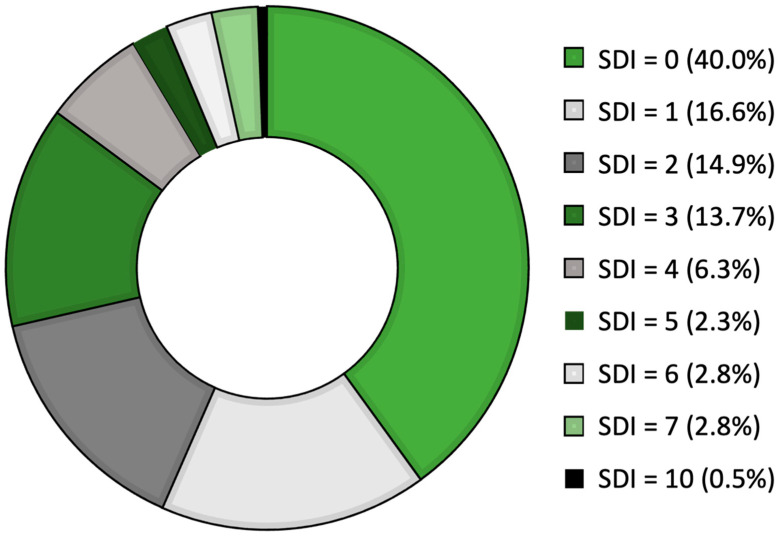
Objective: The purpose of this study was to determine the distribution of organ damage in a cohort of systemic lupus erythematosus (SLE) patients and to evaluate the roles of clinical and genetic factors in determining the development of chronic damage. Methods: Organ damage was assessed by the SLICC Damage Index (SDI). We analyzed a panel of 17 single-nucleotide polymorphism (SNPs) of genes already associated with SLE, and we performed a phenotype−genotype correlation analysis by evaluating specific domains of the SDI. Results: Among 175 Caucasian SLE patients, 105 (60%) exhibited damage (SDI ≥1), with a median value of 1.0 (IQR 3.0). The musculoskeletal (26.2%), neuropsychiatric (24.6%) and ocular domains (20.6%) were involved most frequently. The presence of damage was associated with higher age, longer disease duration, neuropsychiatric (NP) manifestations, anti-phospholipid syndrome and the positivity of anti-dsDNA. Concerning therapies, cyclophosphamide, mycophenolate mofetil and glucocorticoids were associated with the development of damage. The genotype−phenotype correlation analysis showed an association between renal damage, identified in 6.9% of patients, and rs2205960 of TNFSF4 (p = 0.001; OR 17.0). This SNP was significantly associated with end-stage renal disease (p = 0.018, OR 9.68) and estimated GFR < 50% (p = 0.025, OR 1.06). The rs1463335 of MIR1279 gene was associated with the development of NP damage (p = 0.029; OR 2.783). The multivariate logistic regression analysis confirmed the associations between TNFSF4 rs2205960 SNP and renal damage (p = 0.027, B = 2.47) and between NP damage and rs1463335 of MIR1279 gene (p = 0.014, B = 1.29). Conclusions: Our study could provide new insights into the role of genetic background in the development of renal and NP damage.
本研究旨在确定一组系统性红斑狼疮(SLE)患者的器官损害分布情况,并评估临床和遗传因素在慢性损害发生中的作用。方法:采用系统性红斑狼疮国际协作临床(SLICC)损害指数(SDI)评估器官损害。我们分析了一组已与SLE相关的17个单核苷酸多态性(SNP)基因,并通过评估SDI的特定领域进行了表型-基因型相关性分析。结果:在175例白种人SLE患者中,105例(60%)出现损害(SDI≥1),中位数为1.0(四分位间距3.0)。肌肉骨骼(26.2%)、神经精神(24.6%)和眼部领域(20.6%)受累最为频繁。损害的存在与年龄较大、病程较长、神经精神(NP)表现、抗磷脂综合征及抗双链DNA阳性有关。关于治疗,环磷酰胺、霉酚酸酯和糖皮质激素与损害的发生有关。基因型-表型相关性分析显示,6.9%的患者出现的肾损害与TNFSF4基因的rs2205960相关(p = 0.001;比值比17.0)。该SNP与终末期肾病显著相关(p = 0.018,比值比9.68),且与估计的肾小球滤过率<50%相关(p = 0.025,比值比1.06)。MIR1279基因的rs1463335与NP损害的发生相关(p = 0.029;比值比2.783)。多因素逻辑回归分析证实了TNFSF4 rs2205960 SNP与肾损害之间的关联(p = 0.027,B = 2.47)以及NP损害与MIR1279基因的rs1463335之间的关联(p = 0.014,B = 1.29)。结论:我们的研究可为遗传背景在肾损害和NP损害发生中的作用提供新的见解。