Institute of Statistics, National Yang Ming Chiao Tung University, Hsinchu 30010, Taiwan.
Int J Mol Sci. 2021 Jul 21;22(15):7802. doi: 10.3390/ijms22157802.
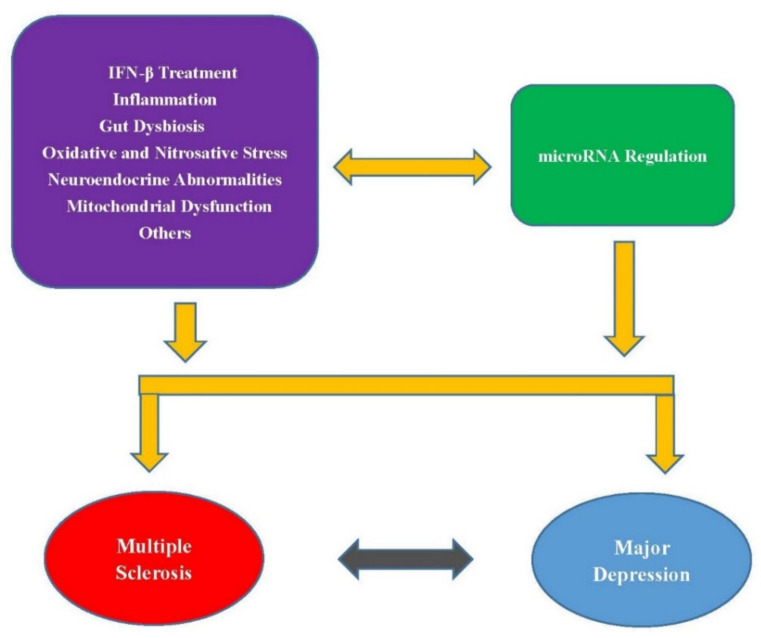
Multiple sclerosis (MS) is a chronic disease of the central nervous system that affects the brain and spinal cord. There are several disease courses in MS including relapsing-remitting MS (RRMS), primary progressive MS (PPMS), and secondary progressive MS (SPMS). Up to 50% of MS patients experience depressive disorders. Major depression (MD) is a serious comorbidity of MS. Many dysfunctions including neuroinflammation, peripheral inflammation, gut dysbiosis, chronic oxidative and nitrosative stress, and neuroendocrine and mitochondrial abnormalities may contribute to the comorbidity between MS and MD. In addition to these actions, medical treatment and microRNA (miRNA) regulation may also be involved in the mechanisms of the comorbidity between MS and MD. In the study, I review many common miRNA biomarkers for both diseases. These common miRNA biomarkers may help further explore the association between MS and MD.
多发性硬化症(MS)是一种中枢神经系统的慢性疾病,影响大脑和脊髓。MS 有几种疾病过程,包括复发缓解型多发性硬化症(RRMS)、原发性进展型多发性硬化症(PPMS)和继发性进展型多发性硬化症(SPMS)。多达 50%的 MS 患者患有抑郁症。重度抑郁症(MD)是 MS 的严重合并症。许多功能障碍,包括神经炎症、外周炎症、肠道菌群失调、慢性氧化和硝化应激以及神经内分泌和线粒体异常,可能导致 MS 和 MD 之间的合并症。除了这些作用外,医学治疗和微小 RNA(miRNA)调节也可能参与 MS 和 MD 合并症的机制。在研究中,我回顾了这两种疾病的许多常见 miRNA 生物标志物。这些常见的 miRNA 生物标志物可能有助于进一步探索 MS 和 MD 之间的关联。