Perez Nathalie Elisabeth, Godbole Neha Pradyumna, Amin Katherine, Syan Raveen, Gater David R
University of Miami Miller School of Medicine, Miami, FL 33136, USA.
Department of Urology, University of Miami Miller School of Medicine, Miami, FL 33136, USA.
J Pers Med. 2022 Jun 14;12(6):968. doi: 10.3390/jpm12060968.
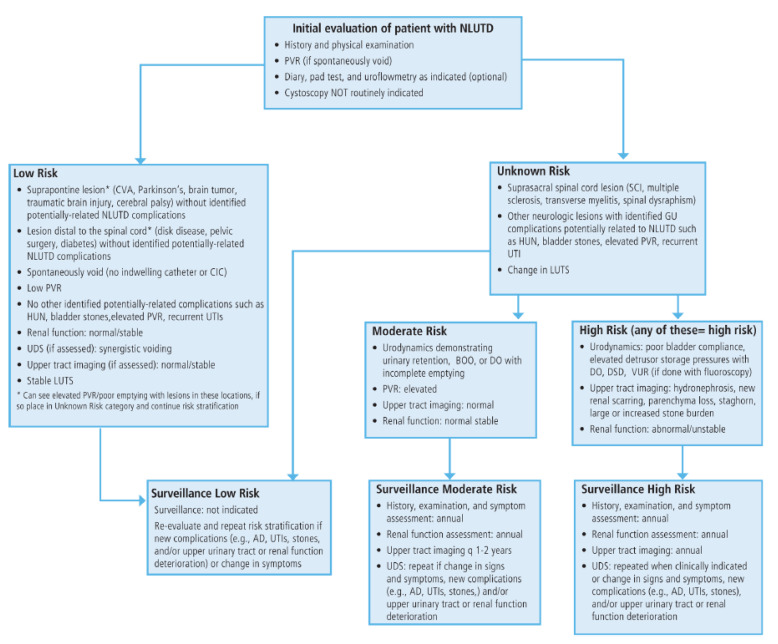
Urinary incontinence is common after spinal cord injury (SCI) due to loss of supraspinal coordination and unabated reflexes in both autonomic and somatic nervous systems; if unchecked, these disturbances can become life-threatening. This manuscript will review normal anatomy and physiology of the urinary system and discuss pathophysiology secondary to SCI. This includes a discussion of autonomic dysreflexia, as well as its diagnosis and management. The kidneys and the ureters, representing the upper urinary tract system, can be at risk related to dyssynergy between the urethral sphincters and high pressures that lead to potential vesicoureteral reflux, urinary tract infections, and calculi associated with neurogenic lower urinary tract dysfunction (NLUTD). Recent guidelines for diagnosis, evaluation, treatment and follow up of the neurogenic bladder will be reviewed and options provided for risk stratification and management. Mechanical, pharmacological, neurolysis and surgical management will be discussed.
脊髓损伤(SCI)后尿失禁很常见,这是由于脊髓上协调功能丧失以及自主神经系统和躯体神经系统反射未受抑制所致;如果不加以控制,这些紊乱可能会危及生命。本文将回顾泌尿系统的正常解剖和生理,并讨论脊髓损伤继发的病理生理。这包括对自主神经反射异常的讨论,以及其诊断和管理。肾脏和输尿管代表上尿路系统,可能因尿道括约肌之间的协同失调和高压而面临风险,这些高压会导致潜在的膀胱输尿管反流、尿路感染以及与神经源性下尿路功能障碍(NLUTD)相关的结石。将回顾神经源性膀胱的最新诊断、评估、治疗和随访指南,并提供风险分层和管理的选项。还将讨论机械、药物、神经松解和手术管理。