NHK Key Laboratory of Trace Element Nutrition, National Institute for Nutrition and Health, Chinese Center for Disease Control and Prevention, Beijing 100050, China.
State Key Laboratory of Resources and Environmental Information System, Institute of Geographic Sciences and Natural Resources Research, Chinese Academy of Sciences, Beijing 100101, China.
Nutrients. 2022 Jun 13;14(12):2449. doi: 10.3390/nu14122449.
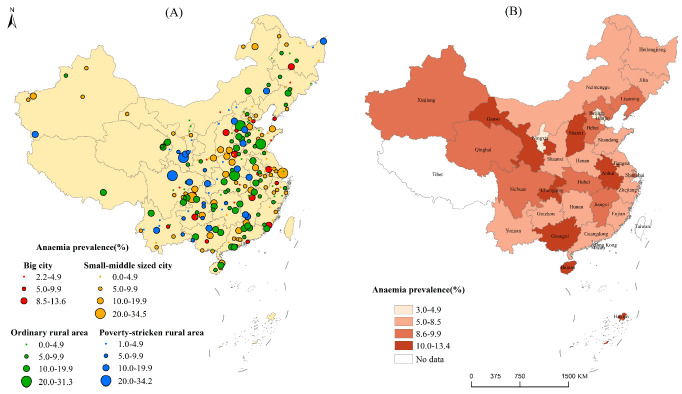
Adolescent girls are in the key stages of rapid physical and psychological development and have a great demand for iron. Anemia affects adolescent girls’ health, future development, and even the health of their offspring. There has been limited study of adolescent girl anemia at the national and provincial levels in China. We investigated the anemia status of adolescent girls in China based on data from the China Nutrition and Health Surveillance (CNHS, 2015−2017). The anemia prevalence in Chinese adolescent girls aged 10−17 years is 8.5%, with mild anemia and moderate anemia accounting for 65.9 and 31.8%, respectively, and severe anemia accounting for only 2.3%. Significant urban−rural disparities and regional disparities were found in adolescent girl anemia. The anemia prevalence in adolescent girls varied from 3 to 13.4% in different provinces, and 90% of the provinces had anemia prevalence higher than 5%. Having started menstruating (OR = 2.58, p < 0.01) and living in rural areas (OR = 1.18, p < 0.05) were risk factors for anemia; having a mother with higher education was a protective factor (OR = 0.87, p < 0.05). As for food intake, consuming meat ≥35 g per day was a protective factor (OR = 0.90, p < 0.05). Consuming vegetables ≥3 times per day was also a protective factor (OR = 0.72, p < 0.01), while consuming vegetables ≥400 g per day was a risk factor (OR = 1.24, p < 0.01). Special attention should be paid to adolescent girls, especially to those already having started menstruating, living in rural areas, to those whose mother has a low education level, and to those with a relatively unbalanced diet. Comprehensive measures, including paying special attention to vulnerable areas and vulnerable subgroups of adolescent girls, would reduce the risk of anemia.
青春期女孩正处于身体和心理快速发育的关键阶段,她们对铁的需求量很大。贫血会影响青春期女孩的健康、未来发展,甚至影响其后代的健康。中国在国家和省级层面上对青春期女孩贫血的研究较少。我们基于中国营养与健康监测(CNHS,2015-2017 年)的数据,调查了中国青春期女孩的贫血状况。中国 10-17 岁青春期女孩的贫血患病率为 8.5%,其中轻度贫血和中度贫血分别占 65.9%和 31.8%,重度贫血仅占 2.3%。城乡和地区之间存在显著差异。不同省份青春期女孩贫血患病率在 3%至 13.4%之间,90%的省份贫血患病率高于 5%。初潮(OR=2.58,p<0.01)和居住在农村(OR=1.18,p<0.05)是贫血的危险因素;母亲受教育程度较高是保护因素(OR=0.87,p<0.05)。就食物摄入而言,每天摄入肉类≥35g 是保护因素(OR=0.90,p<0.05)。每天食用蔬菜≥3 次也是保护因素(OR=0.72,p<0.01),而每天食用蔬菜≥400g 是危险因素(OR=1.24,p<0.01)。应特别关注青春期女孩,尤其是已经初潮、居住在农村、母亲受教育程度较低以及饮食相对不均衡的女孩。综合措施,包括特别关注青春期女孩的脆弱地区和脆弱亚群,将降低贫血的风险。