Department of Family Medicine, Yongin Severance Hospital, Yonsei University College of Medicine, Yongin 16995, Korea.
Department of Medicine, Yonsei University College of Medicine, Seoul 03722, Korea.
Nutrients. 2022 Jun 14;14(12):2460. doi: 10.3390/nu14122460.
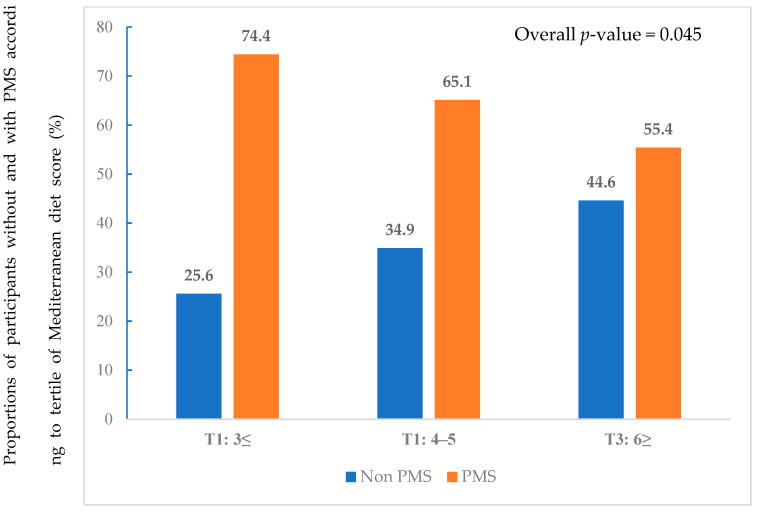
Premenstrual syndrome (PMS) adversely affects the physiological and psychological health and quality of life of women. Mediterranean diet (MD) could be helpful for managing and preventing PMS, but evidence on the association between dietary patterns and PMS in Asian women is limited. This study aimed to investigate the association of dietary patterns and adherence to MD with PMS in Korean women. This cross-sectional study recruited 262 women aged 20-49 years via an online survey. PMS was diagnosed using the American College of Obstetricians and Gynecologists diagnostic criteria. MD adherence was assessed using the Korean version of the Mediterranean Diet Adherence Screener. Mediterranean Diet Score (MDS) was classified into tertiles (T) (T1: 0-3, T2: 4-5, and T3: ≥6). Dietary pattern was assessed with the Food Frequency Questionnaire. Multiple logistic regression analyses were conducted to evaluate the association between dietary pattern scores and PMS prevalence. The proportion of PMS was significantly lower in MDS tertile (T) 3 than in T1 (55.4% in T3 vs. 74.4% in T1, = 0.045). After adjusting for confounders, participants in the highest tertile of the bread/snack pattern had a higher risk of PMS (odds ratio [95% CI]: 2.59 [1.32-5.06]), while traditional dietary pattern and meat/alcohol pattern were not associated with PMS. In conclusion, we found that low adherence to MD and higher bread/snack dietary pattern were associated with increased risk of PMS, respectively.
经前期综合征(PMS)会对女性的生理和心理健康以及生活质量产生不良影响。地中海饮食(MD)可能有助于管理和预防 PMS,但亚洲女性饮食模式与 PMS 之间关联的证据有限。本研究旨在探讨饮食模式和 MD 依从性与韩国女性 PMS 之间的关系。这项横断面研究通过在线调查招募了 262 名年龄在 20-49 岁的女性。使用美国妇产科医师学会的诊断标准诊断 PMS。使用韩国版地中海饮食依从性筛查器评估 MD 依从性。地中海饮食评分(MDS)分为三分位(T)(T1:0-3,T2:4-5,T3:≥6)。饮食模式采用食物频率问卷进行评估。采用多因素 logistic 回归分析评估饮食模式评分与 PMS 患病率之间的关系。MDS 三分位(T)3 的 PMS 比例明显低于 T1(T3 为 55.4%,T1 为 74.4%,=0.045)。调整混杂因素后,面包/零食模式最高三分位的参与者发生 PMS 的风险更高(比值比[95%CI]:2.59[1.32-5.06]),而传统饮食模式和肉/酒模式与 PMS 无关。总之,我们发现 MD 依从性低和较高的面包/零食饮食模式分别与 PMS 风险增加相关。