Jia Miao, Qi Tong, Yuan Qiong, Zhao Peizhu, Jia Mengqiu
College of Chemistry and Materials Engineering, Beijing Technology and Business University, Beijing 100048, China.
Beijing Key Laboratory of Electrochemical Process and Technology for Materials, Beijing University of Chemical Technology, Beijing 100029, China.
Nanomaterials (Basel). 2022 Jun 10;12(12):2006. doi: 10.3390/nano12122006.
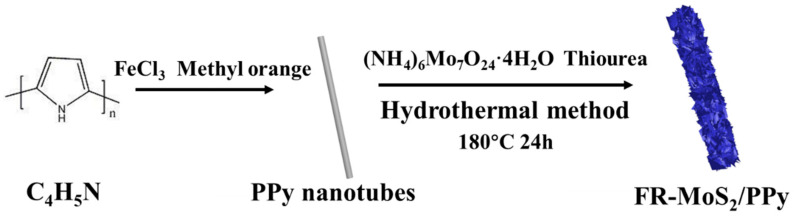
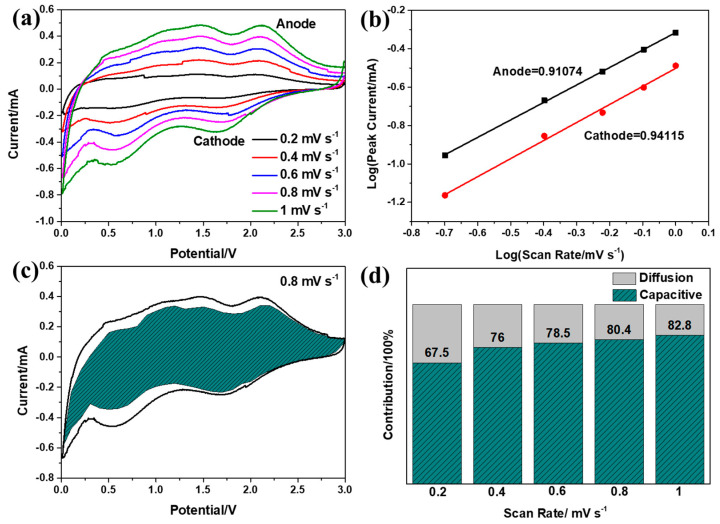
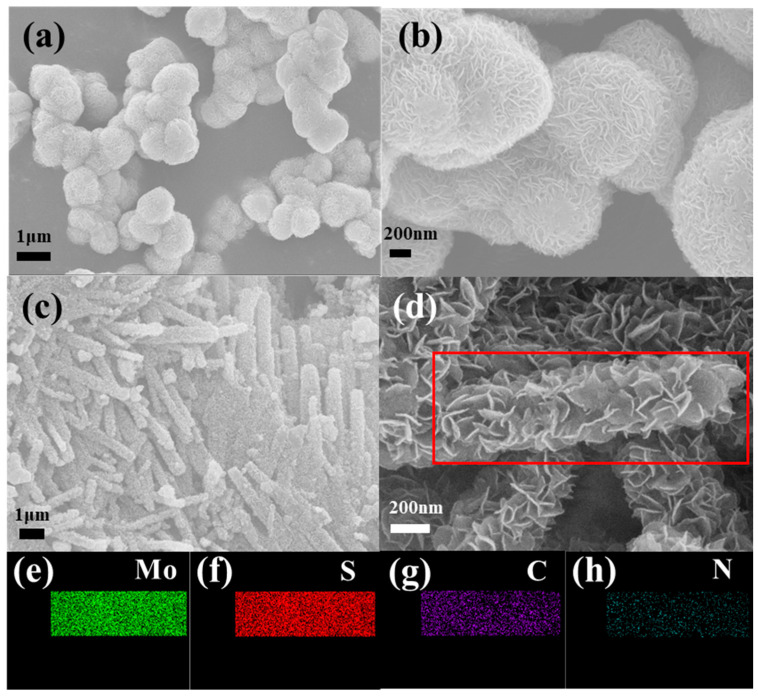
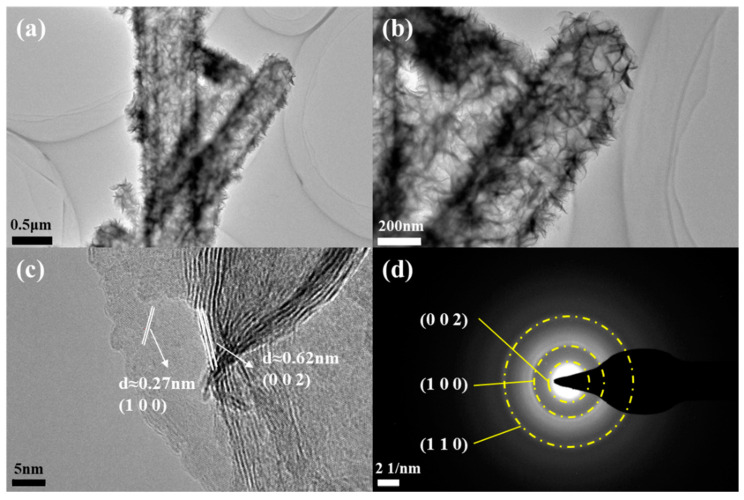
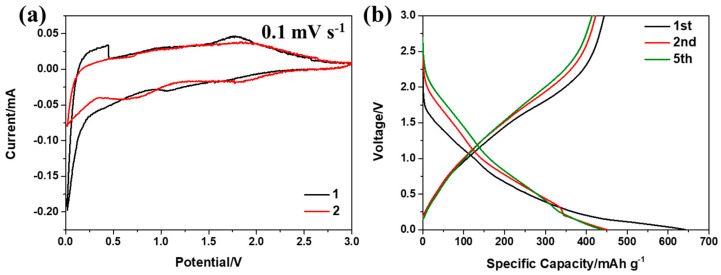
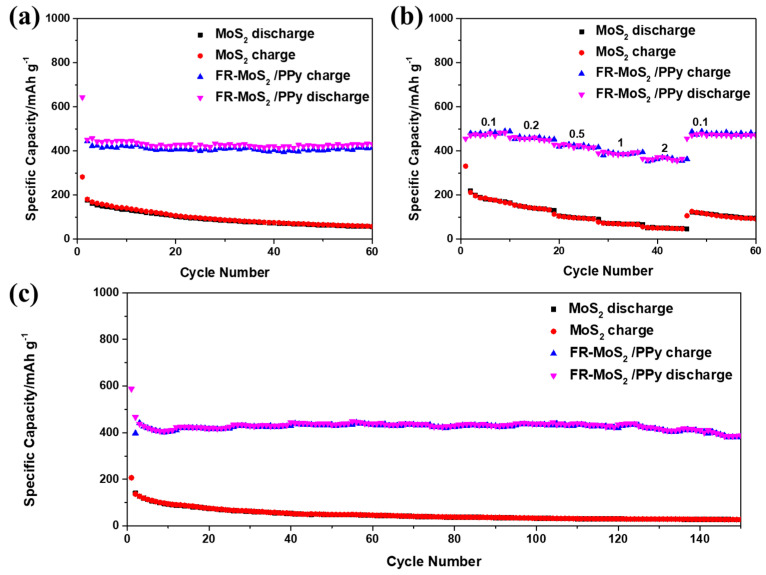
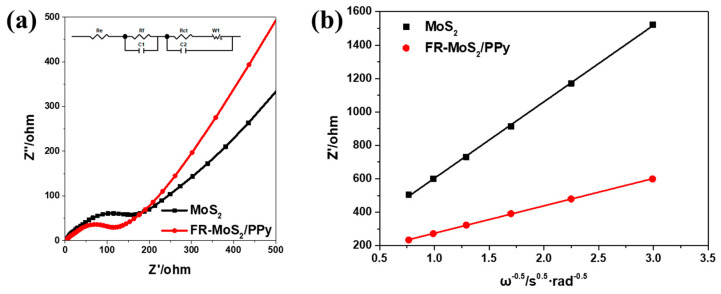
As a typical two-dimensional layered metal sulfide, MoS has a high theoretical capacity and large layer spacing, which is beneficial for ion transport. Herein, a facile polymerization method is employed to synthesize polypyrrole (PPy) nanotubes, followed by a hydrothermal method to obtain flower-rod-shaped MoS/PPy (FR-MoS/PPy) composites. The FR-MoS/PPy achieves outstanding electrochemical performance as a sodium-ion battery anode. After 60 cycles under 100 mA g, the FR-MoS/PPy can maintain a capacity of 431.9 mAh g. As for rate performance, when the current densities range from 0.1 to 2 A g, the capacities only reduce from 489.7 to 363.2 mAh g. The excellent performance comes from a high specific surface area provided by the unique structure and the synergistic effect between the components. Additionally, the introduction of conductive PPy improves the conductivity of the material and the internal hollow structure relieves the volume expansion. In addition, kinetic calculations show that the composite material has a high sodium-ion transmission rate, and the external pseudocapacitance behavior can also significantly improve its electrochemical performance. This method provides a new idea for the development of advanced high-capacity anode materials for sodium-ion batteries.
作为一种典型的二维层状金属硫化物,二硫化钼具有较高的理论容量和较大的层间距,有利于离子传输。在此,采用一种简便的聚合方法合成聚吡咯(PPy)纳米管,随后通过水热法获得花杆状的二硫化钼/聚吡咯(FR-MoS/PPy)复合材料。FR-MoS/PPy作为钠离子电池负极表现出优异的电化学性能。在100 mA g的电流密度下循环60次后,FR-MoS/PPy仍能保持431.9 mAh g的容量。至于倍率性能,当电流密度在0.1至2 A g之间变化时,容量仅从489.7 mAh g降至363.2 mAh g。这种优异的性能源于独特结构提供的高比表面积以及各组分之间的协同效应。此外,导电聚吡咯的引入提高了材料的导电性,内部中空结构缓解了体积膨胀。此外,动力学计算表明该复合材料具有较高的钠离子传输速率,外部赝电容行为也能显著改善其电化学性能。该方法为开发先进的高容量钠离子电池负极材料提供了新思路。