Khoja Omar, Silva Passadouro Bárbara, Mulvey Matthew, Delis Ioannis, Astill Sarah, Tan Ai Lyn, Sivan Manoj
Leeds Institute of Rheumatic and Musculoskeletal Medicine, University of Leeds, Leeds, UK.
Academic Unit of Palliative Care, Leeds Institute of Health Sciences, University of Leeds, Leeds, UK.
J Pain Res. 2022 Jun 17;15:1729-1748. doi: 10.2147/JPR.S365026. eCollection 2022.
Musculoskeletal (MSK) pain is being increasingly reported by patients as one of the most common persistent symptoms in post-COVID-19 syndrome or Long COVID. However, there is a lack of understanding of its prevalence, characteristics, and underlying pathophysiological mechanisms. The objective of this review is to identify and describe the features and characteristics of MSK pain in Long COVID patients.
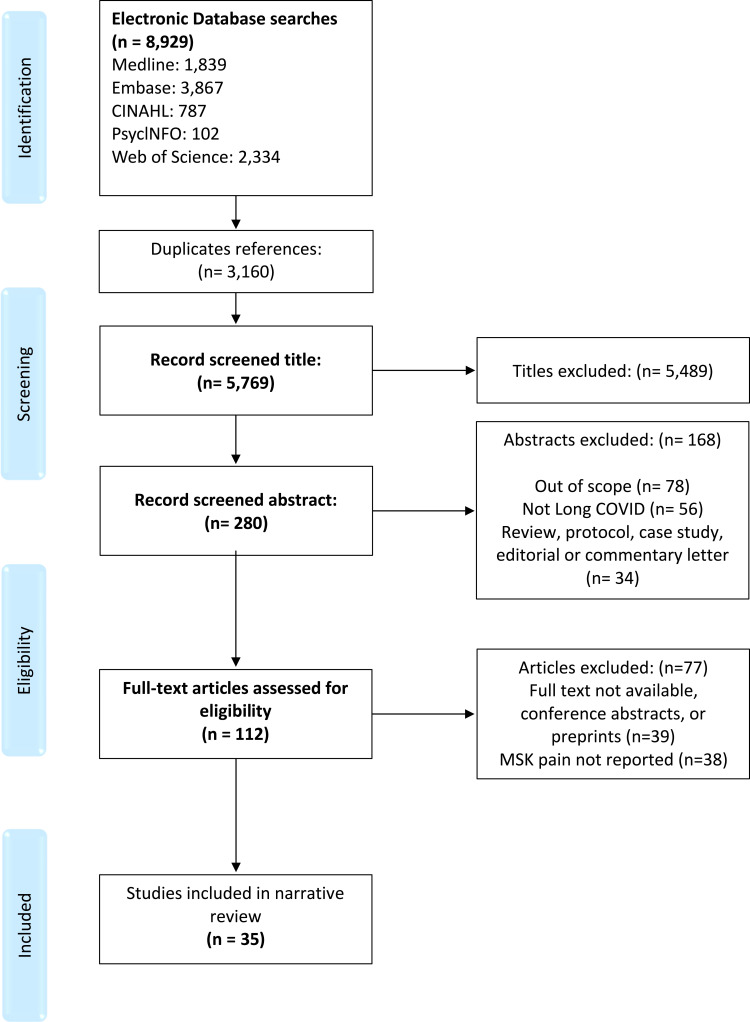
The narrative review involved a literature search of the following online databases: MEDLINE (OVID), EMBASE (OVID), CINAHL, PsyclNFO, and Web of Science (December 2019 to February 2022). We included observational studies that investigated the prevalence, characteristics, risk factors and mechanisms of MSK pain in Long COVID. After screening and reviewing the initial literature search results, a total of 35 studies were included in this review.
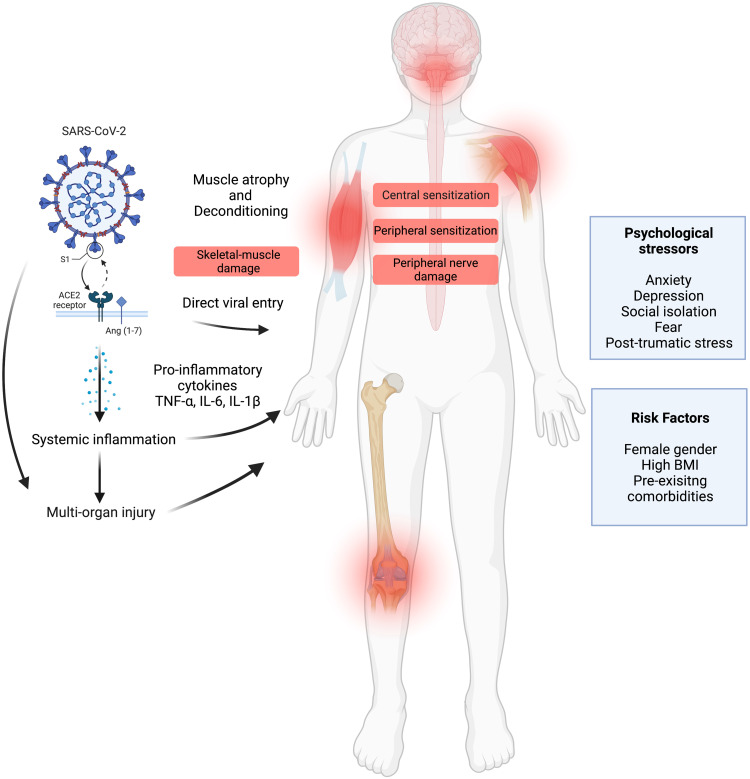
The overall reported prevalence of MSK pain in Long COVID ranged widely from 0.3% to 65.2%. The pain has been reported to be localized to a particular region or generalized and widespread. No consistent pattern of progression of MSK pain symptoms over time was identified. Female gender and higher BMI could be potential risk factors for Long COVID MSK pain, but no clear association has been found with age and ethnicity. Different pathophysiological mechanisms have been hypothesized to contribute to MSK pain in Long COVID including increased production of proinflammatory cytokines, immune cell hyperactivation, direct viral entry of neurological and MSK system cells, and psychological factors.
MSK pain is one of the most common symptoms in Long COVID. Most of the current literature on Long COVID focuses on reporting the prevalence of persistent MSK pain. Studies describing the pain characteristics are scarce. The precise mechanism of MSK pain in Long COVID is yet to be investigated. Future research must explore the characteristics, risk factors, natural progression, and underlying mechanisms of MSK pain in Long COVID.
患者越来越多地报告肌肉骨骼(MSK)疼痛是新冠后综合征或长新冠最常见的持续症状之一。然而,人们对其患病率、特征及潜在病理生理机制缺乏了解。本综述的目的是识别并描述长新冠患者MSK疼痛的特征。
叙述性综述涉及对以下在线数据库进行文献检索:MEDLINE(OVID)、EMBASE(OVID)、CINAHL、PsyclNFO和科学网(2019年12月至2022年2月)。我们纳入了调查长新冠患者MSK疼痛的患病率、特征、危险因素及机制的观察性研究。在筛选和回顾初步文献检索结果后,本综述共纳入35项研究。
报告的长新冠患者MSK疼痛总体患病率差异很大,从0.3%至65.2%不等。据报告,疼痛局限于特定区域或为全身性广泛疼痛。未发现MSK疼痛症状随时间变化的一致模式。女性和较高的体重指数可能是长新冠患者MSK疼痛的潜在危险因素,但未发现与年龄和种族有明确关联。已推测不同的病理生理机制可导致长新冠患者出现MSK疼痛,包括促炎细胞因子产生增加、免疫细胞过度激活、病毒直接进入神经和MSK系统细胞以及心理因素。
MSK疼痛是长新冠最常见的症状之一。目前关于长新冠的大多数文献都集中在报告持续性MSK疼痛的患病率。描述疼痛特征的研究很少。长新冠患者MSK疼痛的确切机制尚待研究。未来的研究必须探索长新冠患者MSK疼痛的特征、危险因素、自然病程及潜在机制。