Department of Pediatrics, Yonsei University College of Medicine, Seoul, Korea.
Biostatistics Collaboration Unit, Yonsei University College of Medicine, Seoul, Korea.
Yonsei Med J. 2022 Jul;63(7):640-647. doi: 10.3349/ymj.2022.63.7.640.
The aims of the study were to develop and evaluate a machine learning model with which to predict postnatal growth failure (PGF) among very low birth weight (VLBW) infants.
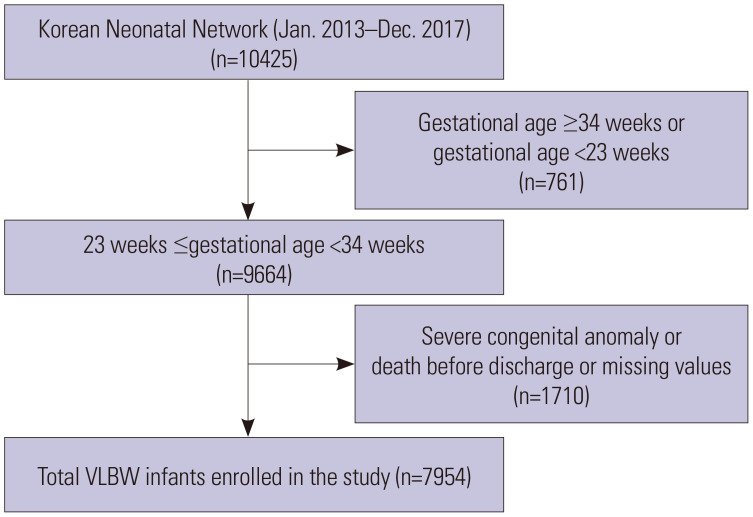
Of 10425 VLBW infants registered in the Korean Neonatal Network between 2013 and 2017, 7954 infants were included. PGF was defined as a decrease in Z score >1.28 at discharge, compared to that at birth. Six metrics [area under the receiver operating characteristic curve (AUROC), accuracy, precision, sensitivity, specificity, and F1 score] were obtained at five time points (at birth, 7 days, 14 days, 28 days after birth, and at discharge). Machine learning models were built using four different techniques [extreme gradient boosting (XGB), random forest, support vector machine, and convolutional neural network] to compare against the conventional multiple logistic regression (MLR) model.
The XGB algorithm showed the best performance with all six metrics across the board. When compared with MLR, XGB showed a significantly higher AUROC (=0.03) for Day 7, which was the primary performance metric. Using optimal cut-off points, for Day 7, XGB still showed better performances in terms of AUROC (0.74), accuracy (0.68), and F1 score (0.67). AUROC values seemed to increase slightly from birth to 7 days after birth with significance, almost reaching a plateau after 7 days after birth.
We have shown the possibility of predicting PGF through machine learning algorithms, especially XGB. Such models may help neonatologists in the early diagnosis of high-risk infants for PGF for early intervention.
本研究旨在开发和评估一种机器学习模型,以预测极低出生体重(VLBW)婴儿的产后生长不良(PGF)。
在 2013 年至 2017 年间,韩国新生儿网络登记了 10425 名 VLBW 婴儿,其中 7954 名婴儿被纳入研究。PGF 定义为与出生时相比,出院时 Z 评分下降>1.28。在五个时间点(出生时、第 7 天、第 14 天、出生后第 28 天和出院时)获得了 6 项指标[接收者操作特征曲线下面积(AUROC)、准确性、精度、敏感性、特异性和 F1 评分]。使用四种不同的技术[极端梯度增强(XGB)、随机森林、支持向量机和卷积神经网络]构建机器学习模型,并与传统的多逻辑回归(MLR)模型进行比较。
XGB 算法在所有六个指标上的表现均优于其他算法。与 MLR 相比,XGB 在第 7 天的主要性能指标 AUROC(=0.03)上表现出显著更高的性能。使用最佳截断点,对于第 7 天,XGB 在 AUROC(0.74)、准确性(0.68)和 F1 评分(0.67)方面仍表现出更好的性能。AUROC 值似乎从出生到出生后第 7 天略有增加,具有统计学意义,出生后第 7 天之后几乎达到一个平台。
我们已经通过机器学习算法展示了预测 PGF 的可能性,尤其是 XGB。这些模型可能有助于新生儿科医生早期诊断 PGF 高危婴儿,以便进行早期干预。