GGZ Rivierduinen Eetstoornissen Ursula, Leiden, Netherlands.
Department of Psychiatry, Leiden University Medical Center, Leiden, Netherlands.
Int J Eat Disord. 2022 Aug;55(8):1143-1155. doi: 10.1002/eat.23763. Epub 2022 Jun 23.
The primary aim was assessing the cost-effectiveness of an internet-based self-help program, expert-patient support, and the combination of both compared to a care-as-usual condition.
An economic evaluation from a societal perspective was conducted alongside a randomized controlled trial. Participants aged 16 or older with at least mild eating disorder symptoms were randomly assigned to four conditions: (1) Featback, an online unguided self-help program, (2) chat or e-mail support from a recovered expert patient, (3) Featback with expert-patient support, and (4) care-as-usual. After a baseline assessment and intervention period of 8 weeks, five online assessments were conducted over 12 months of follow-up. The main result constituted cost-utility acceptability curves with quality-of-life adjusted life years (QALYs) and societal costs over the entire study duration.
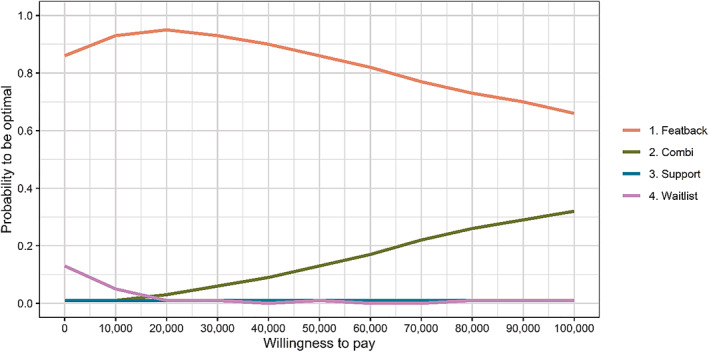
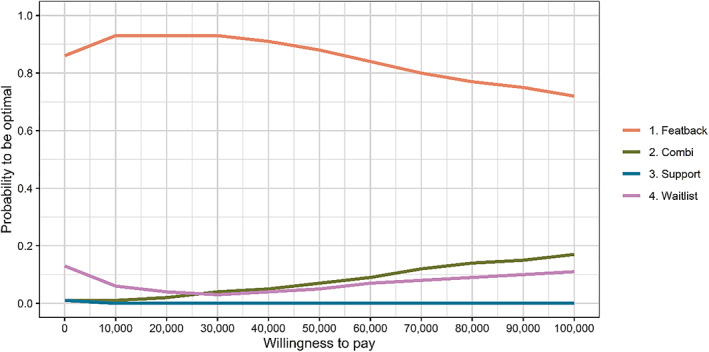
No significant differences between the conditions were found regarding QALYs, health care costs and societal costs. Nonsignificant differences in QALYs were in favor of the Featback conditions and the lowest societal costs per participant were observed in the Featback only condition (€16,741) while the highest costs were seen in the care-as-usual condition (€28,479). The Featback only condition had the highest probability of being efficient compared to the alternatives for all acceptable willingness-to-pay values.
Featback, an internet-based unguided self-help intervention, was likely to be efficient compared to Featback with guidance from an expert patient, guidance alone and a care-as-usual condition. Results suggest that scalable interventions such as Featback may reduce health care costs and help individuals with eating disorders that are currently not reached by other forms of treatment.
Internet-based interventions for eating disorders might reach individuals in society who currently do not receive appropriate treatment at low costs. Featback, an online automated self-help program for eating disorders, was found to improve quality of life slightly while reducing costs for society, compared to a do-nothing approach. Consequently, implementing internet-based interventions such as Featback likely benefits both individuals suffering from an eating disorder and society as a whole.
本研究旨在评估基于互联网的自助计划、医患专家支持以及两者结合与常规护理相比的成本效益。
在一项随机对照试验的基础上进行了经济评估。参与者年龄在 16 岁或以上,至少有轻度饮食障碍症状,随机分配到以下四个条件:(1)Featback,一种在线无指导自助程序;(2)与康复的医患专家进行聊天或电子邮件支持;(3)Featback 与医患专家支持相结合;(4)常规护理。在基线评估和 8 周干预期后,在 12 个月的随访期间进行了 5 次在线评估。主要结果是在整个研究期间,用生活质量调整后的生命年(QALYs)和社会成本绘制成本效用可接受性曲线。
在 QALYs、医疗保健成本和社会成本方面,各条件之间没有显著差异。Featback 条件在 QALYs 方面略有优势,每个参与者的社会成本最低的是仅使用 Featback 的条件(16741 欧元),而最高的是常规护理条件(28479 欧元)。仅使用 Featback 的条件在所有可接受的支付意愿值下,比其他替代方案更有可能具有效率。
Featback,一种基于互联网的无指导自助干预措施,与医患专家指导、单独指导和常规护理相比,可能具有成本效益。结果表明,像 Featback 这样的可扩展干预措施可能会降低医疗保健成本,并帮助那些目前未被其他治疗形式覆盖的饮食障碍患者。
针对饮食障碍的互联网干预措施可能以低成本为社会中那些目前未接受适当治疗的人提供帮助。与不作为相比,Featback,一种针对饮食障碍的在线自动化自助程序,可略微提高生活质量,同时降低社会成本。因此,实施像 Featback 这样的基于互联网的干预措施可能对患有饮食障碍的个人和整个社会都有益。