Laboratory of Molecular Immunology and Infectious Disease, Joint Graduate School of Veterinary Medicine, Yamaguchi University, Yamaguchi 753-8515, Japan.
Laboratory of Molecular Immunology and Infectious Disease, Joint Faculty of Veterinary Medicine, Yamaguchi University, Yamaguchi 753-8515, Japan.
Proc Natl Acad Sci U S A. 2022 Jun 28;119(26):e2114441119. doi: 10.1073/pnas.2114441119. Epub 2022 Jun 24.
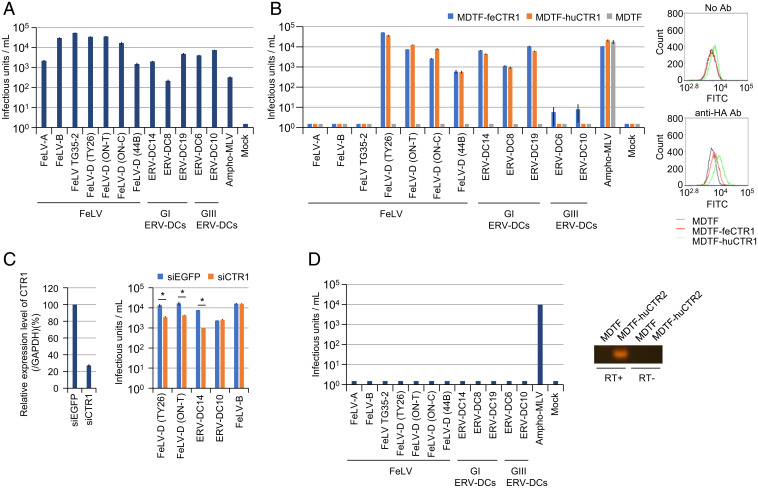
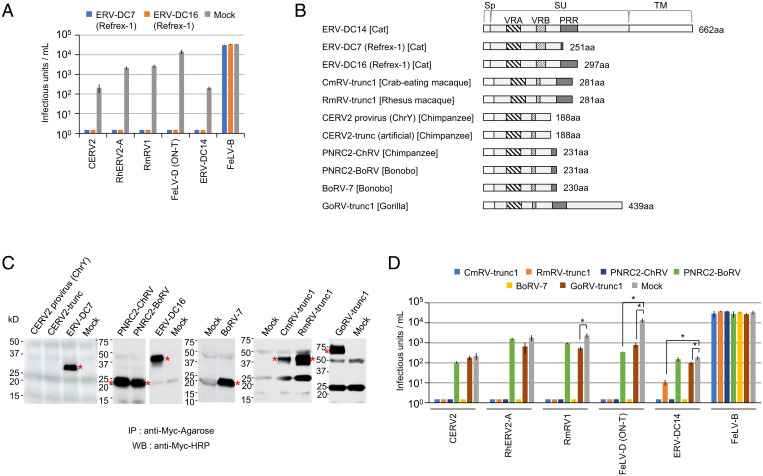
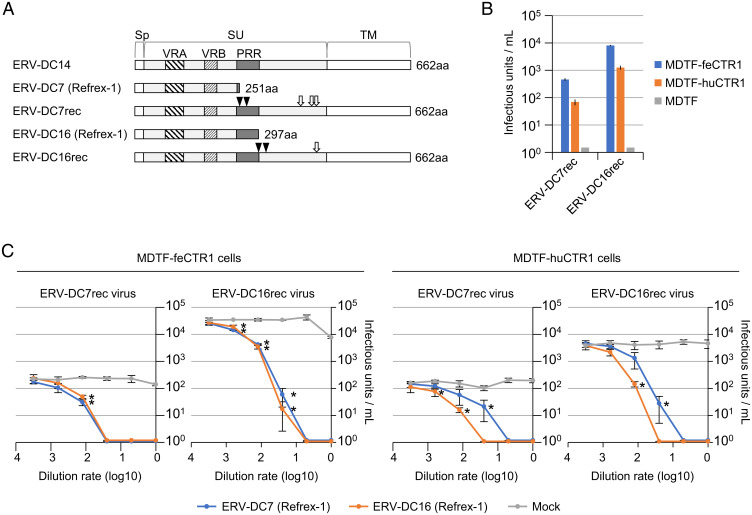
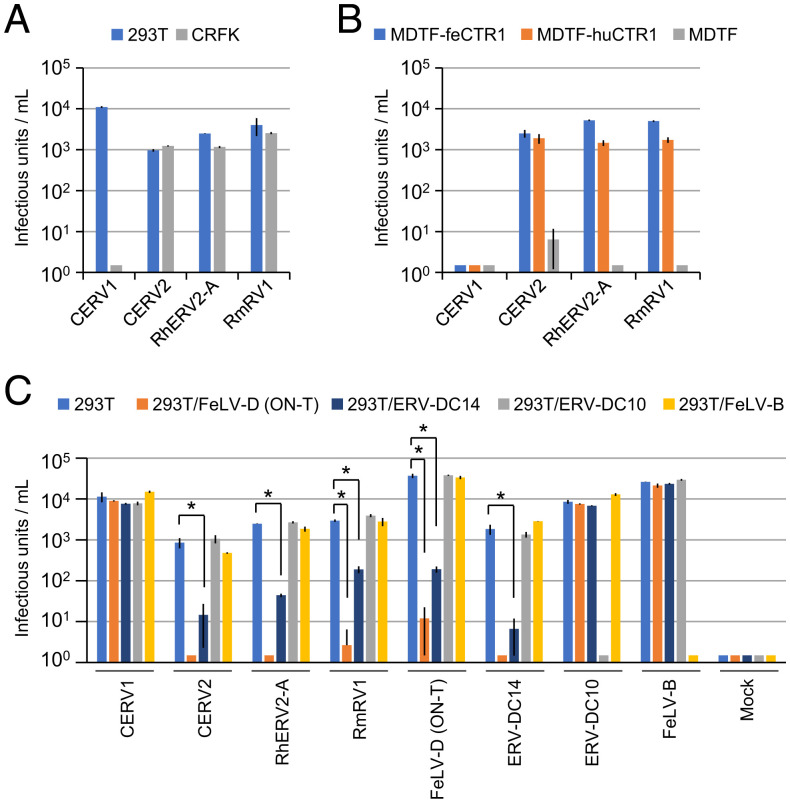
Host genetic resistance to viral infection controls the pathogenicity and epidemic dynamics of infectious diseases. Refrex-1 is a restriction factor against feline leukemia virus subgroup D (FeLV-D) and an endogenous retrovirus (ERV) in domestic cats (ERV-DC). Refrex-1 is encoded by a subset of ERV-DC loci with truncated envelope genes and secreted from cells as a soluble protein. Here, we identified the copper transporter CTR1 as the entry receptor for FeLV-D and genotype I ERV-DCs. We also identified CTR1 as a receptor for primate ERVs from crab-eating macaques and rhesus macaques, which were found in a search of intact envelope genes capable of forming infectious viruses. Refrex-1 counteracted infection by FeLV-D and ERV-DCs via competition for the entry receptor CTR1; the antiviral effects extended to primate ERVs with CTR1-dependent entry. Furthermore, truncated ERV envelope genes found in chimpanzee, bonobo, gorilla, crab-eating macaque, and rhesus macaque genomes could also block infection by feline and primate retroviruses. Genetic analyses showed that these ERV envelope genes were acquired in a species- or genus-specific manner during host evolution. These results indicated that soluble envelope proteins could suppress retroviral infection across species boundaries, suggesting that they function to control retroviral spread. Our findings revealed that several mammalian species acquired antiviral machinery from various ancient retroviruses, leading to convergent evolution for host defense.
宿主对病毒感染的遗传抗性控制着传染病的致病性和流行动态。Refrex-1 是一种针对猫白血病病毒亚群 D(FeLV-D)和家猫内源性逆转录病毒(ERV-DC)的限制因子。Refrex-1 是由一组具有截断包膜基因的 ERV-DC 基因座编码的,作为一种可溶性蛋白从细胞中分泌出来。在这里,我们确定铜转运蛋白 CTR1 是 FeLV-D 和基因型 I ERV-DC 的进入受体。我们还确定 CTR1 是食蟹猴和恒河猴的灵长类 ERV 的受体,这些 ERV 是在搜索能够形成感染性病毒的完整包膜基因时发现的。Refrex-1 通过与进入受体 CTR1 竞争来拮抗 FeLV-D 和 ERV-DC 的感染;抗病毒作用扩展到依赖 CTR1 进入的灵长类 ERV。此外,在黑猩猩、倭黑猩猩、大猩猩、食蟹猴和恒河猴基因组中发现的截断 ERV 包膜基因也可以阻断猫和灵长类逆转录病毒的感染。遗传分析表明,这些 ERV 包膜基因是在宿主进化过程中以物种或属特异性的方式获得的。这些结果表明,可溶性包膜蛋白可以抑制跨越物种界限的逆转录病毒感染,表明它们具有控制逆转录病毒传播的功能。我们的研究结果表明,几种哺乳动物物种从各种古老的逆转录病毒中获得了抗病毒机制,导致宿主防御的趋同进化。