Department of Radiology, Klinikum Rechts der Isar, Technische Universität München, Ismaninger Straße 22, 81675, Munich, Germany.
Department of Orthopaedic Surgery, Klinikum Rechts der Isar, Technische Universität München, Ismaninger Straße 22, 81675, Munich, Germany.
Eur Radiol. 2022 Dec;32(12):8376-8385. doi: 10.1007/s00330-022-08919-9. Epub 2022 Jun 25.
To evaluate a compressed sensing artificial intelligence framework (CSAI) to accelerate MRI acquisition of the ankle.
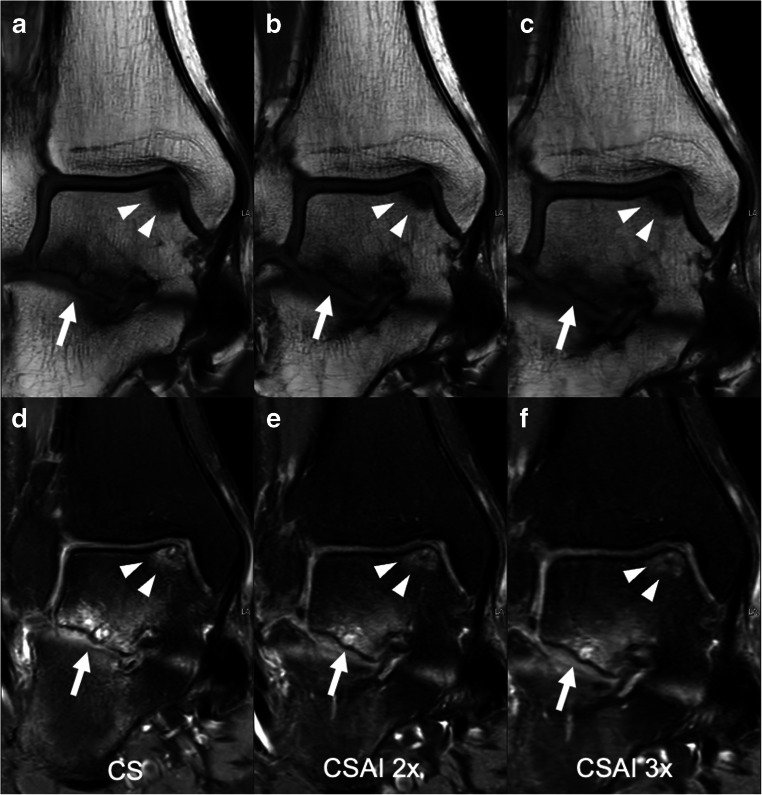
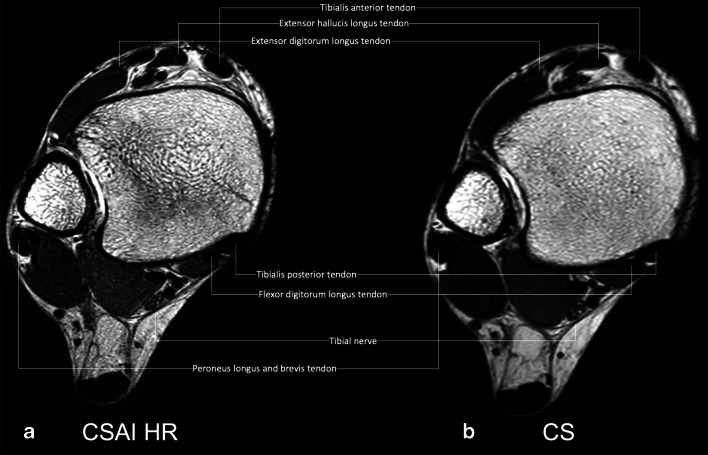
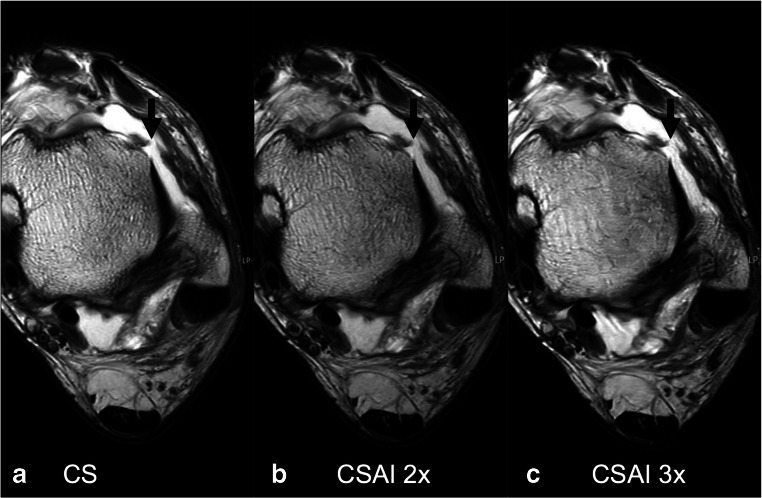
Thirty patients were scanned at 3T. Axial T2-w, coronal T1-w, and coronal/sagittal intermediate-w scans with fat saturation were acquired using compressed sensing only (12:44 min, CS), CSAI with an acceleration factor of 4.6-5.3 (6:45 min, CSAI2x), and CSAI with an acceleration factor of 6.9-7.7 (4:46 min, CSAI3x). Moreover, a high-resolution axial T2-w scan was obtained using CSAI with a similar scan duration compared to CS. Depiction and presence of abnormalities were graded. Signal-to-noise and contrast-to-noise were calculated. Wilcoxon signed-rank test and Cohen's kappa were used to compare CSAI with CS sequences.
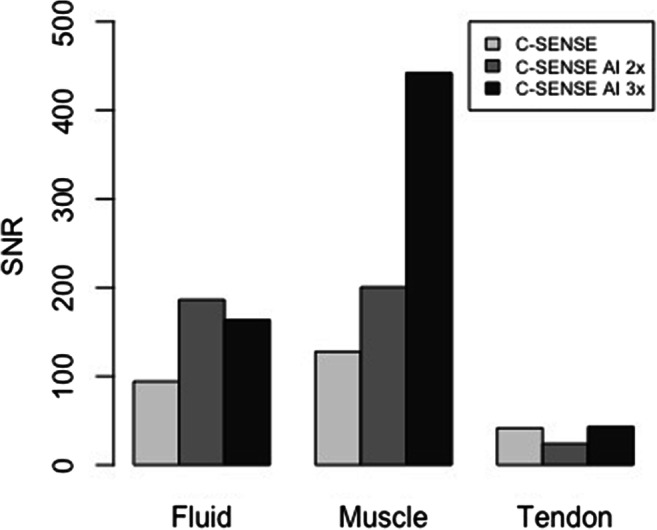
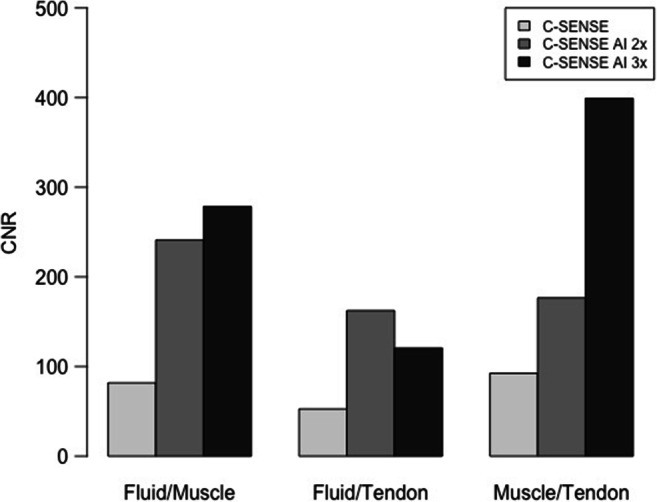
The correlation was perfect between CS and CSAI2x (κ = 1.0) and excellent for CS and CSAI3x (κ = 0.86-1.0). No significant differences were found for the depiction of structures between CS and CSAI2x and the same abnormalities were detected in both protocols. For CSAI3x the depiction was graded lower (p ≤ 0.001), though most abnormalities were also detected. For CSAI2x contrast-to-noise fluid/muscle was higher compared to CS (p ≤ 0.05), while no differences were found for other tissues. Signal-to-noise and contrast-to-noise were higher for CSAI3x compared to CS (p ≤ 0.05). The high - resolution axial T2-w sequence specifically improved the depiction of tendons and the tibial nerve (p ≤ 0.005).
Acquisition times can be reduced by 47% using CSAI compared to CS without decreasing diagnostic image quality. Reducing acquisition times by 63% is feasible but should be reserved for specific patients. The depiction of specific structures is improved using a high-resolution axial T2-w CSAI scan.
• Prospective study showed that CSAI enables reduction in acquisition times by 47% without decreasing diagnostic image quality. • Reducing acquisition times by 63% still produces images with an acceptable diagnostic accuracy but should be reserved for specific patients. • CSAI may be implemented to scan at a higher resolution compared to standard CS images without increasing acquisition times.
评估一种压缩感知人工智能框架(CSAI)以加速踝关节 MRI 采集。
30 例患者在 3T 下进行扫描。使用压缩感知仅采集轴向 T2-w、冠状 T1-w 和冠状/矢状面中 T1-w 脂肪饱和扫描(12:44 分钟,CS)、加速因子为 4.6-5.3 的 CSAI(6:45 分钟,CSAI2x)和加速因子为 6.9-7.7 的 CSAI(4:46 分钟,CSAI3x)。此外,使用与 CS 扫描时间相似的 CSAI 获得高分辨率轴向 T2-w 扫描。对异常的显示和存在进行分级。计算信噪比和对比噪声比。使用 Wilcoxon 符号秩检验和 Cohen's kappa 比较 CSAI 与 CS 序列。
CS 与 CSAI2x 之间的相关性非常好(κ=1.0),CS 与 CSAI3x 之间的相关性极好(κ=0.86-1.0)。CS 和 CSAI2x 之间的结构显示无显著差异,且两种方案均能检测到相同的异常。CSAI3x 的显示评分较低(p≤0.001),但大多数异常也被检测到。CSAI2x 与 CS 相比,液体/肌肉的对比噪声更高(p≤0.05),而其他组织无差异。CSAI3x 的信噪比和对比噪声比均高于 CS(p≤0.05)。高分辨率轴向 T2-w 序列特异性提高了肌腱和胫骨神经的显示(p≤0.005)。
与 CS 相比,CSA 可将采集时间减少 47%,而不会降低诊断图像质量。将采集时间减少 63%是可行的,但应保留给特定患者。高分辨率轴向 T2-w CSAI 扫描可改善特定结构的显示。
前瞻性研究表明,CSA 可将采集时间减少 47%,而不会降低诊断图像质量。
将采集时间减少 63%仍然可以产生具有可接受诊断准确性的图像,但应保留给特定患者。
与标准 CS 图像相比,CSA 可以以更高的分辨率进行扫描,而不会增加采集时间。