Qorbani Mostafa, Zarei Maryam, Moradi Yousef, Appannah Geeta, Djalainia Shirin, Pourrostami Kumars, Ejtahed Hanieh-Sadat, Mahdavi-Gorabi Armita, Naderali Ebrahim Khalil, Khazdouz Maryam
Non-Communicable Diseases Research Center, Alborz University of Medical Sciences, Karaj, Iran.
Endocrinology and Metabolism Research Center, Endocrinology and Metabolism Clinical Sciences Institute, Tehran University of Medical Sciences, Tehran, Iran.
Diabetol Metab Syndr. 2022 Jun 25;14(1):88. doi: 10.1186/s13098-022-00859-0.
There has been a longstanding interest in the potential effect of vitamin D in preventing cardiac-metabolic diseases. However, there are divergent results regarding the impact of vitamin D supplementation (VDS) on managing cardiac-metabolic outcomes in the elderly population.
We systematically searched electronic databases; Web of Science, PubMed, Scopus, EMBASE, Cochrane, and ProQuest. We included all trials that evaluated the effect of VDS on cardiac-metabolic risk factors in the elderly population, which were published until 30 September 2021. The effects of VDS on cardiac-metabolic outcomes were assessed using standardized mean difference (SMD). A random-effect model was used to pool the SMD and 95% confidence interval (CI).
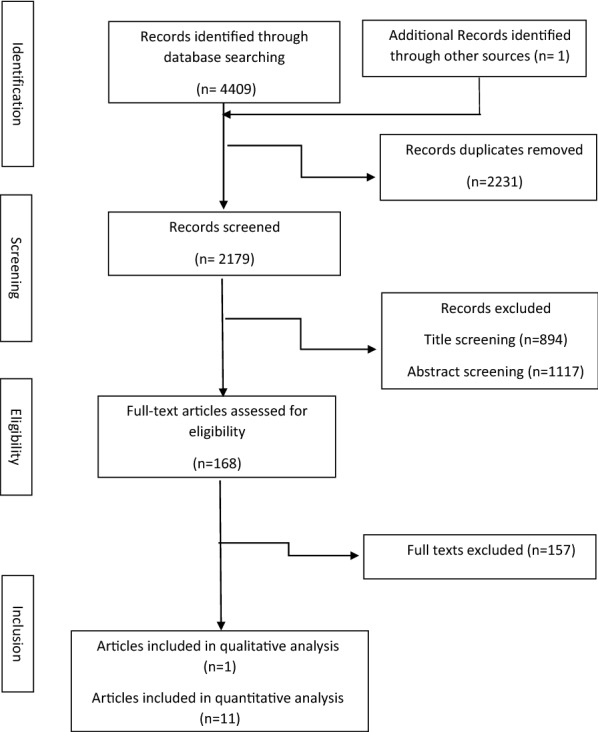
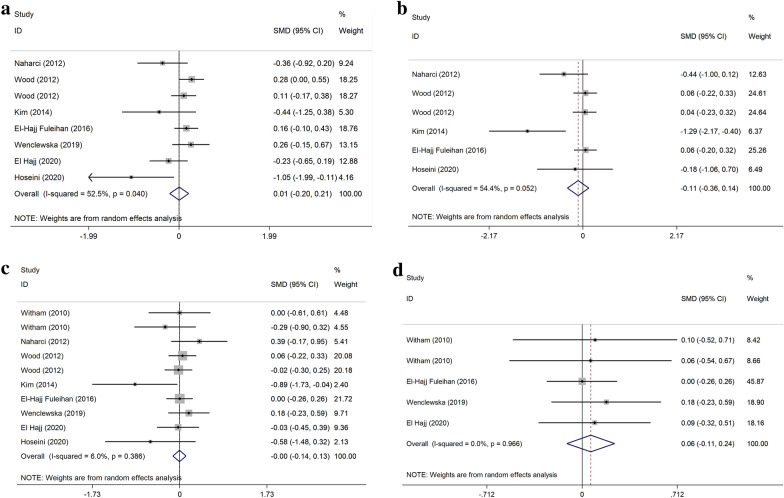
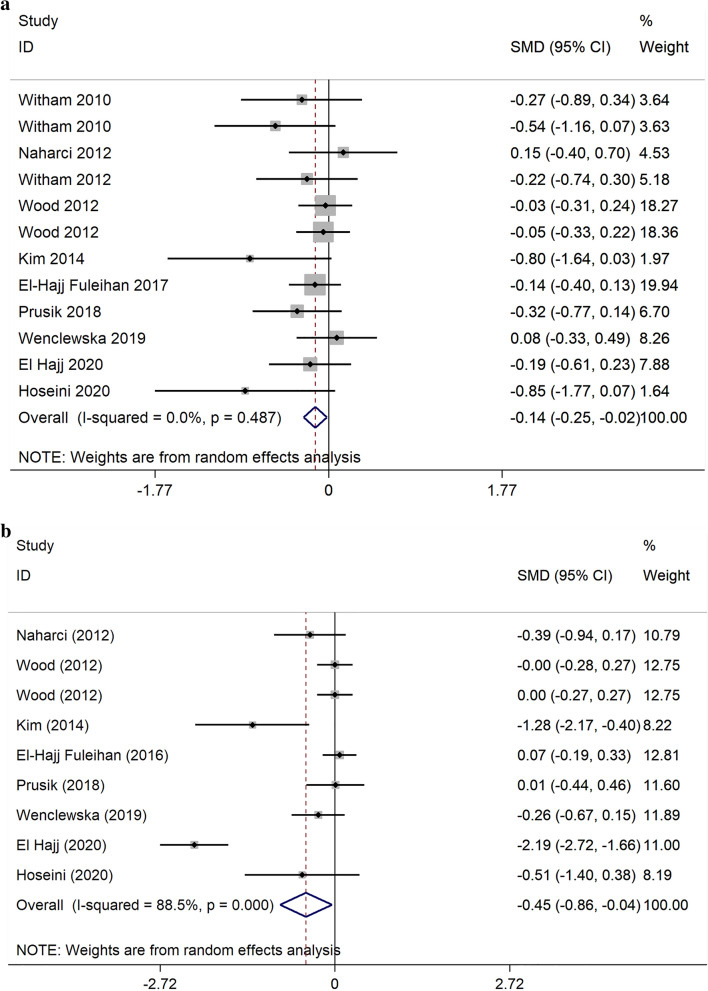
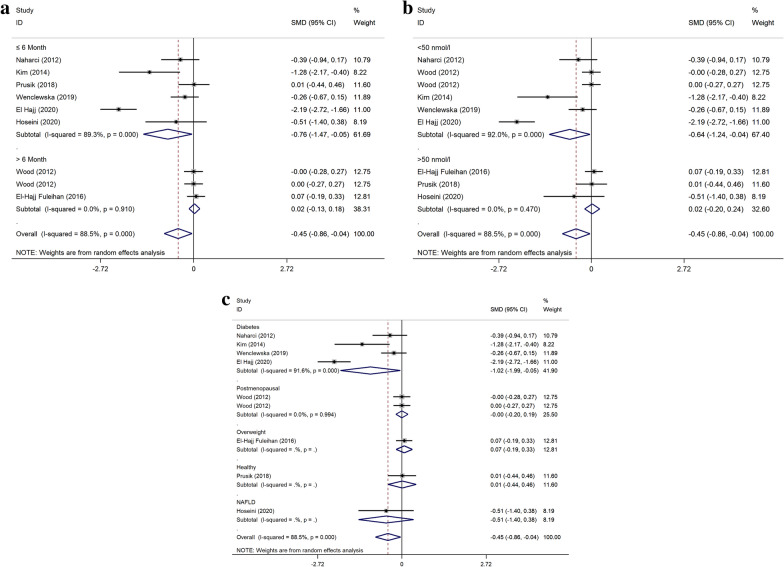
The literature search identified 4409 studies, of which 12 trials met inclusion criteria. Results of random effect meta-analysis indicated a significant reduction in total cholesterol (TC) (SMD: - 0.14 mg/dl; 95% CI: - 0.25, - 0.02) and triglyceride (TG) (SMD: - 0.45 mg/dl; 95% CI: - 0.86, - 0.04) with VDS compared to the placebo. The subgroup analyses revealed that the reduction of TG in patients with diabetes and vitamin D deficiency was significant. Furthermore, short-term intervention (≤ 6 months) induced a significantly lower level of TG and insulin in comparison to longer duration (> 6 months).
The study suggests that VDS could improve insulin concentration and dyslipidemia in the elderly population. The systematic review was registered in Alborz university of medical sciences with 2060-01-03-1397 number and the Ethics council IR.ABZUMS.REC.1397.207 number.
长期以来,人们一直关注维生素D在预防心脏代谢疾病方面的潜在作用。然而,关于补充维生素D(VDS)对老年人群心脏代谢结局的影响,存在不同的结果。
我们系统检索了电子数据库;科学网、PubMed、Scopus、EMBASE、Cochrane和ProQuest。我们纳入了所有评估VDS对老年人群心脏代谢危险因素影响的试验,这些试验截至2021年9月30日发表。使用标准化均数差(SMD)评估VDS对心脏代谢结局的影响。采用随机效应模型汇总SMD和95%置信区间(CI)。
文献检索共识别出4409项研究,其中12项试验符合纳入标准。随机效应荟萃分析结果表明,与安慰剂相比,VDS可显著降低总胆固醇(TC)(SMD:-0.14mg/dl;95%CI:-0.25,-0.02)和甘油三酯(TG)(SMD:-0.45mg/dl;95%CI:-0.86,-0.04)。亚组分析显示,糖尿病和维生素D缺乏患者的TG降低显著。此外,与较长疗程(>6个月)相比,短期干预(≤6个月)可使TG和胰岛素水平显著降低。
该研究表明,VDS可改善老年人群的胰岛素浓度和血脂异常。该系统评价已在阿尔伯兹医科大学注册,注册号为2060-01-03-1397,伦理委员会编号为IR.ABZUMS.REC.1397.207。