Department of Structural Biology, Stanford University, Stanford, CA 94305, USA.
Shanghai Institute for Advanced Immunochemical Studies, ShanghaiTech University, Shanghai, 201210, China.
Environ Res. 2022 Oct;213:113754. doi: 10.1016/j.envres.2022.113754. Epub 2022 Jun 24.
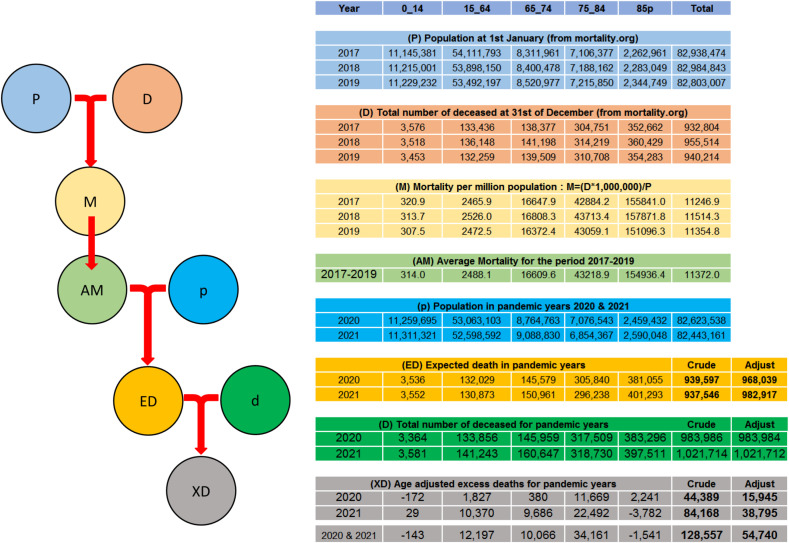
Different modeling approaches can be used to calculate excess deaths for the COVID-19 pandemic period. We compared 6 calculations of excess deaths (4 previously published [3 without age-adjustment] and two new ones that we performed with and without age-adjustment) for 2020-2021. With each approach, we calculated excess deaths metrics and the ratio R of excess deaths over recorded COVID-19 deaths. The main analysis focused on 33 high-income countries with weekly deaths in the Human Mortality Database (HMD at mortality.org) and reliable death registration. Secondary analyses compared calculations for other countries, whenever available. Across the 33 high-income countries, excess deaths were 2.0-2.8 million without age-adjustment, and 1.6-2.1 million with age-adjustment with large differences across countries. In our analyses after age-adjustment, 8 of 33 countries had no overall excess deaths; there was a death deficit in children; and 0.478 million (29.7%) of the excess deaths were in people <65 years old. In countries like France, Germany, Italy, and Spain excess death estimates differed 2 to 4-fold between highest and lowest figures. The R values' range exceeded 0.3 in all 33 countries. In 16 of 33 countries, the range of R exceeded 1. In 25 of 33 countries some calculations suggest R > 1 (excess deaths exceeding COVID-19 deaths) while others suggest R < 1 (excess deaths smaller than COVID-19 deaths). Inferred data from 4 evaluations for 42 countries and from 3 evaluations for another 98 countries are very tenuous. Estimates of excess deaths are analysis-dependent and age-adjustment is important to consider. Excess deaths may be lower than previously calculated.
不同的建模方法可用于计算 COVID-19 大流行期间的超额死亡人数。我们比较了 2020-2021 年的 6 种超额死亡计算方法(4 种之前发表的[3 种未经年龄调整]和我们进行的另外 2 种经年龄调整和未经年龄调整的方法)。对于每种方法,我们计算了超额死亡指标和超额死亡与记录的 COVID-19 死亡之比 R。主要分析侧重于 33 个高收入国家,这些国家在人类死亡率数据库(mortality.org 上的 HMD)中每周有死亡记录,且死亡登记可靠。在其他国家有可用数据的情况下,我们进行了次要分析。在 33 个高收入国家中,未经年龄调整的超额死亡人数为 200 万至 280 万,经年龄调整的超额死亡人数为 160 万至 210 万,各国之间存在较大差异。在我们进行年龄调整后的分析中,33 个国家中有 8 个国家没有总体超额死亡;儿童有死亡不足;0.478 百万(29.7%)的超额死亡发生在 65 岁以下的人群中。在法国、德国、意大利和西班牙等国家,最高和最低估计值之间的超额死亡估计差异高达 2 至 4 倍。所有 33 个国家的 R 值范围都超过 0.3。在 33 个国家中的 16 个国家,R 值范围超过 1。在 33 个国家中的 25 个国家中,一些计算结果表明 R>1(超额死亡超过 COVID-19 死亡),而其他计算结果表明 R<1(超额死亡小于 COVID-19 死亡)。来自 42 个国家的 4 项评估和另外 98 个国家的 3 项评估的推断数据非常脆弱。超额死亡的估计值取决于分析,且年龄调整非常重要。超额死亡可能低于之前的计算。