Nepomuceno Marília R, Klimkin Ilya, Jdanov Dmitri A, Alustiza-Galarza Ainhoa, Shkolnikov Vladimir M
Popul Dev Rev. 2022 Jun;48(2):279-302. doi: 10.1111/padr.12475. Epub 2022 Mar 3.
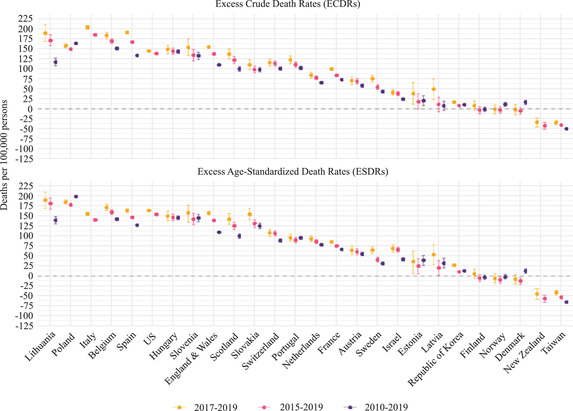
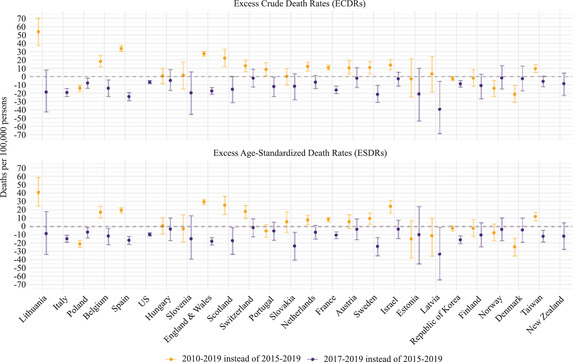
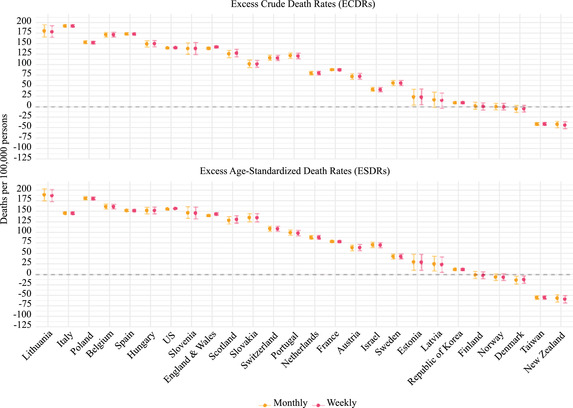
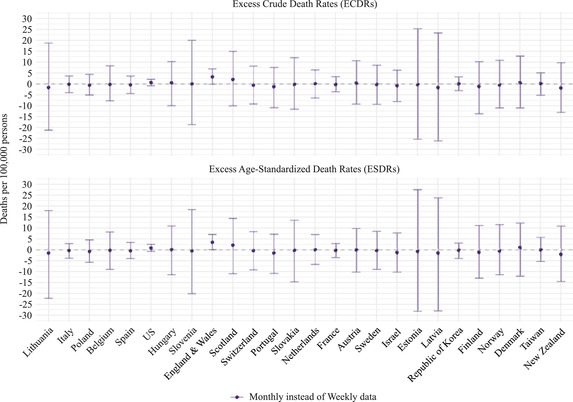
Estimating excess mortality is challenging. The metric depends on the expected mortality level, which can differ based on given choices, such as the method and the time series length used to estimate the baseline. However, these choices are often arbitrary, and are not subject to any sensitivity analysis. We bring to light the importance of carefully choosing the inputs and methods used to estimate excess mortality. Drawing on data from 26 countries, we investigate how sensitive excess mortality is to the choice of the mortality index, the number of years included in the reference period, the method, and the time unit of the death series. We employ two mortality indices, three reference periods, two data time units, and four methods for estimating the baseline. We show that excess mortality estimates can vary substantially when these factors are changed, and that the largest variations stem from the choice of the mortality index and the method. We also find that the magnitude of the variation in excess mortality is country-specific, resulting in cross-country rankings changes. Finally, based on our findings, we provide guidelines for estimating excess mortality.
估算超额死亡率具有挑战性。该指标取决于预期死亡率水平,而预期死亡率水平可能因特定选择而异,比如用于估算基线的方法和时间序列长度。然而,这些选择往往是随意的,且未进行任何敏感性分析。我们揭示了谨慎选择用于估算超额死亡率的输入数据和方法的重要性。利用来自26个国家的数据,我们研究了超额死亡率对死亡率指数的选择、参考期内包含的年份数、方法以及死亡序列的时间单位的敏感性。我们采用了两种死亡率指数、三个参考期、两个数据时间单位以及四种估算基线的方法。我们表明,当这些因素发生变化时,超额死亡率估计值可能会有很大差异,且最大的差异源于死亡率指数和方法的选择。我们还发现,超额死亡率变化的幅度因国家而异,导致跨国排名发生变化。最后,基于我们的研究结果,我们提供了估算超额死亡率的指导方针。