Tian Jiao, Feng Bin, Tian Zhen
Department of Infection, Ministry of Education Key Laboratory of Child Development and Disorders, National Clinical Research Center for Child Health and Disorders, China International Science and Technology Cooperation Base of Child Development and Critical Disorders, Chongqing Key Laboratory of Child Health and Nutrition, Children's Hospital of Chongqing Medical University, Chongqing 400014, China.
State Key Laboratory of Military Stomatology, National Clinical Research Center for Oral Diseases, Shaanxi International Joint Research Center for Oral Diseases, Department of Pharmacy, School of Stomatology, Fourth Military Medical University, Xi'an 710032, China.
Evid Based Complement Alternat Med. 2022 Jun 17;2022:8278744. doi: 10.1155/2022/8278744. eCollection 2022.
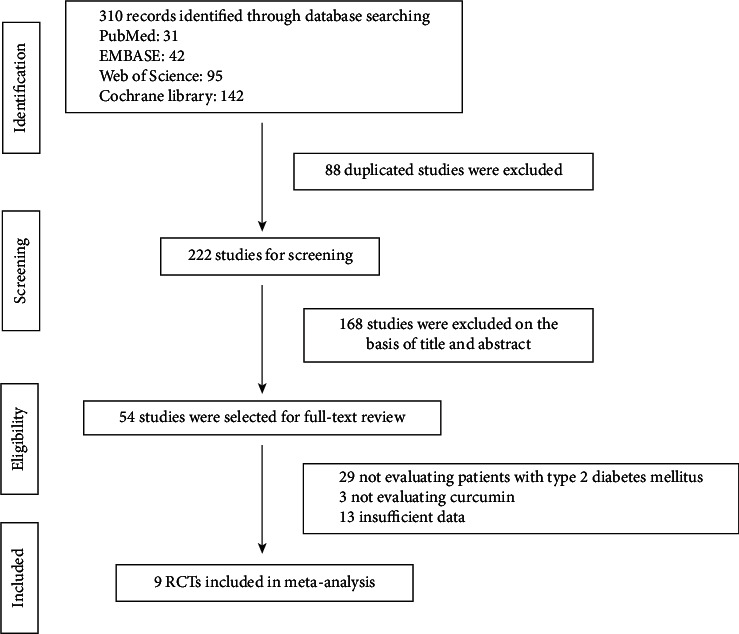
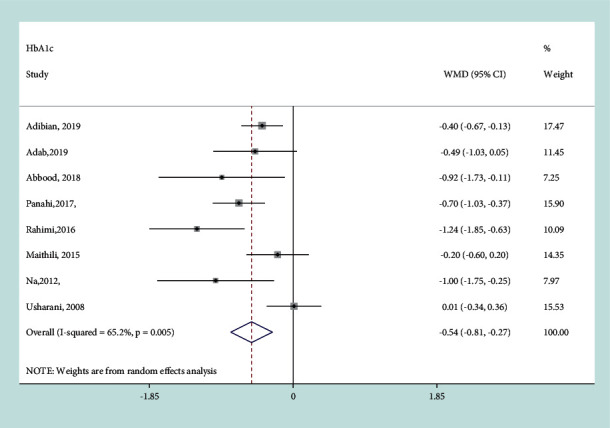
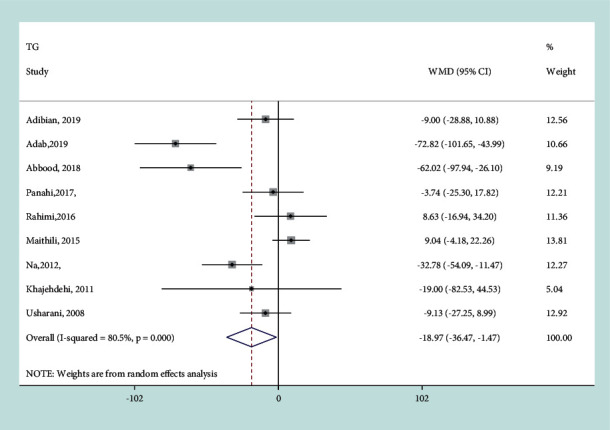
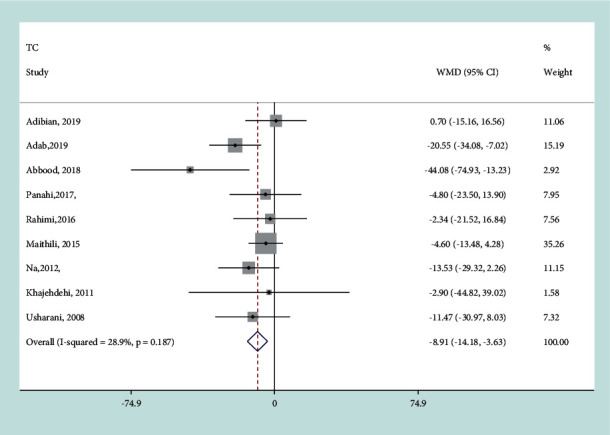
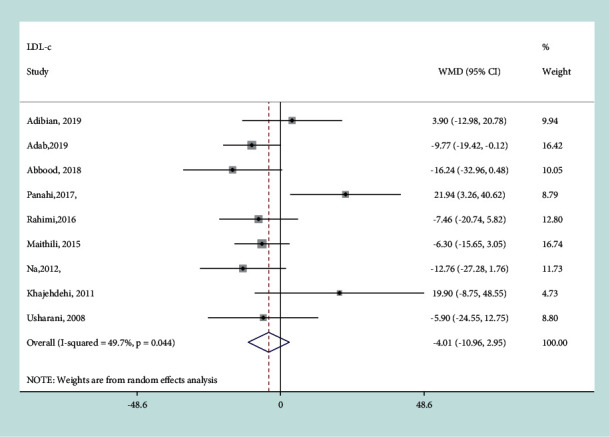
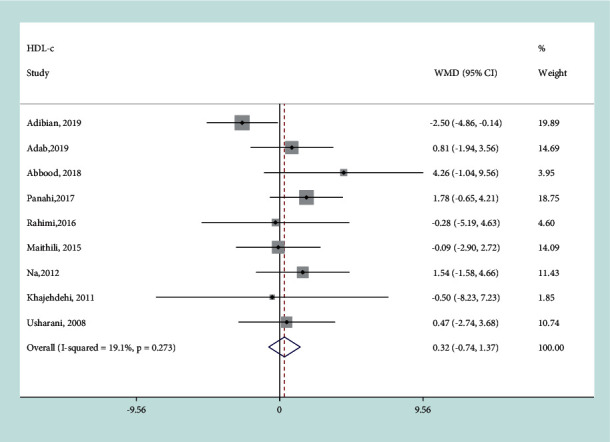
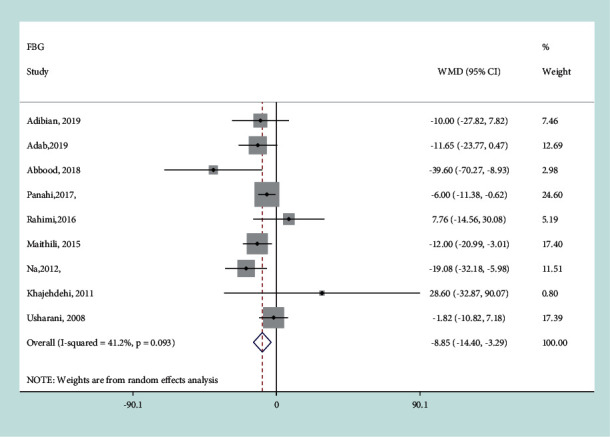
Type 2 diabetes mellitus (T2DM) is a progressive metabolic disorder, some natural compounds are thought to be beneficial in improving the metabolic status of patients with T2DM. Curcumin is the main bioactive agent of turmeric, the impact of curcumin on T2DM is still controversial. This meta-analysis aimed to evaluate the effects of curcumin on lipids profile and glucose status in patients with T2DM. Randomized controlled trials (RCTs) examining the effects of curcumin on lipids profile and glycemic control of T2DM patients were searched in PubMed, Embase, Web of Science and Cochrane Library. Pooled estimates of weighted mean difference (WMD) were calculated between intervention and control groups using random-effects or fixed-effects model. Subgroup and sensitivity analyses were conducted to assess the effects. Nine eligible RCT with 604 subjects were included. The estimated pooled mean changes with curcumin were -18.97 mg/dL (95% CI: -36.47 to -1.47; =0.03) for triglyceride (TG), -8.91 mg/dL (95% CI: -14.18 to -3.63, =0.001) for total cholesterol (TC), -4.01 mg/dL (95% CI: -10.96 to 2.95, =0.259) for low density lipoprotein cholesterol (LDL-c), 0.32 mg/dL (95% CI: -0.74 to 1.37, =0.557) for high density lipoprotein cholesterol (HDL-c), -8.85 mg/dL (95% CI: -14.4 to -3.29, =0.002) for fasting blood glucose (FBG), -0.54 (95% CI: -0.81 to -0.27, ≤ 0.001) for glycated hemoglobin (HbA1c) (%) compared with controls. There was a significant heterogeneity for the influence of curcumin on TG, LDL-c, FBG and HbA1c. Subgroup analysis revealed that the heterogeneity mainly attributed to trial period, curcumin dosage and other therapy. The results of this study showed that curcumin supplementation had beneficial effects on glycemic status and some lipid parameters in patients with T2DM. Further studies with large-scale are still needed to confirm the results.
2型糖尿病(T2DM)是一种进行性代谢紊乱疾病,一些天然化合物被认为有助于改善T2DM患者的代谢状况。姜黄素是姜黄的主要生物活性成分,其对T2DM的影响仍存在争议。本荟萃分析旨在评估姜黄素对T2DM患者血脂谱和血糖状况的影响。在PubMed、Embase、科学网和考克兰图书馆中检索了考察姜黄素对T2DM患者血脂谱和血糖控制影响的随机对照试验(RCT)。使用随机效应或固定效应模型计算干预组和对照组之间加权平均差(WMD)的合并估计值。进行亚组分析和敏感性分析以评估其效果。纳入了9项符合条件的RCT,共604名受试者。与对照组相比,姜黄素治疗后甘油三酯(TG)的合并平均变化估计值为-18.97mg/dL(95%CI:-36.47至-1.47;P=0.03),总胆固醇(TC)为-8.91mg/dL(95%CI:-14.18至-3.63,P=0.001),低密度脂蛋白胆固醇(LDL-c)为-4.01mg/dL(95%CI:-10.96至2.95,P=0.259),高密度脂蛋白胆固醇(HDL-c)为0.32mg/dL(95%CI:-0.74至1.37,P=0.557),空腹血糖(FBG)为-8.85mg/dL(95%CI:-14.4至-3.29,P=0.002),糖化血红蛋白(HbA1c)(%)为-0.54(95%CI:-0.81至-0.27,P≤0.001)。姜黄素对TG、LDL-c、FBG和HbA1c的影响存在显著异质性。亚组分析显示,异质性主要归因于试验期、姜黄素剂量和其他治疗方法。本研究结果表明,补充姜黄素对T2DM患者的血糖状况和一些血脂参数有有益影响。仍需要大规模的进一步研究来证实这些结果。