Hasanpour Galehban Morteza, Zeynizadeh Behzad, Mousavi Hossein
Department of Organic Chemistry, Faculty of Chemistry, Urmia University Urmia Iran
RSC Adv. 2022 Jun 7;12(26):16454-16478. doi: 10.1039/d1ra08454b. eCollection 2022 Jun 1.
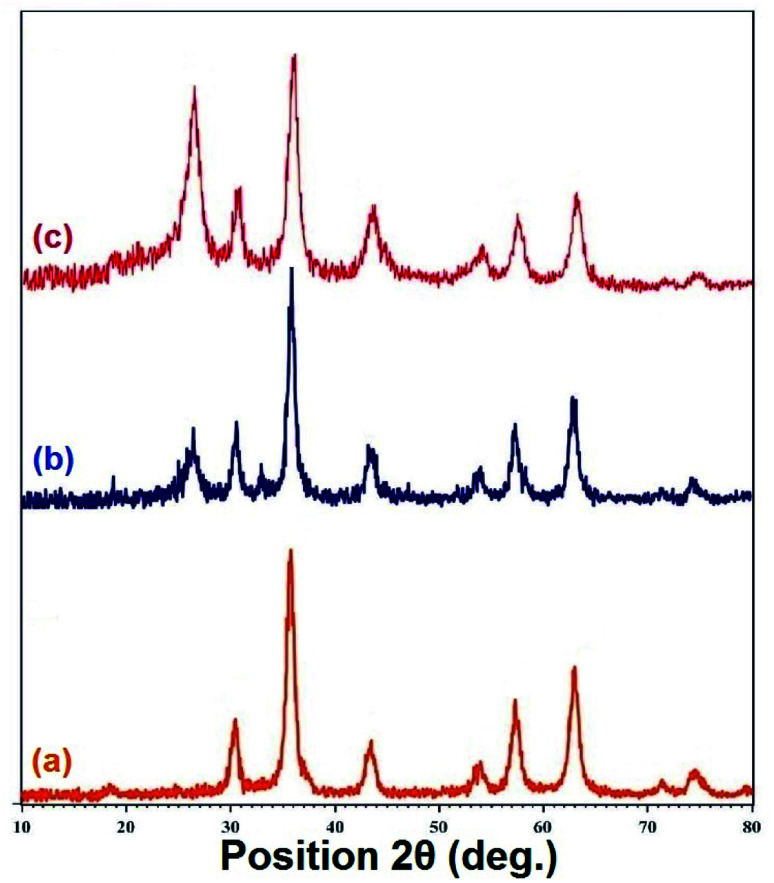
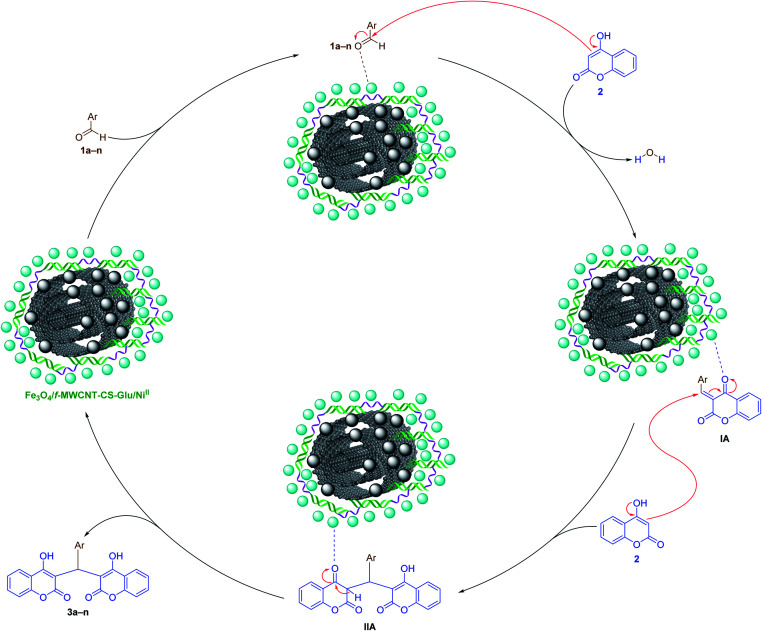
In the present study, a new l-glutamic acid cross-linked chitosan supported on magnetic carboxylic acid-functionalized multi-walled carbon nanotube (FeO/-MWCNT-CS-Glu) nanocomposite was prepared through a convenient one-pot multi-component sequential strategy. Then, nickel nanoparticles (Ni NPs) were entrapped within a matrix of the mentioned nanocomposite. Afterward, the structure of the as-prepared FeO/-MWCNT-CS-Glu/Ni nanosystem was elucidated by various techniques, including FT-IR, PXRD, SEM, TEM, SEM-based EDX and elemental mapping, ICP-OES, TGA/DTA, and VSM. In the next part of this research, the catalytic applications of the mentioned nickel-containing magnetic nanocomposite were assessed upon green one-pot synthesis of diverse heterocyclic frameworks, including bis-coumarins (3a-n), 2-aryl(or heteroaryl)-2,3-dihydroquinazolin-4(1)-ones (5a-r), 9-aryl-3,3,6,6-tetramethyl-3,4,5,6,7,9-hexahydro-1-xanthene-1,8(2)-diones (7a-n), and 2-amino-4-aryl-7,7-dimethyl-5-oxo-5,6,7,8-tetrahydro-4-chromene-3-carbonitriles (9a-n). The good-to-excellent yields of the desired products, satisfactory reaction rates, use of water solvent or solvent-free reaction medium, acceptable turnover numbers (TONs) and turnover frequencies (TOFs), along with comfortable recoverability and satisfying reusability of the as-prepared nanocatalyst for at least eight successive runs, and also easy work-up and purification procedures are some of the advantages of the current synthetic protocols.
在本研究中,通过简便的一锅多组分连续策略制备了一种负载在磁性羧酸功能化多壁碳纳米管(FeO/-MWCNT-CS-Glu)上的新型L-谷氨酸交联壳聚糖纳米复合材料。然后,将镍纳米颗粒(Ni NPs)包裹在上述纳米复合材料的基质中。随后,通过多种技术对所制备的FeO/-MWCNT-CS-Glu/Ni纳米体系的结构进行了阐明,包括傅里叶变换红外光谱(FT-IR)、粉末X射线衍射(PXRD)、扫描电子显微镜(SEM)、透射电子显微镜(TEM)、基于扫描电子显微镜的能谱分析(EDX)和元素映射、电感耦合等离子体发射光谱(ICP-OES)、热重分析/差示热分析(TGA/DTA)以及振动样品磁强计(VSM)。在本研究的下一部分,在绿色一锅法合成多种杂环骨架的过程中评估了上述含镍磁性纳米复合材料的催化应用,这些杂环骨架包括双香豆素(3a-n)、2-芳基(或杂芳基)-2,3-二氢喹唑啉-4(1)-酮(5a-r)、9-芳基-3,3,6,6-四甲基-3,4,5,6,7,9-六氢-1-占吨-1,8(2)-二酮(7a-n)以及2-氨基-4-芳基-7,7-二甲基-5-氧代-5,6,7,8-四氢-4-色烯-3-甲腈(9a-n)。所需产物的产率良好至优异、反应速率令人满意、使用水溶剂或无溶剂反应介质、可接受的转化数(TONs)和转化频率(TOFs),以及所制备的纳米催化剂至少连续八次运行具有良好的可回收性和令人满意的可重复使用性,还有简便的后处理和纯化程序,这些都是当前合成方案的一些优点。