Anyfanti Panagiota, Margouta Anastasia, Goulas Kyriakos, Gavriilaki Maria, Lazaridou Elizabeth, Patsatsi Aikaterini, Gkaliagkousi Eugenia
Department of Internal Medicine, Papageorgiou Hospital, Aristotle University of Thessaloniki, Thessaloniki, Greece.
Postgraduate Course, School of Medicine, Aristotle University of Thessaloniki, Thessaloniki, Greece.
Front Med (Lausanne). 2022 Jun 10;9:864185. doi: 10.3389/fmed.2022.864185. eCollection 2022.
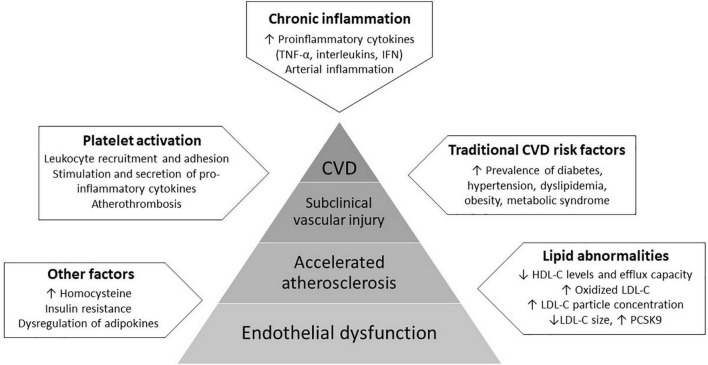
Although psoriasis is predominantly a chronic inflammatory skin disorder, epidemiological data provide a solid link between psoriasis, especially in its more severe forms, and increased risk for cardiovascular morbidity and mortality. Apart from the increased prevalence of traditional cardiovascular risk factors, chronic inflammation appears to act synergistically with the underlying process of endothelial dysfunction toward the development of accelerated atherosclerosis, subclinical vascular injury and subsequently, clinically evident cardiovascular manifestations. Endothelial dysfunction is regarded as an early precursor of atherosclerosis with a predictive value for the development of future cardiovascular events. A thorough understanding of the mechanisms of endothelial dysfunction in psoriasis might pave the path for the development of more accurate cardiovascular risk prediction tools and possible therapeutic targets aiming to alleviate the increased cardiovascular burden associated with the disease. The present review summarizes the available evidence about the role of chronic inflammation and other important pathophysiological mechanisms involved in the development of endothelial dysfunction in psoriasis. An overview of studies implementing the most widely applied circulating and vascular biomarkers of endothelial dysfunction in psoriasis patients will be provided, and the impact of systemic psoriasis treatments on endothelial dysfunction and patients' cardiovascular risk will be discussed.
尽管银屑病主要是一种慢性炎症性皮肤病,但流行病学数据表明,银屑病尤其是其更严重的形式与心血管疾病发病率和死亡率增加之间存在确凿联系。除了传统心血管危险因素的患病率增加外,慢性炎症似乎与内皮功能障碍的潜在过程协同作用,导致动脉粥样硬化加速发展、亚临床血管损伤,进而出现临床上明显的心血管表现。内皮功能障碍被认为是动脉粥样硬化的早期先兆,对未来心血管事件的发生具有预测价值。深入了解银屑病中内皮功能障碍的机制可能为开发更准确的心血管风险预测工具以及旨在减轻与该疾病相关的心血管负担增加的潜在治疗靶点铺平道路。本综述总结了关于慢性炎症和其他参与银屑病内皮功能障碍发展的重要病理生理机制作用的现有证据。将概述在银屑病患者中应用最广泛的循环和血管内皮功能障碍生物标志物的研究,并讨论全身性银屑病治疗对内皮功能障碍和患者心血管风险的影响。