Tsai Kun-Zhe, Su Fang-Ying, Cheng Wan-Chien, Huang Ren-Yeong, Lin Yen-Po, Lin Gen-Min
Department of Medicine, Hualien Armed Forces General Hospital, Hualien, Taiwan.
Departments of Dentistry, Tri-Service General Hospital, Taipei, Taiwan.
J Dent Sci. 2022 Apr;17(2):1018-1023. doi: 10.1016/j.jds.2021.10.018. Epub 2021 Nov 23.
BACKGROUND/PURPOSE: To investigate the associations between treated and untreated dental caries and periodontitis in young adults.
The study enrolled 1289 participants aged 18-45 years in Taiwan. Localized periodontitis was categorized into healthy and stage II/III (n = 936 and n = 353, respectively) based on the 2017 criteria of the World Workshop. Multivariable logistic regression analysis with adjustments for sex, age, tobacco smoking status, betel nut consumption status, metabolic syndrome, and total white blood cell count was used to determine the associations.
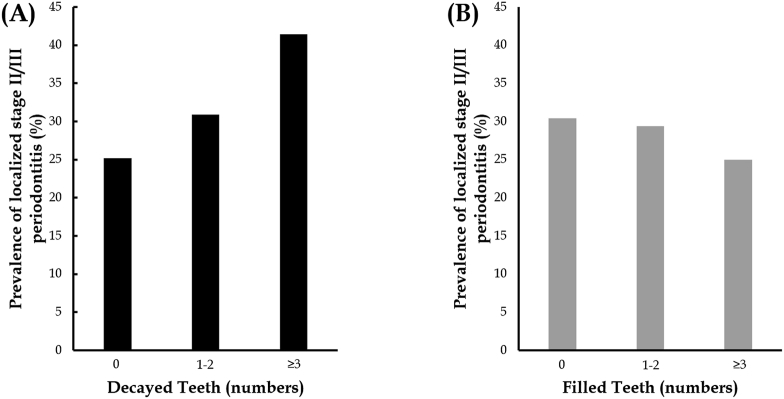
Decayed tooth numbers were positively associated with localized stage II/III periodontitis [odds ratio (OR): 1.15 (95% confidence intervals (CI): 1.06-2.25)], while filled tooth numbers were inversely associated with localized stage II/III periodontitis in young adults [OR: 0.96 (95% CI: 0.92-0.99)].
Our study confirms the relationship between dental caries and periodontitis by direct evidence that the more decayed teeth there are, the higher the risk of periodontitis and by indirect evidence that the more treated decayed teeth there are, the lower the risk of periodontitis in young adults.
背景/目的:研究年轻成年人中已治疗和未治疗的龋齿与牙周炎之间的关联。
该研究纳入了台湾地区1289名年龄在18至45岁之间的参与者。根据2017年世界研讨会的标准,局限性牙周炎被分为健康组和II/III期组(分别为n = 936和n = 353)。采用多变量逻辑回归分析,并对性别、年龄、吸烟状况、槟榔咀嚼状况、代谢综合征和白细胞总数进行调整,以确定两者之间的关联。
龋齿数量与局限性II/III期牙周炎呈正相关[比值比(OR):1.15(95%置信区间(CI):1.06 - 2.25)],而补牙数量与年轻成年人局限性II/III期牙周炎呈负相关[OR:0.96(95% CI:0.92 - 0.99)]。
我们的研究通过直接证据(龋齿越多,牙周炎风险越高)和间接证据(治疗的龋齿越多,年轻成年人牙周炎风险越低)证实了龋齿与牙周炎之间的关系。