• 文献检索
  • 文档翻译
  • 深度研究
  • 学术资讯
  • Suppr Zotero 插件Zotero 插件
  • 邀请有礼
  • 套餐&价格
  • 历史记录
应用&插件
Suppr Zotero 插件Zotero 插件浏览器插件Mac 客户端Windows 客户端微信小程序
定价
高级版会员购买积分包购买API积分包
服务
文献检索文档翻译深度研究API 文档MCP 服务
关于我们
关于 Suppr公司介绍联系我们用户协议隐私条款
关注我们

Suppr 超能文献

核心技术专利:CN118964589B侵权必究
粤ICP备2023148730 号-1Suppr @ 2026

文献检索

告别复杂PubMed语法,用中文像聊天一样搜索,搜遍4000万医学文献。AI智能推荐,让科研检索更轻松。

立即免费搜索

文件翻译

保留排版,准确专业,支持PDF/Word/PPT等文件格式,支持 12+语言互译。

免费翻译文档

深度研究

AI帮你快速写综述,25分钟生成高质量综述,智能提取关键信息,辅助科研写作。

立即免费体验

通过深度学习从物种组合预测微生物群落组成。

Predicting microbiome compositions from species assemblages through deep learning.

作者信息

Michel-Mata Sebastian, Wang Xu-Wen, Liu Yang-Yu, Angulo Marco Tulio

机构信息

Center for Applied Physics and Advanced Technology, Universidad Nacional Autónoma de México, Juriquilla 76230, México.

Department of Ecology and Evolutionary Biology, Princeton University, Princeton, NJ 08544, USA.

出版信息

Imeta. 2022 Mar;1(1). doi: 10.1002/imt2.3. Epub 2022 Mar 1.

DOI:10.1002/imt2.3
PMID:35757098
原文链接:https://pmc.ncbi.nlm.nih.gov/articles/PMC9221840/
Abstract

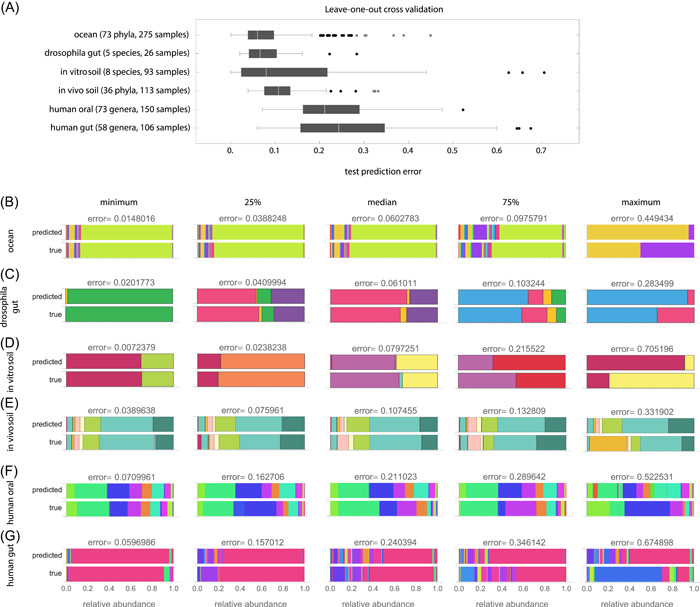
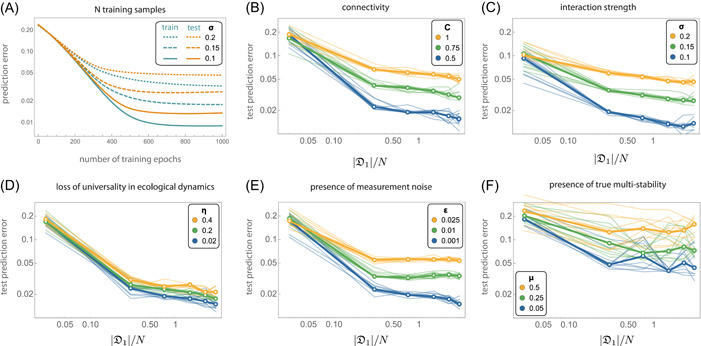
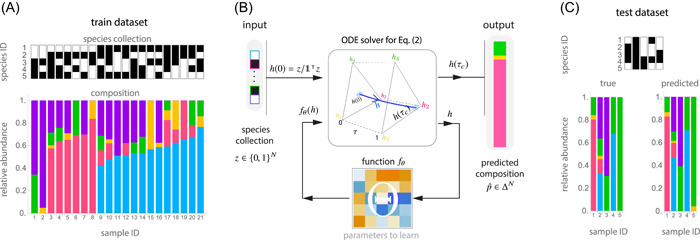
Microbes can form complex communities that perform critical functions in maintaining the integrity of their environment or their hosts' well-being. Rationally managing these microbial communities requires improving our ability to predict how different species assemblages affect the final species composition of the community. However, making such a prediction remains challenging because of our limited knowledge of the diverse physical, biochemical, and ecological processes governing microbial dynamics. To overcome this challenge, we present a deep learning framework that automatically learns the map between species assemblages and community compositions from training data only, without knowing any of the above processes. First, we systematically validate our framework using synthetic data generated by classical population dynamics models. Then, we apply our framework to data from and microbial communities, including ocean and soil microbiota, gut microbiota, and human gut and oral microbiota. We find that our framework learns to perform accurate out-of-sample predictions of complex community compositions from a small number of training samples. Our results demonstrate how deep learning can enable us to understand better and potentially manage complex microbial communities.

摘要

微生物能够形成复杂的群落,这些群落在维持其生存环境的完整性或宿主的健康方面发挥着关键作用。合理管理这些微生物群落需要提高我们预测不同物种组合如何影响群落最终物种组成的能力。然而,由于我们对控制微生物动态的各种物理、生化和生态过程的了解有限,做出这样的预测仍然具有挑战性。为了克服这一挑战,我们提出了一个深度学习框架,该框架仅从训练数据中自动学习物种组合与群落组成之间的映射关系,而无需了解上述任何过程。首先,我们使用经典种群动态模型生成的合成数据系统地验证了我们的框架。然后,我们将我们的框架应用于来自海洋和土壤微生物群、肠道微生物群以及人类肠道和口腔微生物群等微生物群落的数据。我们发现,我们的框架能够从少量训练样本中学习,对复杂的群落组成进行准确的样本外预测。我们的结果证明了深度学习如何使我们能够更好地理解并有可能管理复杂的微生物群落。
https://cdn.ncbi.nlm.nih.gov/pmc/blobs/5d00/10989856/7f95049af228/IMT2-1-e3-g004.jpg
https://cdn.ncbi.nlm.nih.gov/pmc/blobs/5d00/10989856/55547510cb78/IMT2-1-e3-g002.jpg
https://cdn.ncbi.nlm.nih.gov/pmc/blobs/5d00/10989856/24b3ac4dafd0/IMT2-1-e3-g003.jpg
https://cdn.ncbi.nlm.nih.gov/pmc/blobs/5d00/10989856/7f95049af228/IMT2-1-e3-g004.jpg
https://cdn.ncbi.nlm.nih.gov/pmc/blobs/5d00/10989856/55547510cb78/IMT2-1-e3-g002.jpg
https://cdn.ncbi.nlm.nih.gov/pmc/blobs/5d00/10989856/24b3ac4dafd0/IMT2-1-e3-g003.jpg
https://cdn.ncbi.nlm.nih.gov/pmc/blobs/5d00/10989856/7f95049af228/IMT2-1-e3-g004.jpg

相似文献

1
Predicting microbiome compositions from species assemblages through deep learning.通过深度学习从物种组合预测微生物群落组成。
Imeta. 2022 Mar;1(1). doi: 10.1002/imt2.3. Epub 2022 Mar 1.
2
Universal gut microbial relationships in the gut microbiome of wild baboons.野生狒狒肠道微生物组中的普遍肠道微生物关系。
Elife. 2023 May 9;12:e83152. doi: 10.7554/eLife.83152.
3
BioMiCo: a supervised Bayesian model for inference of microbial community structure.BioMiCo:一种用于推断微生物群落结构的有监督贝叶斯模型。
Microbiome. 2015 Mar 10;3:8. doi: 10.1186/s40168-015-0073-x. eCollection 2015.
4
Identifying keystone species in microbial communities using deep learning.使用深度学习识别微生物群落中的关键物种。
bioRxiv. 2023 Mar 31:2023.03.15.532858. doi: 10.1101/2023.03.15.532858.
5
Identifying keystone species in microbial communities using deep learning.使用深度学习识别微生物群落中的关键种。
Nat Ecol Evol. 2024 Jan;8(1):22-31. doi: 10.1038/s41559-023-02250-2. Epub 2023 Nov 16.
6
Data-driven prediction of colonization outcomes for complex microbial communities.基于数据驱动的复杂微生物群落定殖结果预测。
Nat Commun. 2024 Mar 16;15(1):2406. doi: 10.1038/s41467-024-46766-y.
7
Quantitative differences in synthetic gut microbial inoculums do not affect the final stabilized community compositions.人工合成肠道微生物菌剂的数量差异不会影响最终稳定的群落组成。
mSystems. 2023 Aug 31;8(4):e0124922. doi: 10.1128/msystems.01249-22. Epub 2023 Jul 10.
8
Data-driven prediction of colonization outcomes for complex microbial communities.复杂微生物群落定殖结果的数据驱动预测
bioRxiv. 2023 Apr 21:2023.04.19.537502. doi: 10.1101/2023.04.19.537502.
9
10
Ecological Adaptation and Succession of Human Fecal Microbial Communities in an Automated Fermentation System.自动化发酵系统中人类粪便微生物群落的生态适应与演替
mSystems. 2021 Aug 31;6(4):e0023221. doi: 10.1128/mSystems.00232-21. Epub 2021 Jul 27.

引用本文的文献

1
KeySDL: Sparse Dictionary Learning for Keystone Microbe Identification.KeySDL:用于关键微生物识别的稀疏字典学习
bioRxiv. 2025 Aug 11:2025.08.07.669165. doi: 10.1101/2025.08.07.669165.
2
Credible inferences in microbiome research: ensuring rigour, reproducibility and relevance in the era of AI.微生物组研究中的可靠推断:在人工智能时代确保严谨性、可重复性和相关性
Nat Rev Gastroenterol Hepatol. 2025 Jul 31. doi: 10.1038/s41575-025-01100-9.
3
Physics-constrained neural ordinary differential equation models to discover and predict microbial community dynamics.

本文引用的文献

1
Multi-kingdom ecological drivers of microbiota assembly in preterm infants.早产儿肠道微生物组装配的多王国生态驱动因素。
Nature. 2021 Mar;591(7851):633-638. doi: 10.1038/s41586-021-03241-8. Epub 2021 Feb 24.
2
Predicting microbiomes through a deep latent space.通过深层潜在空间预测微生物组。
Bioinformatics. 2021 Jun 16;37(10):1444-1451. doi: 10.1093/bioinformatics/btaa971.
3
Deep in the Bowel: Highly Interpretable Neural Encoder-Decoder Networks Predict Gut Metabolites from Gut Microbiome.深入肠道:高度可解释的神经编解码器网络从肠道微生物组预测肠道代谢物。
基于物理约束的神经常微分方程模型用于发现和预测微生物群落动态。
bioRxiv. 2025 Jul 12:2025.07.08.663743. doi: 10.1101/2025.07.08.663743.
4
Deep Learning Transforms Phage-Host Interaction Discovery from Metagenomic Data.深度学习改变了从宏基因组数据中发现噬菌体-宿主相互作用的方式。
bioRxiv. 2025 Jun 27:2025.05.26.656232. doi: 10.1101/2025.05.26.656232.
5
Deep learning for microbiome-informed precision nutrition.用于微生物群导向的精准营养的深度学习
Natl Sci Rev. 2025 Apr 16;12(6):nwaf148. doi: 10.1093/nsr/nwaf148. eCollection 2025 Jun.
6
The spatiotemporal transcriptional profiling of murine brain during cerebral malaria progression and after artemisinin treatment.小鼠脑在脑型疟疾进展过程中和青蒿素治疗后的时空转录谱分析。
Nat Commun. 2025 Feb 11;16(1):1540. doi: 10.1038/s41467-024-52223-7.
7
Deep learning in microbiome analysis: a comprehensive review of neural network models.微生物组分析中的深度学习:神经网络模型综述
Front Microbiol. 2025 Jan 22;15:1516667. doi: 10.3389/fmicb.2024.1516667. eCollection 2024.
8
Agricultural practices influence soil microbiome assembly and interactions at different depths identified by machine learning.农业实践通过机器学习确定了不同深度土壤微生物组的组装和相互作用。
Commun Biol. 2024 Oct 18;7(1):1349. doi: 10.1038/s42003-024-07059-8.
9
Emergent ecological patterns and modelling of gut microbiomes in health and in disease.肠道微生物组在健康和疾病中的紧急生态模式和建模。
PLoS Comput Biol. 2024 Sep 27;20(9):e1012482. doi: 10.1371/journal.pcbi.1012482. eCollection 2024 Sep.
10
iMeta: Integrated meta-omics for biology and environments.iMeta:用于生物学和环境的综合元组学
Imeta. 2022 Mar 28;1(1):e15. doi: 10.1002/imt2.15. eCollection 2022 Mar.
BMC Genomics. 2020 Jul 20;21(Suppl 4):256. doi: 10.1186/s12864-020-6652-7.
4
An ecological framework to understand the efficacy of fecal microbiota transplantation.理解粪便微生物群移植疗效的生态框架。
Nat Commun. 2020 Jul 3;11(1):3329. doi: 10.1038/s41467-020-17180-x.
5
Human Gut Microbiome Aging Clock Based on Taxonomic Profiling and Deep Learning.基于分类学分析和深度学习的人类肠道微生物群衰老时钟
iScience. 2020 Jun 26;23(6):101199. doi: 10.1016/j.isci.2020.101199. Epub 2020 May 23.
6
TaxoNN: ensemble of neural networks on stratified microbiome data for disease prediction.TaxoNN:基于分层微生物组数据的神经网络集成用于疾病预测。
Bioinformatics. 2020 Nov 1;36(17):4544-4550. doi: 10.1093/bioinformatics/btaa542.
7
Predicting coexistence in experimental ecological communities.预测实验生态群落中的共存。
Nat Ecol Evol. 2020 Jan;4(1):91-100. doi: 10.1038/s41559-019-1059-z. Epub 2019 Dec 16.
8
Graph Embedding Deep Learning Guides Microbial Biomarkers' Identification.图嵌入深度学习助力微生物生物标志物识别。
Front Genet. 2019 Nov 22;10:1182. doi: 10.3389/fgene.2019.01182. eCollection 2019.
9
Prediction of microbial communities for urban metagenomics using neural network approach.基于神经网络方法的城市宏基因组微生物群落预测。
Hum Genomics. 2019 Oct 22;13(Suppl 1):47. doi: 10.1186/s40246-019-0224-4.
10
MetaPheno: A critical evaluation of deep learning and machine learning in metagenome-based disease prediction.MetaPheno:基于宏基因组的疾病预测中深度学习和机器学习的批判性评估。
Methods. 2019 Aug 15;166:74-82. doi: 10.1016/j.ymeth.2019.03.003. Epub 2019 Mar 16.