Elfar Sohil, Elzeiny Sara Mohamed, Ismail Hesham, Makkeyah Yahya, Ibrahim Mokhtar
Cardiology Department, Faculty of Medicine, Portsaid University, PortSaid, Egypt.
Cardiology Department, Nasser Institute for Research and Treatment, Cairo, Egypt.
Front Cardiovasc Med. 2022 Jun 9;9:847286. doi: 10.3389/fcvm.2022.847286. eCollection 2022.
The use of Direct Oral Anticoagulants (DOACs) in patients who have both atrial fibrillation (AF) and end-stage renal disease (ESRD) requiring hemodialysis remains controversial, with warfarin remaining the mainstay of the treatment. As hemodialysis patients were excluded from most clinical DOACs trials, the evidence of their efficacy and safety is lacking in this cohort of patients.
To review the current evidence investigating safety profile and the efficacy of DOACs in comparison with warfarin in patients with AF and end-stage renal disease (ESRD) requiring hemodialysis.
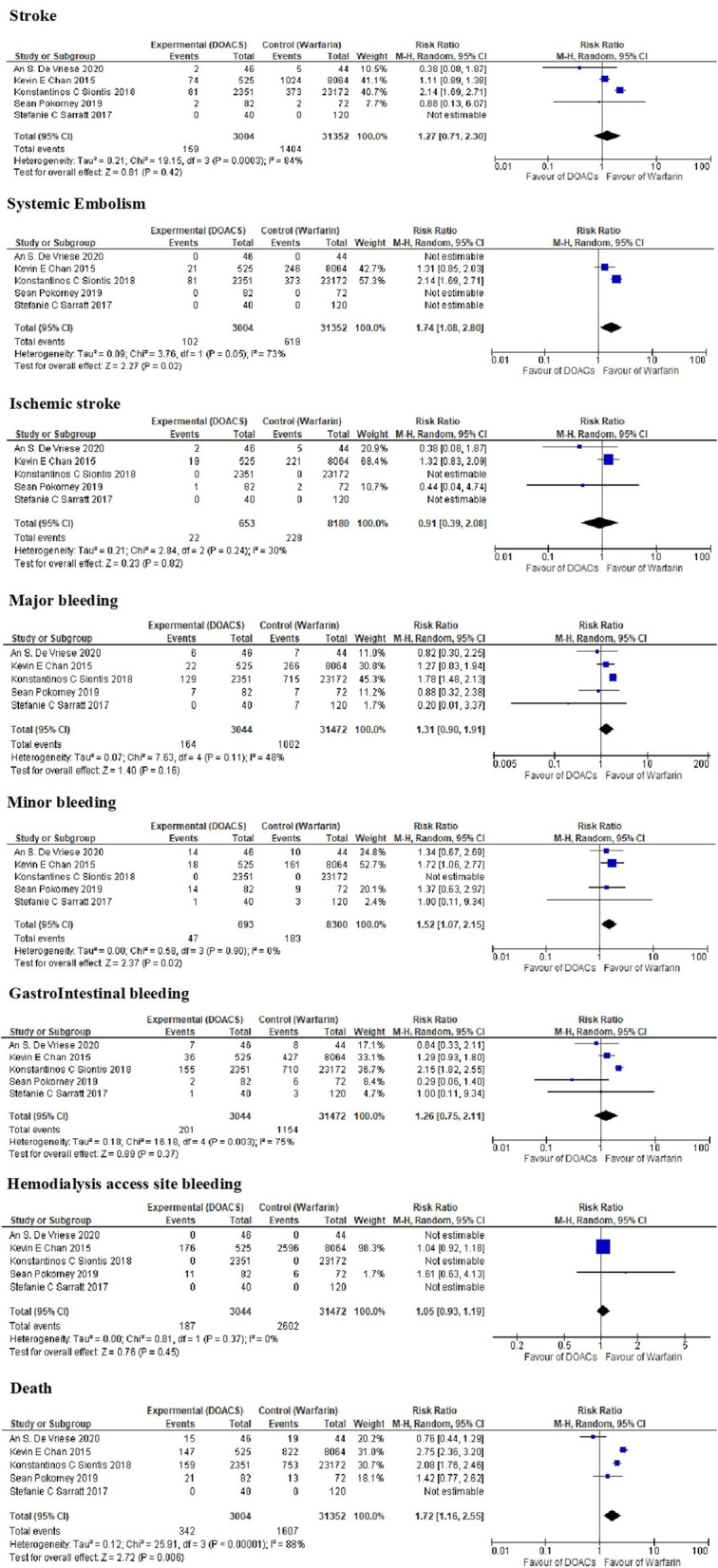
We included five studies with a total of 34,516 patients in our meta-analysis. The outcomes were major bleeding, ischemic stroke, systemic embolization, hemorrhagic stroke, gastrointestinal bleeding, minor bleeding, and death. Of these patients, 31,472 (92.14%) received warfarin and 3,044 patients received DOACs (8.91%). No significant differences in the incidence of hemorrhagic stroke, major bleeding, hemodialysis access site bleeding, ischemic stroke, and GI bleeding were found between DOACs and warfarin. However, there were higher rates of systemic embolization, minor bleeding, and death events in patients who received DOACs than in the warfarin group (3.39% vs. 1.97%, -value = 0.02), (6.78% vs. 2.2%, -value 0.02), and (11.38% vs. 5.12%, -value < 0.006) respectively.
In patients on dialysis who require anticoagulation for AF, warfarin could be associated with a significant reduction in minor bleeding, systemic embolization, and death compared to DOACs. These findings need to be validated by further prospective studies to address the best strategy to deal with the increased thrombotic and bleeding risks in such patients.
对于患有心房颤动(AF)且终末期肾病(ESRD)需要血液透析的患者,使用直接口服抗凝剂(DOACs)仍存在争议,华法林仍是主要治疗药物。由于大多数临床DOACs试验都排除了血液透析患者,因此该类患者群体缺乏其疗效和安全性的证据。
回顾当前关于DOACs与华法林相比,在患有AF且ESRD需要血液透析的患者中的安全性和疗效的证据。
我们在荟萃分析中纳入了五项研究,共34516名患者。观察指标包括大出血、缺血性卒中、全身性栓塞、出血性卒中、胃肠道出血、小出血和死亡。在这些患者中,31472名(92.14%)接受了华法林治疗,3044名患者接受了DOACs治疗(8.91%)。DOACs与华法林在出血性卒中、大出血、血液透析通路部位出血、缺血性卒中和胃肠道出血的发生率上没有显著差异。然而,接受DOACs治疗的患者发生全身性栓塞、小出血和死亡事件的发生率高于华法林组,分别为(3.39%对1.97%,P值=0.02),(6.78%对2.2%,P值0.02),以及(11.38%对5.12%,P值<0.006)。
对于因AF需要抗凝治疗的透析患者,与DOACs相比,华法林可能会显著降低小出血、全身性栓塞和死亡的发生率。这些发现需要通过进一步的前瞻性研究来验证,以确定应对此类患者血栓形成和出血风险增加的最佳策略。