Division of Rheumatology, Department of Internal Medicine, School of Medicine, The Catholic University of Korea, Seoul, Republic of Korea.
Department of Biomedical Systems Informatics, Biostatistics Collaboration Unit, Yonsei University College of Medicine, Seoul, Republic of Korea.
Arthritis Res Ther. 2022 Jun 27;24(1):157. doi: 10.1186/s13075-022-02842-6.
Tumor necrosis factor (TNF) inhibitors increase the risk of tuberculosis (TB) in patients with rheumatoid arthritis (RA). This study compared the incidence of TB after treatment with TNF inhibitors and tocilizumab in patients with RA, separately in those who were treated for latent tuberculosis infection (LTBI) and those without evidence of LTBI.
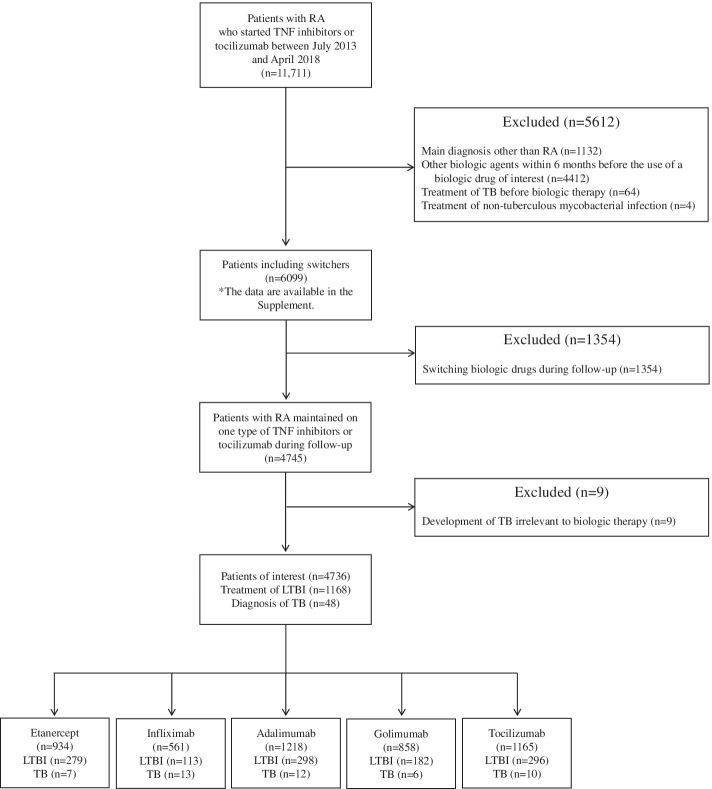
This study included patients with RA who initiated TNF inhibitors and tocilizumab between December 2013 and August 2018. Patient data were collected from the nationwide database of the Health Insurance Review and Assessment service in South Korea. The incidence of TB was compared among different biologic drugs in patients with or without LTBI treatment.
Of 4736 patients, 1168 were treated for LTBI and 48 developed TB (554.9 per 100,000 person-years). When compared based on etanercept, infliximab showed a higher risk of TB (adjusted incidence rate ratio 2.71, 95% confidence interval 1.05-7.01), especially in patients without evidence of LTBI. Other TNF inhibitors and tocilizumab showed a comparable incidence of TB, regardless of treatment for LTBI. There was no significant difference in TB incidence after biologic therapy between patients with and without LTBI treatment (627.9/100,000 vs. 529.5/100,000 person-years). In patients treated for LTBI, no differential risk of TB was observed among biologic drugs.
The incidence of TB was not significantly different among biologic drugs in the current era, except for infliximab in patients who were not treated for LTBI. Treatment of LTBI might alleviate the drug-specific risk of TB in patients with RA.
肿瘤坏死因子(TNF)抑制剂会增加类风湿关节炎(RA)患者发生结核病(TB)的风险。本研究比较了 RA 患者在治疗潜伏性结核感染(LTBI)和未发现 LTBI 时分别接受 TNF 抑制剂和托珠单抗治疗后的 TB 发生率。
本研究纳入了 2013 年 12 月至 2018 年 8 月期间接受 TNF 抑制剂和托珠单抗治疗的 RA 患者。患者数据来自韩国健康保险审查和评估服务的全国性数据库。比较了 LTBI 治疗和未治疗患者中不同生物药物的 TB 发生率。
在 4736 名患者中,有 1168 名患者接受了 LTBI 治疗,48 名患者发生了 TB(554.9/100,000 人年)。与依那西普相比,英夫利昔单抗的 TB 风险更高(调整后的发病率比 2.71,95%置信区间 1.05-7.01),尤其是在未发现 LTBI 的患者中。其他 TNF 抑制剂和托珠单抗的 TB 发生率相当,无论是否接受 LTBI 治疗。LTBI 治疗和未治疗的患者在接受生物治疗后 TB 发生率无显著差异(627.9/100,000 与 529.5/100,000 人年)。在接受 LTBI 治疗的患者中,不同生物药物之间未观察到 TB 风险的差异。
在当前时代,除了未接受 LTBI 治疗的患者外,英夫利昔单抗的 TB 发生率在生物药物之间没有显著差异。LTBI 治疗可能会减轻 RA 患者中药物特异性 TB 风险。