Center for Autism Research, Children's Hospital of Philadelphia, Philadelphia, PA, USA.
Department of Psychology, University of Pennsylvania, Philadelphia, PA, USA.
Mol Autism. 2022 Jun 27;13(1):28. doi: 10.1186/s13229-022-00503-8.
Canonical babbling-producing syllables with a mature consonant, full vowel, and smooth transition-is an important developmental milestone that typically occurs in the first year of life. Some studies indicate delayed or reduced canonical babbling in infants at high familial likelihood for autism spectrum disorder (ASD) or who later receive an ASD diagnosis, but evidence is mixed. More refined characterization of babbling in the first year of life in infants with high likelihood for ASD is needed.
Vocalizations produced at 6 and 12 months by infants (n = 267) taking part in a longitudinal study were coded for canonical and non-canonical syllables. Infants were categorized as low familial likelihood (LL), high familial likelihood diagnosed with ASD at 24 months (HL-ASD) or not diagnosed (HL-Neg). Language delay was assessed based on 24-month expressive and receptive language scores. Canonical babble ratio (CBR) was calculated by dividing the number of canonical syllables by the number of total syllables. Generalized linear (mixed) models were used to assess the relationship between group membership and CBR, controlling for site, sex, and maternal education. Logistic regression was used to assess whether canonical babbling ratios at 6 and 12 months predict 24-month diagnostic outcome.
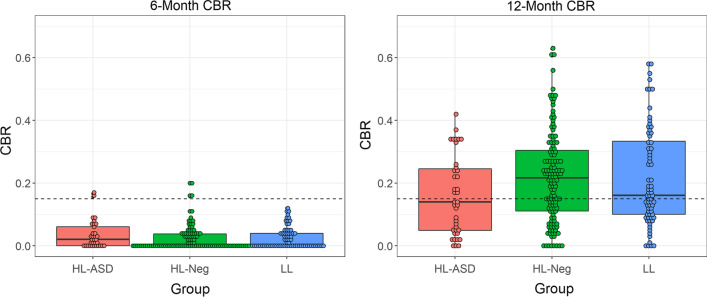
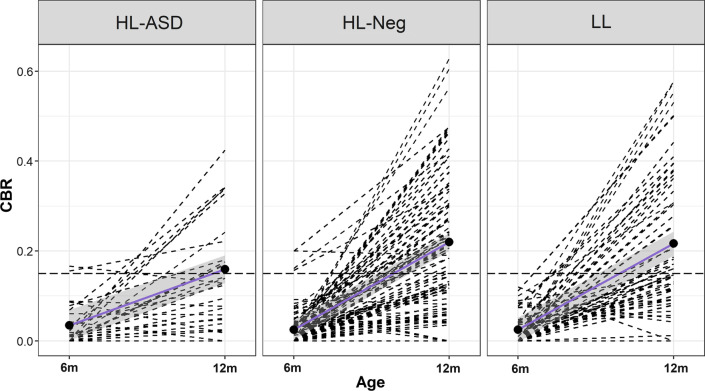
No diagnostic group differences in CBR were detected at 6 months, but HL-ASD infants produced significantly lower CBR than both the HL-Neg and LL groups at 12 months. HL-Neg infants with language delay also showed reduced CBR at 12 months. Neither 6- nor 12-month CBR was significant predictors of 24-month diagnostic outcome (ASD versus no ASD) in logistic regression.
Small numbers of vocalizations produced by infants at 6 months may limit the reliability of CBR estimates. It is not known if results generalize to infants who are not at high familial likelihood, or infants from more diverse racial and socioeconomic backgrounds.
Lower canonical babbling ratios are apparent by the end of the first year of life in ASD regardless of later language delay, but are also observed for infants with later language delay without ASD. Canonical babbling may lack specificity as an early marker when used on its own.
具有成熟辅音、完全元音和流畅过渡的规范咿呀学语是生命第一年的一个重要发育里程碑。一些研究表明,在高家族自闭症谱系障碍(ASD)可能性或后来被诊断为 ASD 的婴儿中,规范的咿呀学语出现延迟或减少,但证据不一。需要更精细地描述高 ASD 可能性婴儿在生命第一年的咿呀学语。
参加纵向研究的 6 个月和 12 个月大的婴儿(n=267)的发声被编码为规范和非规范音节。婴儿被分为低家族可能性(LL)、24 个月时被诊断为高家族可能性 ASD(HL-ASD)或未被诊断(HL-Neg)。语言延迟根据 24 个月的表达和接受语言评分来评估。通过将规范音节数除以总音节数来计算规范咿呀学语比(CBR)。使用广义线性(混合)模型评估组间关系和 CBR,控制地点、性别和母亲教育。逻辑回归用于评估 6 个月和 12 个月的规范咿呀学语比是否预测 24 个月的诊断结果。
在 6 个月时,各组间的 CBR 无差异,但 HL-ASD 婴儿在 12 个月时的 CBR 明显低于 HL-Neg 和 LL 组。有语言延迟的 HL-Neg 婴儿在 12 个月时也表现出较低的 CBR。在逻辑回归中,6 个月和 12 个月的 CBR 均不是 24 个月诊断结果(ASD 与非 ASD)的显著预测因素。
6 个月时婴儿发出的声音数量较少,可能会限制 CBR 估计的可靠性。目前尚不清楚结果是否适用于非高家族可能性的婴儿,或来自种族和社会经济背景更加多样化的婴儿。
无论后来是否有语言延迟,在 ASD 中,在生命的第一年结束时,规范的咿呀学语比率都较低,但在没有 ASD 的后来有语言延迟的婴儿中也观察到这种情况。单独使用时,规范的咿呀学语可能缺乏特异性,无法作为早期标志物。