Department of Periodontology, School of Dental Medicine, University of Bern, Bern, Switzerland.
Department of Oral and Maxillofacial Surgery, Copenhagen University Hospital, Copenhagen, Denmark.
Clin Oral Implants Res. 2022 Aug;33(8):844-857. doi: 10.1111/clr.13966. Epub 2022 Jul 11.
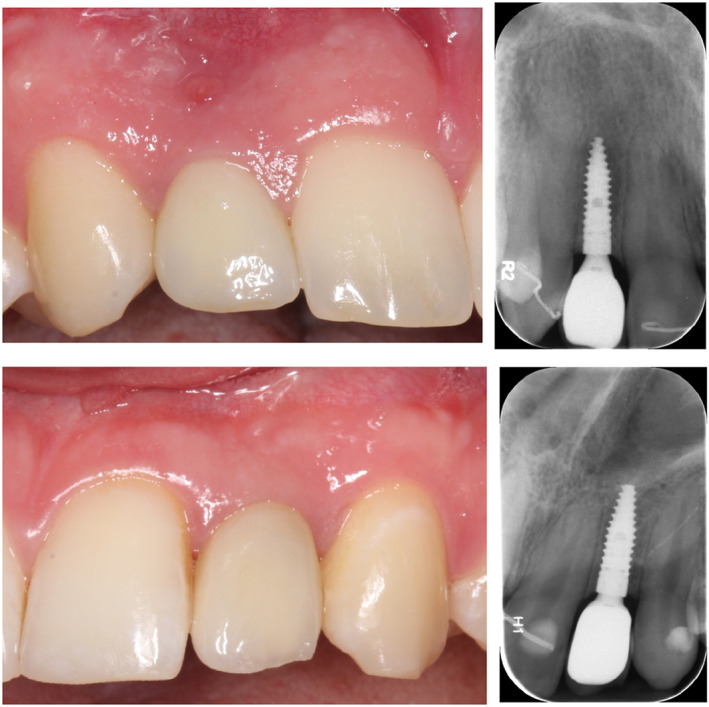
To report the clinical, radiographic, esthetic, and patient-reported outcomes after placement of a newly developed narrow-diameter implant (NDI) in patients with congenitally missing lateral incisors (MLIs).
Patients with MLIs with a mesio-distal distance between the canine and the central incisor of 5.9-6.3 mm received a dental implant with a diameter of 2.9 mm (Test), while a diameter of 3.3 mm (Control) was used when the distance was 6.4-7.1 mm. After healing, a cement-retained bi-layered zirconia crown was fabricated. At the 1-year follow-up (T2), implant survival rate, marginal crestal bone level (CBL) changes, biological and technical complications were registered. The esthetic outcome was assessed by using the Copenhagen index score, and the patient-reported outcomes were recorded using the OHIP-49 questionnaire.
One hundred patients rehabilitated with 100 dental implants Ø0.9 mm (n = 50) or Ø3.3 mm (n = 50) were included. One Ø3.3 mm implant was lost, and seven patients dropped out of the study, yielding an implant survival rate of 99% (p = 1.000). At T2 a. CBL of -0.19 ± 0.25 mm (Test) and -0.25 ± 0.31 mm (Control) was detected, with no statistically significant difference between the groups (p = .342). Good to excellent esthetic scores (i.e., 1-2) were recorded in most of cases. Technical complications (i.e., loss of retention, abutment fracture, and chipping of veneering ceramic) occurred once in three patients with no statistically significant difference between the groups (p > .05). OHIP scores did not differ significantly at follow-ups between groups (p = .110).
The use of Ø2.9 mm diameter implants represents as reliable a treatment option as Ø3.3 mm implants, in terms of CBL changes, biological and technical complications. Favorable esthetics and patient-reported outcomes were recorded for both groups.
报告在先天缺失侧切牙(MLI)患者中植入新型小直径种植体(NDI)后的临床、放射学、美观和患者报告结果。
犬齿和中切牙之间的近远中距离为 5.9-6.3mm 的 MLI 患者接受直径为 2.9mm 的牙科种植体(测试),而距离为 6.4-7.1mm 的患者则使用直径为 3.3mm 的种植体(对照)。愈合后,制作了一个粘结固位的双层氧化锆冠。在 1 年随访(T2)时,记录种植体存活率、边缘嵴骨水平(CBL)变化、生物学和技术并发症。使用哥本哈根指数评分评估美观效果,使用 OHIP-49 问卷记录患者报告结果。
100 名患者接受了 100 个直径 0.9mm(n=50)或 3.3mm(n=50)的牙科种植体修复,其中 1 个 3.3mm 种植体脱落,7 名患者退出研究,种植体存活率为 99%(p=1.000)。在 T2 时,检测到测试组的 CBL 为-0.19±0.25mm,对照组为-0.25±0.31mm,两组间无统计学差异(p=0.342)。大多数病例记录了良好到优秀的美学评分(即 1-2 分)。技术并发症(即固位体丢失、基台折断和饰面陶瓷崩裂)在每组各发生 1 次,两组间无统计学差异(p>0.05)。在随访期间,两组间 OHIP 评分无显著差异(p=0.110)。
在 CBL 变化、生物学和技术并发症方面,使用 2.9mm 直径种植体作为治疗选择与 3.3mm 种植体一样可靠。两组均记录了良好的美观和患者报告结果。