Department of Immunology, Shemyakin-Ovchinnikov Institute of Bioorganic Chemistry, Russian Academy of Sciences, Moscow, Russia.
Dmitriy Rogachev National Medical Research Center of Pediatric Hematology, Oncology, and Immunology, Moscow, Russia.
J Immunother Cancer. 2022 Jun;10(6). doi: 10.1136/jitc-2022-004646.
Both ganglioside GD2-targeted immunotherapy and antibody-drug conjugates (ADCs) have demonstrated clinical success as solid tumor therapies in recent years, yet no research has been carried out to develop anti-GD2 ADCs against solid tumors. This is the first study to analyze cytotoxic activity of clinically relevant anti-GD2 ADCs in a wide panel of cell lines with varying GD2 expression and their effects in mouse models of GD2-positive solid cancer.
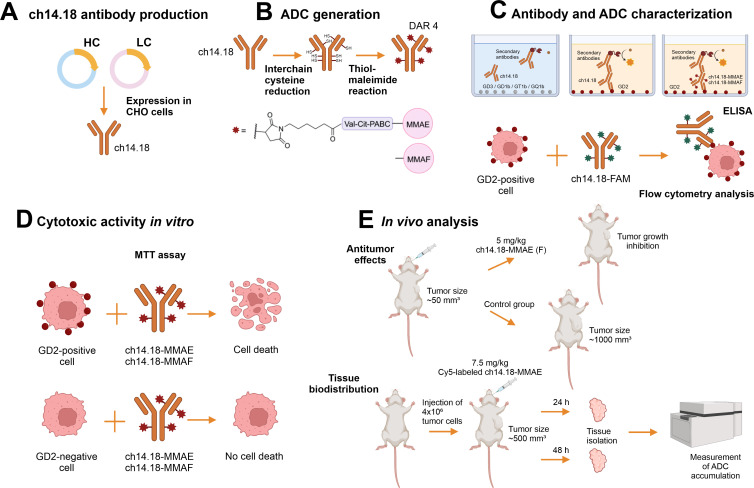
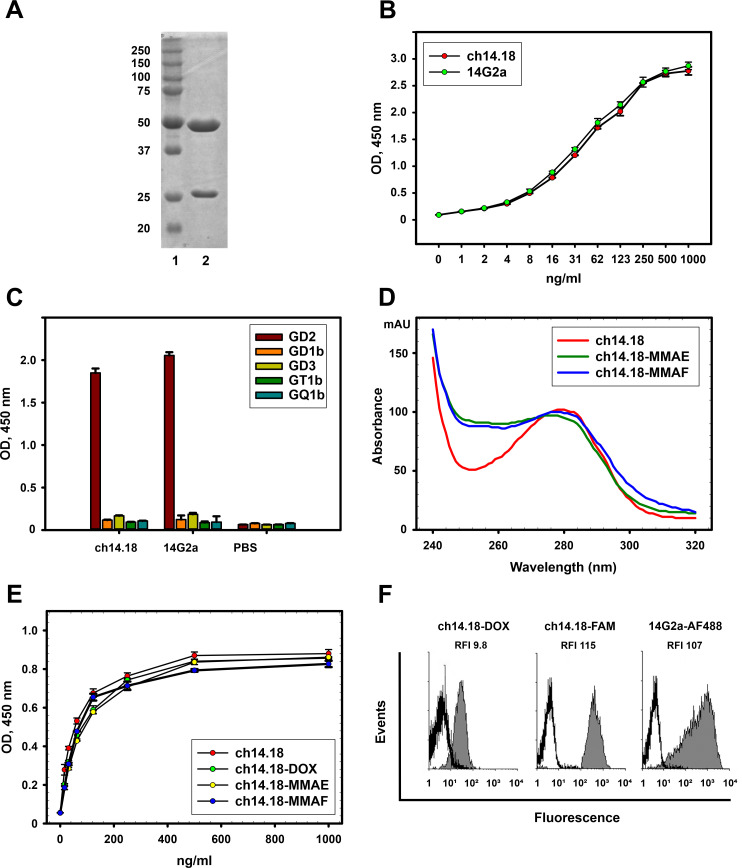
Anti-GD2 ADCs were generated based on the GD2-specific antibody ch14.18 approved for the treatment of neuroblastoma and commonly used drugs monomethyl auristatin E (MMAE) or F (MMAF), conjugated via a cleavable linker by thiol-maleimide chemistry. The antibody was produced in a mammalian expression system, and its specific binding to GD2 was analyzed. Antigen-binding properties and biodistribution of the ADCs in mice were studied in comparison with the parent antibody. Cytotoxic effects of the ADCs were evaluated in a wide panel of GD2-positive and GD2-negative tumor cell lines of neuroblastoma, glioma, sarcoma, melanoma, and breast cancer. Their antitumor effects were studied in the B78-D14 melanoma and EL-4 lymphoma syngeneic mouse models.
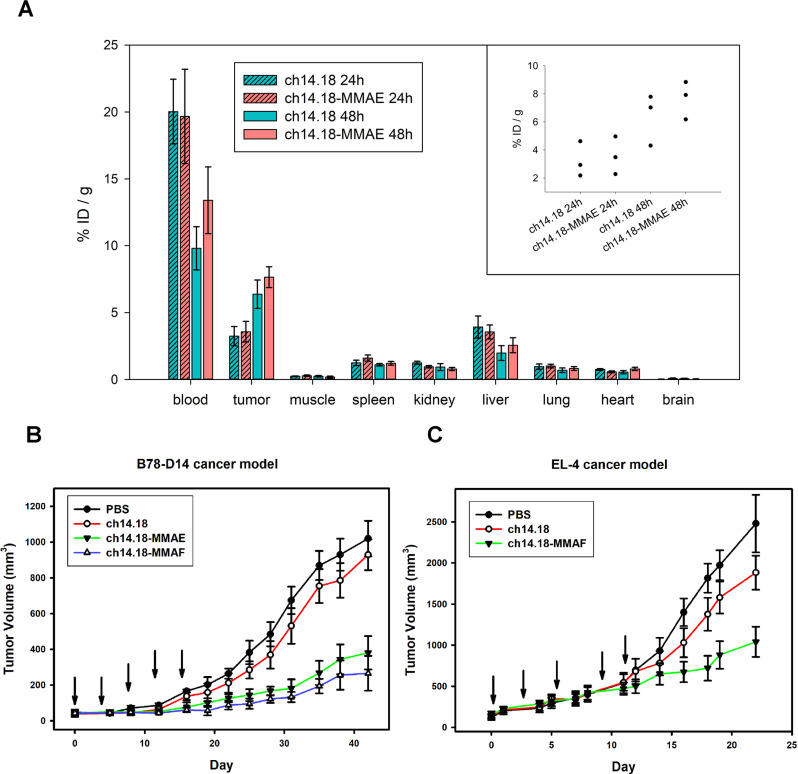
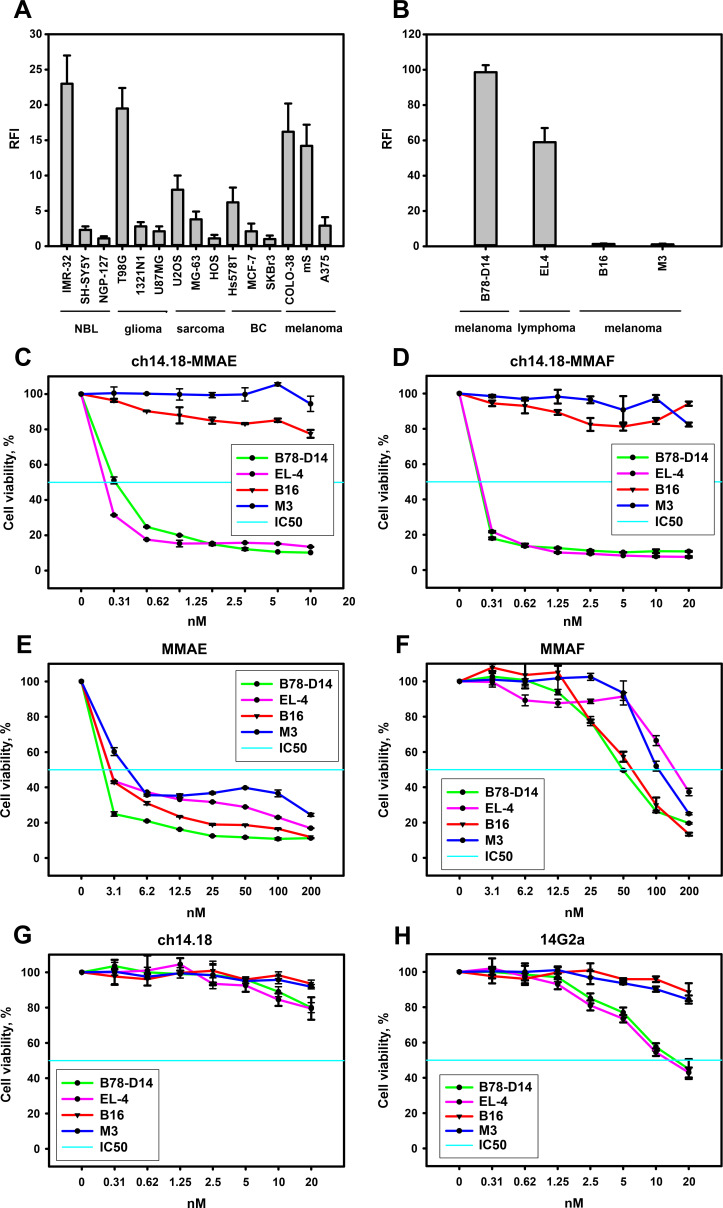
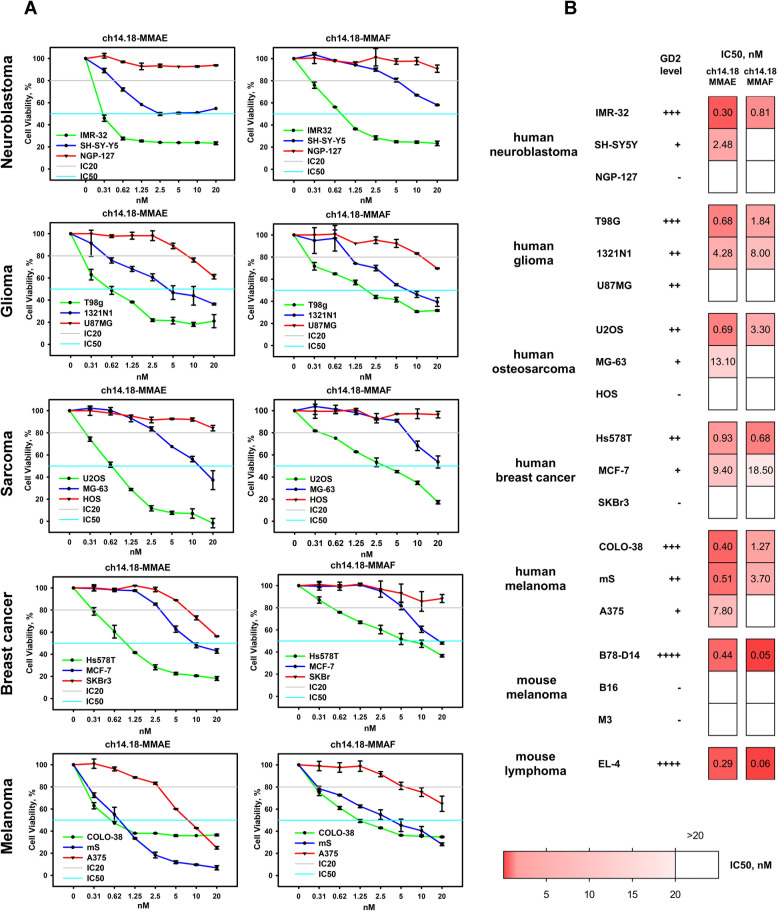
The ch14.18-MMAE and ch14.18-MMAF ADCs retained antigen-binding properties of the parent antibody. Direct dependence of the cytotoxic effect on the level of GD2 expression was observed in cell lines of different origin for both ADCs, with IC50 below 1 nM for the cells with high GD2 expression and no cytotoxic effect for GD2-negative cells. Within the analyzed cell lines, ch14.18-MMAF was more effective in the cells overexpressing GD2, while ch14.18-MMAE had more prominent activity in the cells expressing low GD2 levels. The ADCs had a similar biodistribution profile in the B78-D14 melanoma model compared with the parent antibody, reaching 7.7% ID/g in the tumor at 48 hours postinjection. The average tumor size in groups treated with ch14.18-MMAE or ch14.18-MMAF was 2.6 times and 3.8 times smaller, respectively, compared with the control group. Antitumor effects of the anti-GD2 ADCs were also confirmed in the EL-4 lymphoma model.
These findings validate the potential of ADCs targeting ganglioside GD2 in treating multiple GD2-expressing solid tumors.
近年来,神经节苷脂 GD2 靶向免疫疗法和抗体药物偶联物(ADC)已在实体瘤治疗方面取得了临床成功,但尚未开展针对 GD2 阳性实体瘤的抗 GD2 ADC 研究。本研究首次分析了临床相关抗 GD2 ADC 在具有不同 GD2 表达水平的广泛细胞系中的细胞毒性活性及其在 GD2 阳性实体癌小鼠模型中的作用。
基于获批用于神经母细胞瘤治疗且广泛应用的 GD2 特异性抗体 ch14.18,通过硫醇-马来酰亚胺化学连接物,构建了抗 GD2 ADC,该抗体由单甲基奥瑞他汀 E(MMAE)或 F(MMAF)连接。该抗体通过哺乳动物表达系统产生,并对其与 GD2 的特异性结合进行了分析。与亲本抗体相比,研究了 ADC 在小鼠中的抗原结合特性和体内分布。在包含神经母细胞瘤、神经胶质瘤、肉瘤、黑色素瘤和乳腺癌的 GD2 阳性和 GD2 阴性肿瘤细胞系中评估了 ADC 的细胞毒性作用。在 B78-D14 黑色素瘤和 EL-4 淋巴瘤同基因小鼠模型中研究了它们的抗肿瘤作用。
ch14.18-MMAE 和 ch14.18-MMAF ADC 保留了亲本抗体的抗原结合特性。在两种 ADC 的不同来源的细胞系中均观察到细胞毒性作用与 GD2 表达水平直接相关,对高 GD2 表达的细胞,IC50 低于 1 nM,对 GD2 阴性细胞无细胞毒性作用。在所分析的细胞系中,ch14.18-MMAF 在过度表达 GD2 的细胞中更有效,而 ch14.18-MMAE 在表达低水平 GD2 的细胞中具有更显著的活性。与亲本抗体相比,ADC 在 B78-D14 黑色素瘤模型中的体内分布谱相似,在注射后 48 小时,肿瘤中的摄取量达到 7.7% ID/g。与对照组相比,用 ch14.18-MMAE 或 ch14.18-MMAF 治疗的组的平均肿瘤体积分别缩小了 2.6 倍和 3.8 倍。在 EL-4 淋巴瘤模型中也证实了抗 GD2 ADC 的抗肿瘤作用。
这些发现验证了针对神经节苷脂 GD2 的 ADC 在治疗多种 GD2 表达实体瘤方面的潜力。