CAS Key Laboratory of Behavioral Science, Institute of Psychology, Chinese Academy of Sciences, 16, Lincui Road, 100101, Beijing, China.
Center for Adaptive Rationality, Max Planck Institute for Human Development, Lentzeallee 94, 14195, Berlin, Germany.
Mem Cognit. 2022 Aug;50(6):1284-1298. doi: 10.3758/s13421-022-01331-0. Epub 2022 Jun 29.
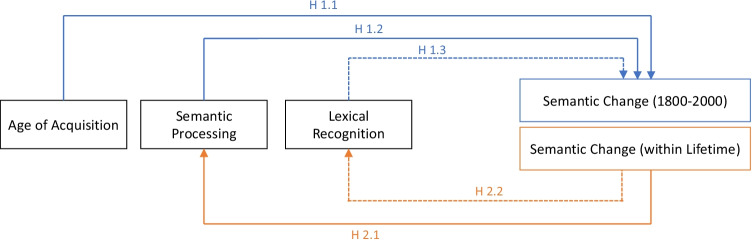
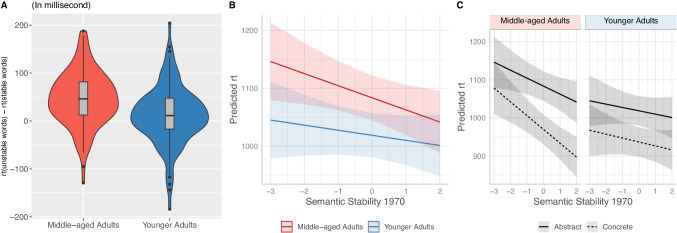
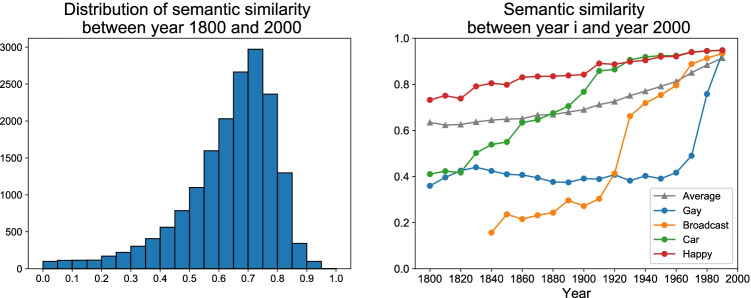
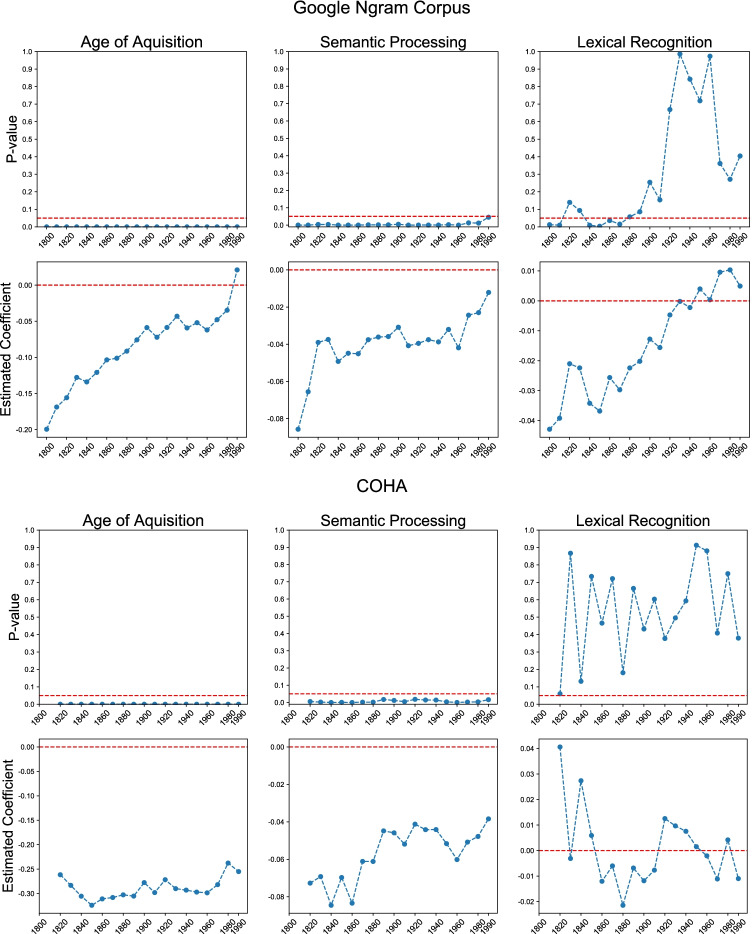
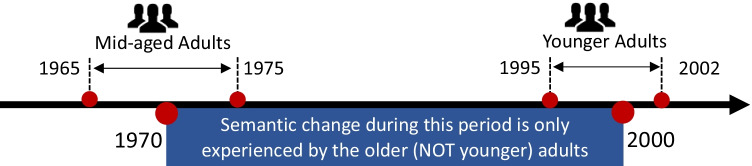
While it has long been understood that the human mind evolved to learn language, recent studies have begun to ask the inverted question: How has language evolved under the cognitive constraints of its users and become more learnable over time? In this paper, we explored how the semantic change of English words is shaped by the way humans acquire and process language. In Study 1, we quantified the extent of semantic change over the past 200 years and found that meaning change is more likely for words that are acquired later in life and are more difficult to process. We argue that it is human cognition that constrains the semantic evolution of words, rather than the other way around, because historical meanings of words were not easily accessible to people living today, and therefore could not have directly influenced how they learn and process language. In Study 2, we went further to show that semantic change, while bringing the benefit of meeting communicative needs, is cognitively costly for those who were born early enough to experience the change: Semantic change between 1970 and 2000 hindered processing speeds among middle-aged adults (ages 45-55) but not in younger adults (ages <25) in a semantic decision task. This hampering effect may have, in turn, curbed the rate of semantic change so that language does not change too fast for the human mind to catch up. Taken together, our research demonstrates that semantic change is shaped by processing and acquisition patterns across generations of language users.
虽然人们早就知道人类的大脑是为了学习语言而进化的,但最近的研究开始提出一个相反的问题:在用户认知的限制下,语言是如何进化的,并且随着时间的推移变得更易学习?在本文中,我们探讨了英语单词的语义变化是如何受到人类获取和处理语言方式的影响的。在研究 1 中,我们量化了过去 200 年来语义变化的程度,发现对于那些在生命后期习得且更难处理的单词,其意义变化的可能性更大。我们认为,是人类认知限制了单词的语义演变,而不是相反,因为生活在当今的人们无法轻易获得单词的历史意义,因此这些历史意义不可能直接影响他们学习和处理语言的方式。在研究 2 中,我们更进一步地表明,语义变化虽然满足了交际需求的好处,但对于那些出生足够早以至于经历了这种变化的人来说,认知成本是高昂的:在语义决策任务中,1970 年至 2000 年之间的语义变化会阻碍中年成年人(45-55 岁)的处理速度,但不会阻碍年轻成年人(<25 岁)的处理速度。这种阻碍效应可能反过来又抑制了语义变化的速度,以使语言的变化不会快到人类大脑无法跟上的程度。总的来说,我们的研究表明,语义变化是由几代语言使用者的处理和习得模式塑造的。