GROW School for Oncology and Developmental Biology, Maastricht University, Maastricht, the Netherlands.
Department of Clinical Epidemiology and Medical Technology Assessment, Maastricht University Medical Centre, the Netherlands.
JAMA Netw Open. 2022 Jun 1;5(6):e2219372. doi: 10.1001/jamanetworkopen.2022.19372.
There has been a growing interest in the use of electronic noses (e-noses) in detecting volatile organic compounds in exhaled breath for the diagnosis of cancer. However, no systematic evaluation has been performed of the overall diagnostic accuracy and methodologic challenges of using e-noses for cancer detection in exhaled breath.
To provide an overview of the diagnostic accuracy and methodologic challenges of using e-noses for the detection of cancer.
An electronic search was performed in the PubMed and Embase databases (January 1, 2000, to July 1, 2021).
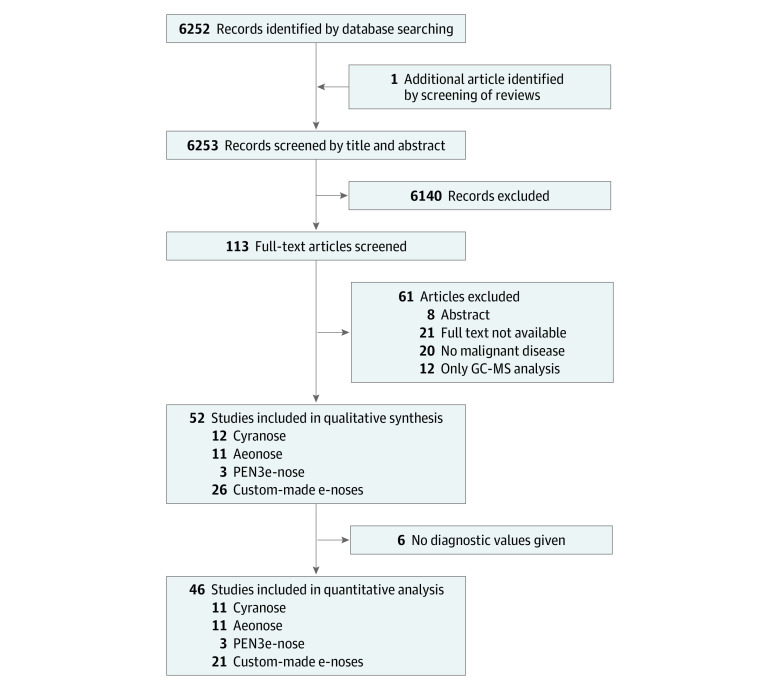
Inclusion criteria were the following: (1) use of e-nose technology, (2) detection of cancer, and (3) analysis of exhaled breath. Exclusion criteria were (1) studies published before 2000; (2) studies not performed in humans; (3) studies not performed in adults; (4) studies that only analyzed biofluids; and (5) studies that exclusively used gas chromatography-mass spectrometry to analyze exhaled breath samples.
PRISMA guidelines were used for the identification, screening, eligibility, and selection process. Quality assessment was performed using Quality Assessment of Diagnostic Accuracy Studies 2. Generalized mixed-effects bivariate meta-analysis was performed.
Main outcomes were sensitivity, specificity, and mean area under the receiver operating characteristic curve.
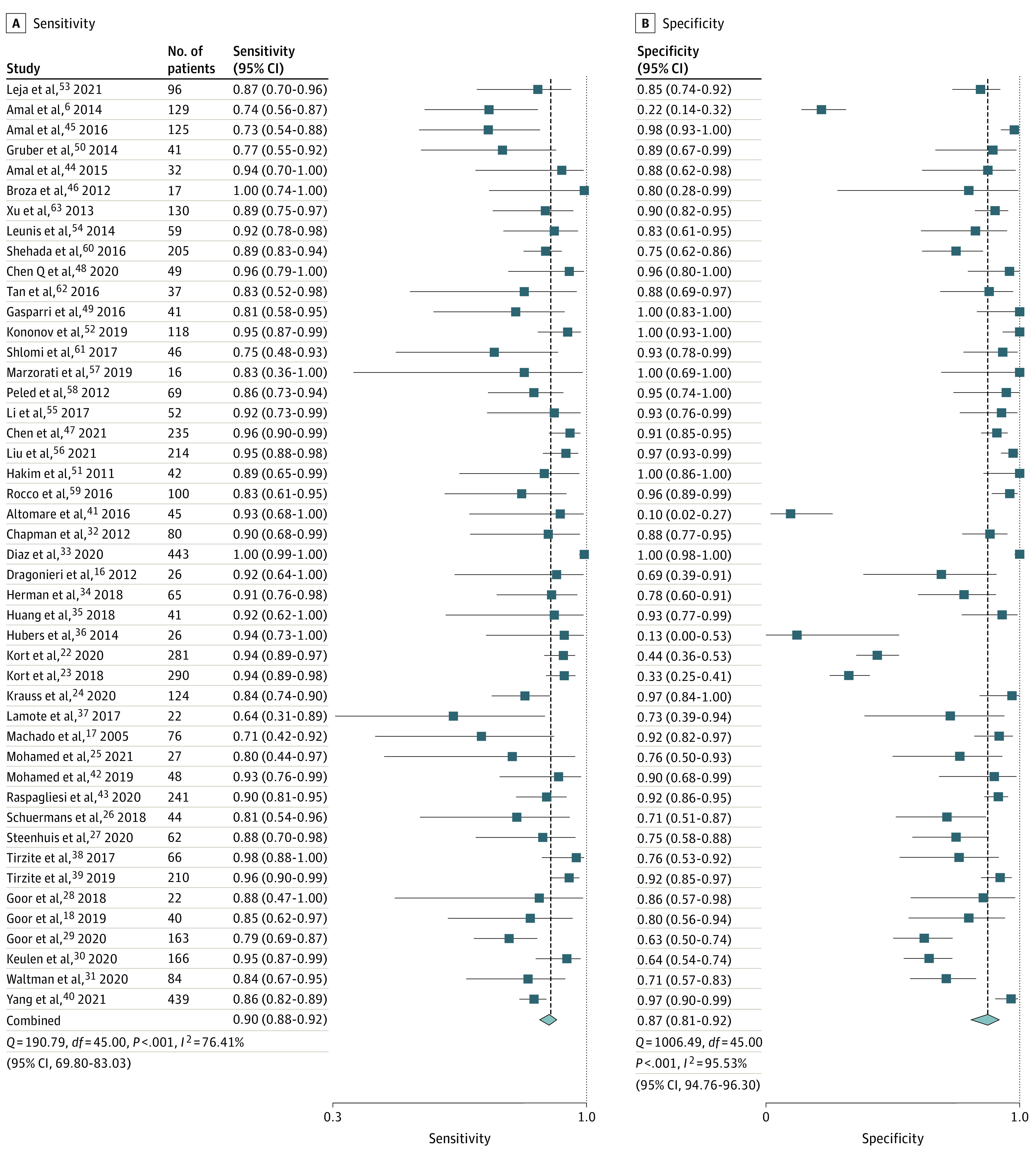
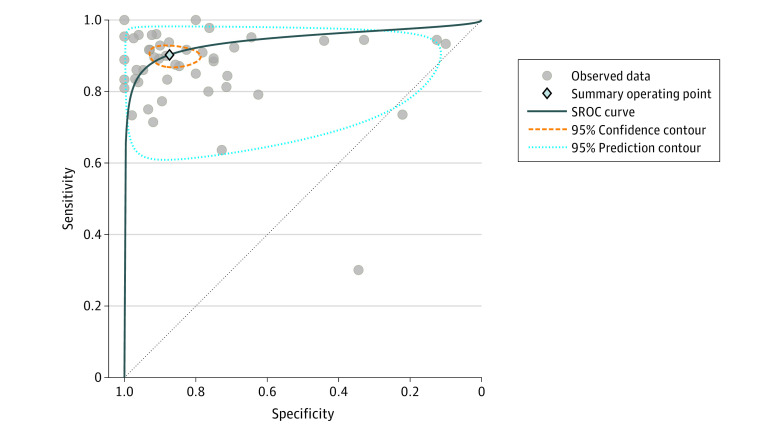
This review identified 52 articles with a total of 3677 patients with cancer. All studies were feasibility studies. The sensitivity of e-noses ranged from 48.3% to 95.8% and the specificity from 10.0% to 100.0%. Pooled analysis resulted in a mean (SE) area under the receiver operating characteristic curve of 94% (95% CI, 92%-96%), a sensitivity of 90% (95% CI, 88%-92%), and a specificity of 87% (95% CI, 81%-92%). Considerable heterogeneity existed among the studies because of differences in the selection of patients, endogenous and exogenous factors, and collection of exhaled breath.
Results of this review indicate that e-noses have a high diagnostic accuracy for the detection of cancer in exhaled breath. However, most studies were feasibility studies with small sample sizes, a lack of standardization, and a high risk of bias. The lack of standardization and reproducibility of e-nose research should be addressed in future research.
人们对电子鼻(e-nose)在检测呼气中挥发性有机化合物以诊断癌症方面的应用越来越感兴趣。然而,目前还没有对使用电子鼻检测呼气中挥发性有机化合物以诊断癌症的整体诊断准确性和方法学挑战进行系统评价。
提供使用电子鼻检测呼气中挥发性有机化合物以诊断癌症的诊断准确性和方法学挑战概述。
对 PubMed 和 Embase 数据库进行了电子检索(2000 年 1 月 1 日至 2021 年 7 月 1 日)。
纳入标准如下:(1)使用电子鼻技术,(2)检测癌症,(3)分析呼气。排除标准为:(1)发表于 2000 年以前的研究;(2)非人体研究;(3)非成人研究;(4)仅分析生物流体的研究;(5)仅使用气相色谱-质谱联用技术分析呼气样本的研究。
使用 PRISMA 指南进行识别、筛选、合格性和选择过程。使用诊断准确性研究的质量评估 2 进行质量评估。进行广义混合效应双变量荟萃分析。
主要结果是敏感性、特异性和受试者工作特征曲线下的平均面积。
本综述共识别出 52 篇文章,共计 3677 例癌症患者。所有研究均为可行性研究。电子鼻的敏感性范围为 48.3%至 95.8%,特异性范围为 10.0%至 100.0%。汇总分析得出,受试者工作特征曲线下的平均(SE)面积为 94%(95%CI,92%-96%),敏感性为 90%(95%CI,88%-92%),特异性为 87%(95%CI,81%-92%)。由于患者选择、内源性和外源性因素以及呼气采集的差异,研究之间存在明显的异质性。
本综述结果表明,电子鼻对呼气中癌症的检测具有较高的诊断准确性。然而,大多数研究为样本量较小、缺乏标准化且偏倚风险较高的可行性研究。未来的研究应解决电子鼻研究中缺乏标准化和可重复性的问题。