Yao Guohua, Muhammad Muhammad, Zhao Jiajiang, Liu Jianguo, Huang Qing
CAS Key Laboratory of High Magnetic Field and Ion Beam Physical Biology, Hefei Institute of Intelligent Agricuture, Institute of Intelligent Machines, Hefei Institutes of Physical Science, Chinese Academy of Sciences, Hefei 230031, China.
Key Laboratory of Resource Chemistry of Ministry of Education, Shanghai Key Laboratory of Rare Earth Functional Materials, Department of Chemistry, Shanghai Normal University, Shanghai 200234, China.
Food Chem (Oxf). 2022 Mar 14;4:100103. doi: 10.1016/j.fochms.2022.100103. eCollection 2022 Jul 30.
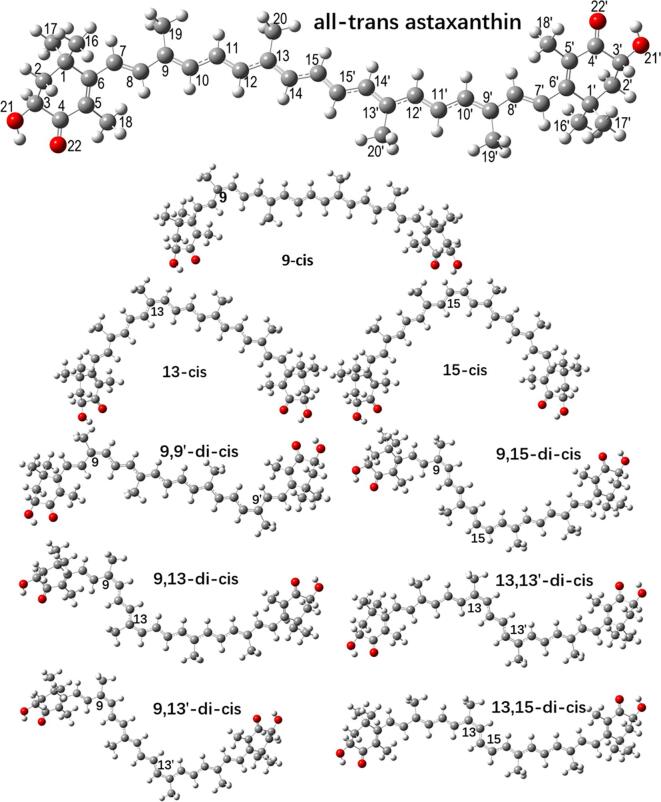
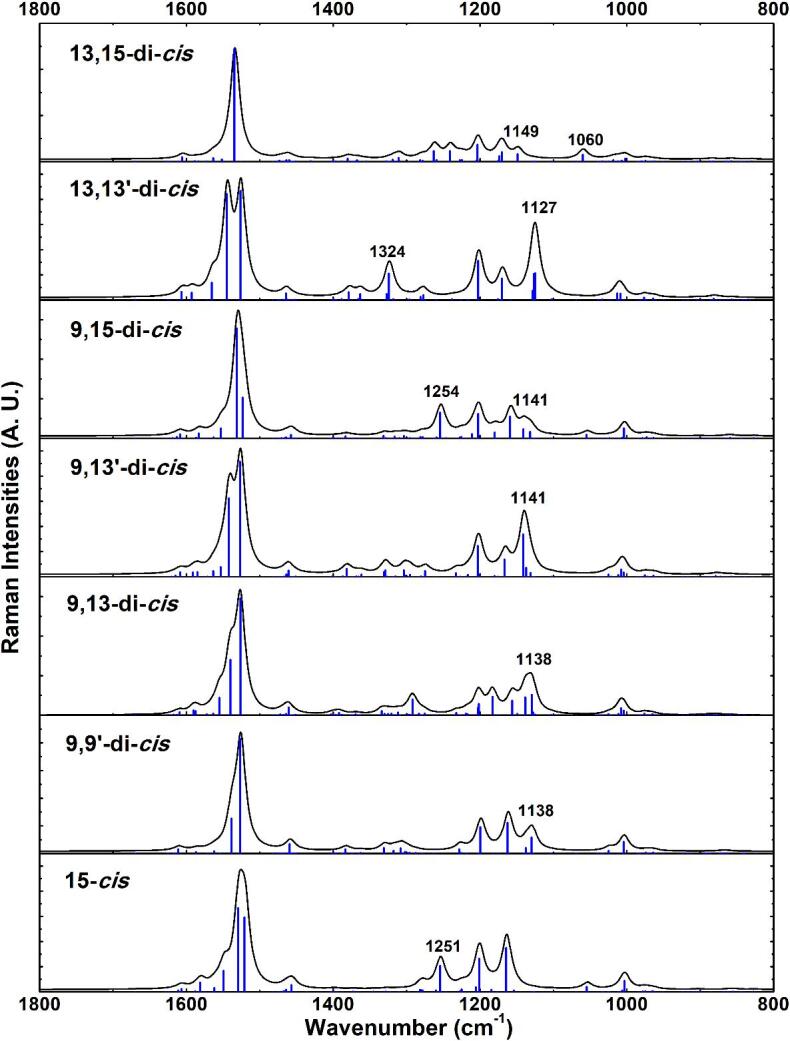
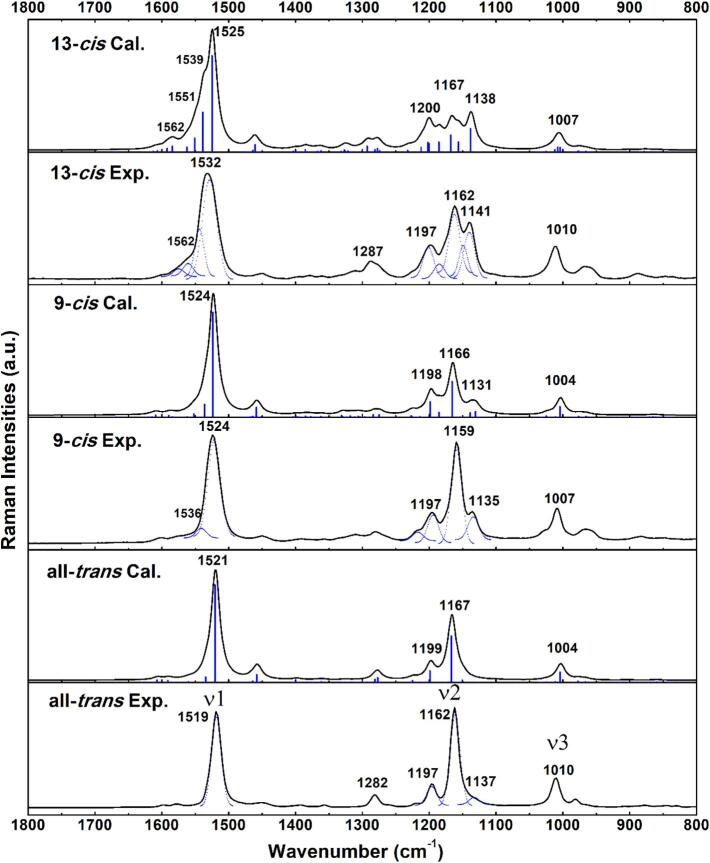
Astaxanthin is a carotenoid widely used in food additives, nutritional product and medicines, which shows many physiological functions such as antioxidant, anti-inflammatory, anti-hypertensive and anti-diabetic activities. It has been recognized that astaxanthin has all- and nine isomers, and these geometrical isomers have very different biological activities. The process of selective enrichment, metabolism and isomerization of astaxanthin in animals remains to be studied. Therefore, identifying isomers and obtaining their structural parameters are important for understanding the active mechanism of different molecular isomers. Although the traditional methods such as high-performance liquid chromatography (HPLC) and nuclear magnetic resonance (NMR) spectroscopy can be used to distinguish these isomers, these methods generally require considerable testing time, cost, sample volume, and hardly be applied in vivo. In this work, Raman spectroscopy combined with density functional theory (DFT) calculation was introduced to study different geometrical isomers of astaxanthin. The theoretical and experimental Raman spectra are in agreement, and we have demonstrated that all the known ten geometrical isomers of astaxanthin can be readily distinguished using this spectroscopic approach. The astaxanthin molecular vibrational modes, geometric structures, energies of ten geometric isomers are systematically scrutinized. Moreover, a lot of structural and Raman problems unsolved previously have been solved by the DFT-based spectral analysis. Therefore, this work provides an effective way for identification of different astaxanthin geometrical isomers, and may have important significance for promoting the research of astaxanthin isomers on biological property mechanisms and related applications in food molecular science.
虾青素是一种广泛应用于食品添加剂、营养产品和药物中的类胡萝卜素,具有抗氧化、抗炎、抗高血压和抗糖尿病等多种生理功能。人们已经认识到虾青素存在全反式和九种异构体,这些几何异构体具有非常不同的生物活性。虾青素在动物体内的选择性富集、代谢和异构化过程仍有待研究。因此,鉴定异构体并获得其结构参数对于理解不同分子异构体的活性机制非常重要。虽然传统方法如高效液相色谱(HPLC)和核磁共振(NMR)光谱可用于区分这些异构体,但这些方法通常需要相当长的测试时间、成本和样品量,并且很难应用于体内。在这项工作中,引入了拉曼光谱结合密度泛函理论(DFT)计算来研究虾青素的不同几何异构体。理论拉曼光谱和实验拉曼光谱一致,并且我们已经证明使用这种光谱方法可以很容易地区分虾青素所有已知的十种几何异构体。对虾青素分子的振动模式、十种几何异构体的几何结构和能量进行了系统研究。此外,通过基于DFT的光谱分析解决了许多以前未解决的结构和拉曼问题。因此,这项工作为鉴定不同的虾青素几何异构体提供了一种有效方法,可能对推动虾青素异构体在生物学性质机制及食品分子科学相关应用方面的研究具有重要意义。