Ha Hea-Seon, Hong Jung-Ja, Kim In-Ok, Lee Sae-Rom, Lee Ah-Young, Ha Tae-Yong, Song Gi-Won, Jung Dong-Hwan, Park Gil-Chun, Ahn Chul-Soo, Moon Deok-Bog, Kim Ki-Hun, Lee Sung-Gyu, Hwang Shin
Organ Transplantation Center, Asan Medical Center, Seoul, Korea.
Department of Surgery, Asan Medical Center, University of Ulsan College of Medicine, Seoul, Korea.
Korean J Transplant. 2019 Dec 31;33(4):112-117. doi: 10.4285/jkstn.2019.33.4.112.
The Korean model for end-stage liver disease (MELD) score-based liver allocation system was started in June 2016 in Korea.
This study analyzed the detailed allocation results of deceased donor liver transplantation (DDLT) during the first 2 years after the MELD score-based liver allocation system implementation at a high-volume liver transplantation (LT) center in Korea.
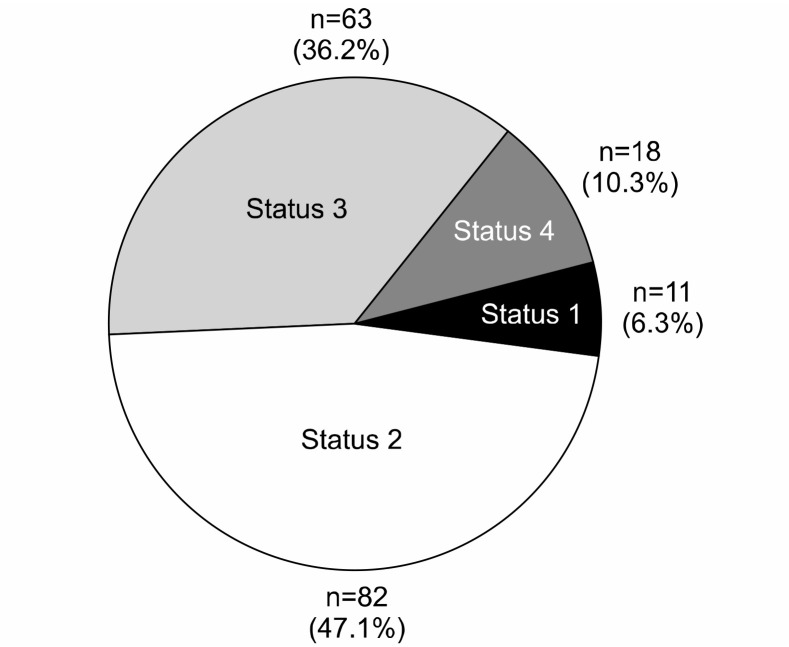
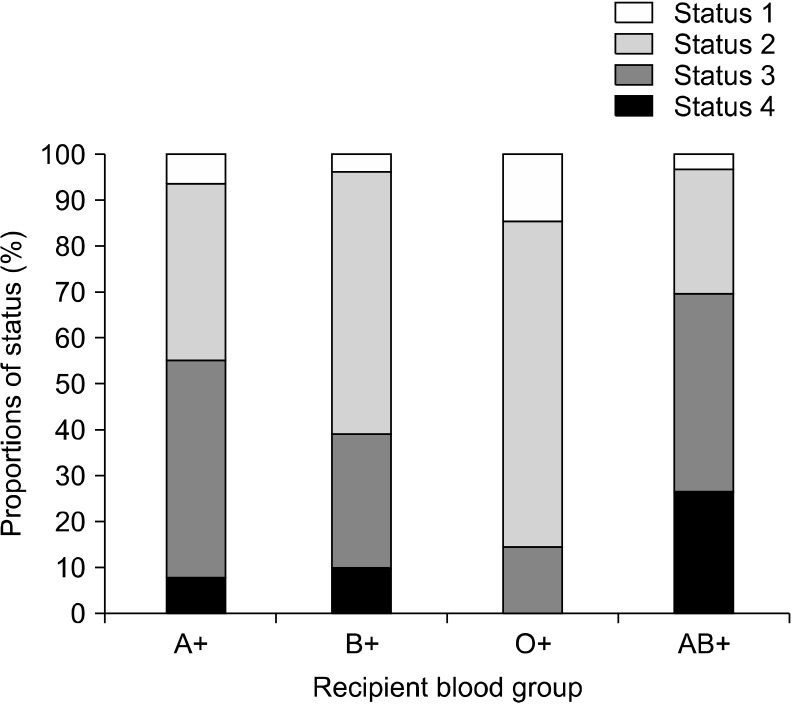
This study included 174 patients with age above 12 years. The patient ABO blood groups were A (n=65, 37.4%), B (n=51, 29.3%), O (n=28, 16.1%), and AB (n=30, 17.2%). The LT types were primary LT in 141 patients (81.0%) and retransplantation in 33 (19.0%). The Korean Network for Organ Sharing status categories at LT were as follows: status 1 (n=11, 6.3%), status 2 (n=82, 47.1%), status 3 (n=63, 36.2%), and status 4 (n=18, 10.3%). The mean MELD score at LT and waiting period were 36.6±4.6 and 62.1±98.2 days in blood group A; 37.6±3.6 and 25.7±38.1 days in blood group B; 38.8±2.7 and 26.0±30.5 days in blood group O; and 34.8±5.5 and 68.4±110.5 days in blood group AB (P<0.001 and P=0.012), respectively. Patients with blood group O and AB had the highest and lowest mean MELD scores at LT allocation, respectively.
Serious deceased organ donor shortage resulted in very high MELD score cutoffs for DDLT allocation. Additionally, a significant inequality was observed in the possibility for DDLT according to blood group compatibility. Nationwide follow-up studies are necessary to precisely determine the allocation status of DDLT.
基于韩国终末期肝病模型(MELD)评分的肝脏分配系统于2016年6月在韩国启动。
本研究分析了韩国一家大型肝脏移植(LT)中心在基于MELD评分的肝脏分配系统实施后的头2年期间尸体供肝移植(DDLT)的详细分配结果。
本研究纳入了174例年龄在12岁以上的患者。患者的ABO血型为A型(n = 65,37.4%)、B型(n = 51,29.3%)、O型(n = 28,16.1%)和AB型(n = 30,17.2%)。LT类型为初次LT 141例(81.0%),再次移植33例(19.0%)。LT时韩国器官共享网络状态分类如下:1类(n = 11,6.3%)、2类(n = 82,47.1%)、3类(n = 63,36.2%)和4类(n = 18,10.3%)。A型血患者LT时的平均MELD评分和等待期分别为36.6±4.6和62.1±98.2天;B型血患者为37.6±3.6和25.7±38.1天;O型血患者为38.8±2.7和26.0±30.5天;AB型血患者为34.8±5.5和68.4±110.5天(P<0.001和P = 0.012)。O型血和AB型血患者在LT分配时的平均MELD评分分别最高和最低。
严重的尸体器官供体短缺导致DDLT分配的MELD评分临界值非常高。此外,根据血型相容性观察到DDLT可能性存在显著不平等。有必要进行全国性的随访研究以精确确定DDLT的分配状况。