Department of General Practice, RCSI University of Medicine and Health Sciences, Dublin, Ireland
Health Technology Assessment, Health Information and Quality Authority, Dublin, Ireland.
BMJ Evid Based Med. 2023 Feb;28(1):48-57. doi: 10.1136/bmjebm-2021-111905. Epub 2022 Jun 30.
To describe perceptions of providing, and using rapid evidence, to support decision making by two national bodies (one public health policy and one front-line clinical practice) during the COVID-19 pandemic.
Descriptive qualitative study (March-August 2020): 25 semistructured interviews were conducted, transcribed verbatim and thematically analysed.
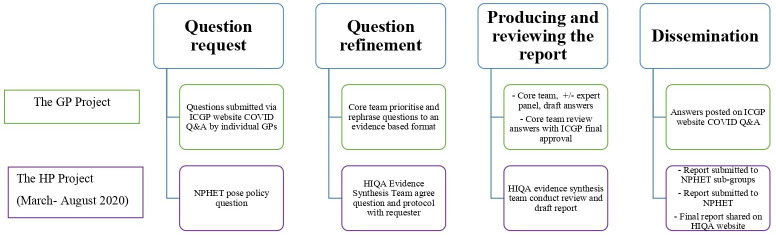
Data were obtained as part of an evaluation of two Irish national projects; the Irish COVID-19 Evidence for General Practitioners project (General Practice (GP) project) which provided relevant evidence to address clinical questions posed by GPs; and the COVID-19 Evidence Synthesis Team (Health Policy project) which produced rapid evidence products at the request of the National Public Health Emergency Team.
Purposive sample of 14 evidence providers (EPs: generated and disseminated rapid evidence) and 11 service ssers (SUs: GPs and policy-makers, who used the evidence).
Participant perceptions.
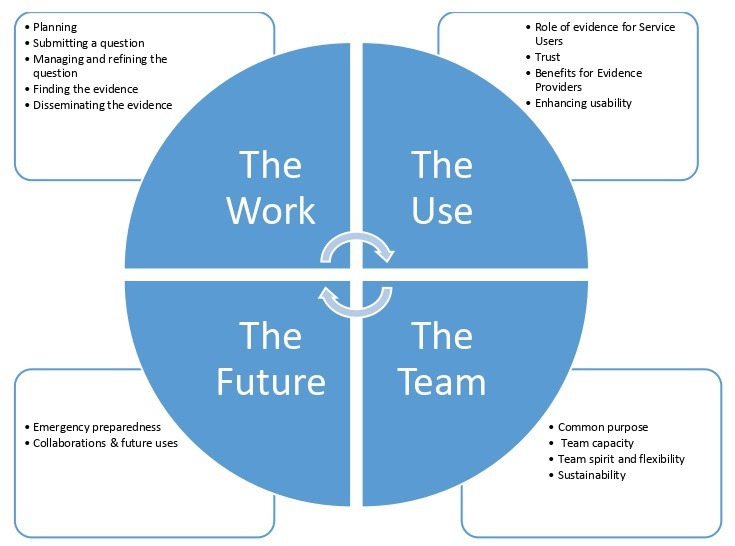
The Policy Project comprised 27 EPs, producing 30 reports across 1432 person-work-days. The GP project comprised 10 members from 3 organisations, meeting 49 times and posting evidence-based answers to 126 questions. Four unique themes were generated. 'The Work' highlighted that a structured but flexible organisational approach to producing evidence was essential. Ensuring quality of evidence products was challenging, particularly in the context of absent or poor-quality evidence. 'The Use' highlighted that rapid evidence products were considered invaluable to decision making. Trust and credibility of EPs were key, however, communication difficulties were highlighted by SUs (eg, website functionality). 'The Team' emphasised that a highly skilled team, working collaboratively, is essential to meeting the substantial workload demands and tight turnaround time. 'The Future' highlighted that investing in resources, planning and embedding evidence synthesis support, is crucial to national emergency preparedness.
Rapid evidence products were considered invaluable to decision making. The credibility of EPs, a close relationship with SUs and having a highly skilled and adaptable team to meet the workload demands were identified as key strengths that optimised the utilisation of rapid evidence.
Ethical approval was obtained from the National Research Ethics Committee for COVID-19-related Research, Ireland.
描述在 COVID-19 大流行期间,两个国家机构(一个公共卫生政策机构和一个一线临床实践机构)提供和使用快速证据以支持决策的看法。
描述性定性研究(2020 年 3 月至 8 月):进行了 25 次半结构化访谈,逐字记录并进行主题分析。
数据是作为对两个爱尔兰国家项目进行评估的一部分获得的;爱尔兰 COVID-19 证据为全科医生项目(全科医生项目)为解决全科医生提出的临床问题提供了相关证据;以及 COVID-19 证据综合小组(卫生政策项目)应国家公共卫生应急小组的要求制作快速证据产品。
有目的的 14 名证据提供者(EP:生成和传播快速证据)和 11 名服务使用者(SU:全科医生和政策制定者,他们使用证据)的样本。
参与者的看法。
政策项目由 27 名 EP 组成,在 1432 人/工作日内制作了 30 份报告。全科医生项目由来自 3 个组织的 10 名成员组成,共举行了 49 次会议,并发布了 126 个问题的循证答案。生成了四个独特的主题。“工作”突出了一种结构化但灵活的组织方法对于制作证据至关重要。确保证据产品的质量具有挑战性,尤其是在缺乏或证据质量差的情况下。“使用”突出表明,快速证据产品对决策非常有价值。EP 的信任和信誉是关键,但 SU 强调了沟通困难(例如,网站功能)。“团队”强调,一个高技能的团队,协作工作,对于满足大量的工作负载需求和紧张的周转时间至关重要。“未来”强调,投资资源、规划和嵌入证据综合支持对于国家应急准备至关重要。
快速证据产品被认为对决策非常有价值。EP 的信誉、与 SU 的密切关系以及拥有一支高技能和适应性强的团队来满足工作负载需求被确定为优化快速证据利用的关键优势。
爱尔兰 COVID-19 相关研究国家伦理委员会获得了 COVID-19 相关研究的伦理批准。