Department of Radiology, University of Pennsylvania, Philadelphia, Pennsylvania
Department of Radiology, University of Pennsylvania, Philadelphia, Pennsylvania.
J Nucl Med. 2023 Jan;64(1):131-136. doi: 10.2967/jnumed.122.264152. Epub 2022 Jun 30.
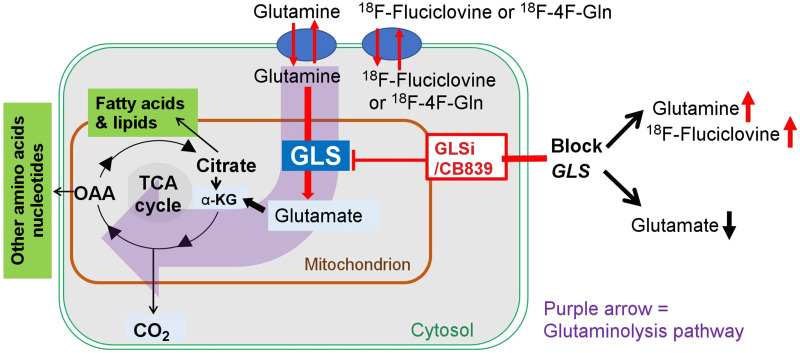
Aggressive cancers such as triple-negative breast cancer (TNBC) avidly metabolize glutamine as a feature of their malignant phenotype. The conversion of glutamine to glutamate by the glutaminase enzyme represents the first and rate-limiting step of this pathway and a target for drug development. Indeed, a novel glutaminase inhibitor (GLSi) has been developed and tested in clinical trials but with limited success, suggesting the potential for a biomarker to select patients who could benefit from this novel therapy. Here, we studied a nonmetabolized amino acid analog, F-fluciclovine, as a PET imaging biomarker for detecting the pharmacodynamic response to GLSi. Uptake of F-fluciclovine into human breast cancer cells was studied in the presence and absence of inhibitors of glutamine transporters and GLSi. To allow F-fluciclovine PET to be performed on mice, citrate in the tracer formulation is replaced by phosphate-buffered saline. Mice bearing triple-negative breast cancer (TNBC) xenografts (HCC38, HCC1806, and MBA-MD-231) and estrogen receptor-positive breast cancer xenografts (MCF-7) were imaged with dynamic PET at baseline and after a 2-d treatment of GLSi (CB839) or vehicle. Kinetic analysis suggested reversible uptake of the tracer, and the distribution volume (V) of F-fluciclovine was estimated by Logan plot analysis. Our data showed that cellular uptake of F-fluciclovine is mediated by glutamine transporters. A significant increase in V was observed after CB839 treatment in TNBC models exhibiting high glutaminase activity (HCC38 and HCC1806) but not in TNBC or MCF-7 exhibiting low glutaminase. Changes in V were corroborated with changes in GLS activity measured in tumors treated with CB839 versus vehicle, as well as with changes in V of F-(2S,R4)-fluoroglutamine, which we previously validated as a measure of cellular glutamine pool size. A moderate, albeit significant, decrease in F-FDG PET signal was observed in HCC1806 tumors after CB839 treatment. F-fluciclovine PET has potential to serve as a clinically translatable pharmacodynamic biomarker of GLSi.
侵袭性癌症,如三阴性乳腺癌(TNBC),作为其恶性表型的特征,会积极代谢谷氨酰胺。谷氨酰胺酶将谷氨酰胺转化为谷氨酸是该途径的第一步和限速步骤,也是药物开发的靶点。事实上,一种新型的谷氨酰胺酶抑制剂(GLSi)已被开发并在临床试验中进行了测试,但收效甚微,这表明可能需要一种生物标志物来选择可能受益于这种新型治疗的患者。在这里,我们研究了一种非代谢性氨基酸类似物 F-氟丁氨酸(F-fluciclovine),作为检测 GLSi 药效反应的 PET 成像生物标志物。我们研究了在存在和不存在谷氨酰胺转运体抑制剂和 GLSi 的情况下,F-氟丁氨酸在人乳腺癌细胞中的摄取情况。为了允许使用 F-氟丁氨酸进行 PET 成像,将示踪剂配方中的柠檬酸替换为磷酸盐缓冲盐水。携带三阴性乳腺癌(TNBC)异种移植瘤(HCC38、HCC1806 和 MBA-MD-231)和雌激素受体阳性乳腺癌异种移植瘤(MCF-7)的小鼠进行了动态 PET 成像,在基线和接受 GLSi(CB839)或载体治疗 2 天后进行了成像。动力学分析表明示踪剂的摄取是可逆的,通过 Logan 绘图分析估计 F-氟丁氨酸的分布容积(V)。我们的数据表明,F-氟丁氨酸的细胞摄取是由谷氨酰胺转运体介导的。在高谷氨酰胺酶活性(HCC38 和 HCC1806)的 TNBC 模型中,在 CB839 治疗后观察到 V 显著增加,但在 TNBC 或 MCF-7 中观察到的谷氨酰胺酶活性较低的模型中则没有增加。V 的变化与用 CB839 治疗与载体治疗的肿瘤中 GLS 活性的变化以及我们之前验证为细胞谷氨酰胺池大小的 F-(2S,R4)-氟谷氨酸的 V 变化相吻合。在 HCC1806 肿瘤中,在用 CB839 治疗后,观察到 F-FDG PET 信号有适度但显著的降低。F-氟丁氨酸 PET 有可能成为一种可临床转化的 GLSi 药效学生物标志物。