Okajima Isa, Honda Yukako, Semba Osamu, Kiyota Yoji, Tani Yasuo
Behavioral Sleep Medicine and Sciences Laboratory, Department of Psychological Counseling, Faculty of Humanities, Tokyo Kasei University, Tokyo, Japan.
Graduate School of Human Life Sciences, Tokyo Kasei University, Tokyo, Japan.
Front Psychiatry. 2022 Jun 14;13:918417. doi: 10.3389/fpsyt.2022.918417. eCollection 2022.
COVID-19-related anxiety, sleep problems, and loneliness may be risk factors for school refusal in children and adolescents. However, few studies have examined the mechanisms by which these risk factors cause school refusal. This study examined the process by which COVID-19-related anxiety, sleep problems, and loneliness cause school refusal, using structural equation modeling.
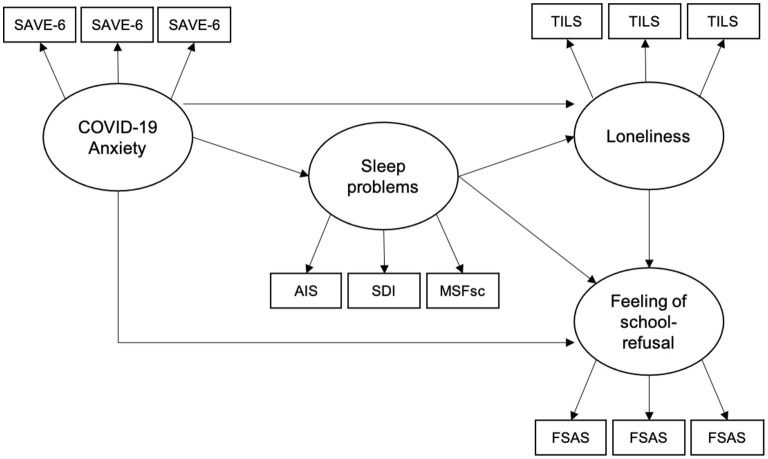
In this cross-sectional questionnaire-based study, 256 (109 male, 147 female, mean age: 15.37 ± 0.48 years) senior high school students were asked to complete the Stress and Anxiety associated with Viral Epidemics-6 questionnaire to assess COVID-19-related anxiety, the Athens Insomnia Scale (AIS), Sleep Debt Index (SDI), and chronotype (MSFsc) to assess sleep problems, the Three-Item Loneliness Scale (TILS) to assess loneliness, and Feelings of School-Avoidance Scale (FSAS) to assess school refusal.
Structural equation modeling showed that sleep problems affected loneliness (β = 0.52) and feelings of school refusal (β = 0.37), and that loneliness affected feelings of school refusal (β = 0.47). There was no significant pathway of COVID-19-related anxiety on sleep problems, loneliness, or feelings of school refusal. The indirect effect of sleep problems on feelings of school refusal through loneliness was significant. The results of hierarchical multiple regression analysis showed that AIS (β = 0.30) and SDI (β = 0.13) scores were associated with TILS, and AIS (β = 0.26) and MSFsc (β = -0.14) scores were associated with FSAS scores.
The findings of this study showed that sleep problems affected feelings of school refusal both direct and indirect pathways through the exacerbation of loneliness. To prevent school refusal in adolescents, addressing the indirect pathway loneliness could be effective in improving insomnia and sleep debt, while addressing the direct pathway could be effective in improving insomnia and chronotype.
与新冠疫情相关的焦虑、睡眠问题和孤独感可能是儿童和青少年拒绝上学的风险因素。然而,很少有研究探讨这些风险因素导致拒绝上学的机制。本研究使用结构方程模型,考察了与新冠疫情相关的焦虑、睡眠问题和孤独感导致拒绝上学的过程。
在这项基于问卷调查的横断面研究中,256名(109名男性,147名女性,平均年龄:15.37±0.48岁)高中生被要求完成《与病毒流行相关的压力和焦虑-6问卷》以评估与新冠疫情相关的焦虑,完成雅典失眠量表(AIS)、睡眠债指数(SDI)和生物钟类型(MSFsc)以评估睡眠问题,完成三项孤独感量表(TILS)以评估孤独感,完成学校回避感量表(FSAS)以评估拒绝上学情况。
结构方程模型显示,睡眠问题影响孤独感(β = 0.52)和拒绝上学感(β = 0.37),孤独感影响拒绝上学感(β = 0.47)。与新冠疫情相关的焦虑对睡眠问题、孤独感或拒绝上学感没有显著影响路径。睡眠问题通过孤独感对拒绝上学感的间接效应显著。分层多元回归分析结果显示,AIS(β = 0.30)和SDI(β = 0.13)得分与TILS相关,AIS(β = 0.26)和MSFsc(β = -0.14)得分与FSAS得分相关。
本研究结果表明,睡眠问题通过加剧孤独感以直接和间接途径影响拒绝上学感。为防止青少年拒绝上学,解决孤独感这一间接途径可能对改善失眠和睡眠债有效,而解决直接途径可能对改善失眠和生物钟类型有效。