Microbiology Unit, Department of Biological Sciences, Covenant University, Km 10, Idi-Iroko Road, Ota, Nigeria.
Department of Internal Medicine and Infectious Diseases, Faculty of Veterinary Medicine, Mansoura University, Mansoura, 35516, Egypt.
Ann Clin Microbiol Antimicrob. 2022 Jul 1;21(1):31. doi: 10.1186/s12941-022-00516-4.
Observable emergence of Vancomycin-Non susceptible Coagulase-negative Staphylococci (VNS-CoNS) associated with skin and soft tissue infections spreading among the urban and rural populace is gradually intensifying severe complications. The isolated VNS-CoNS were evaluated with Matrix-assisted Laser Desorption/ionization Time of Flight Mass Spectrometry (MALDI ToF MS) for species characterization and pan-antimicrobial resistance pattern.
Out of 256 clinical samples collected including pus, abscess, ear swabs, eye swabs, and aspirates, 91 CoNS isolates were biotyped and further characterized with MALDI-TOF MS. Staphylococci marker genes, Vancomycin susceptibility, and biofilm assays were performed.
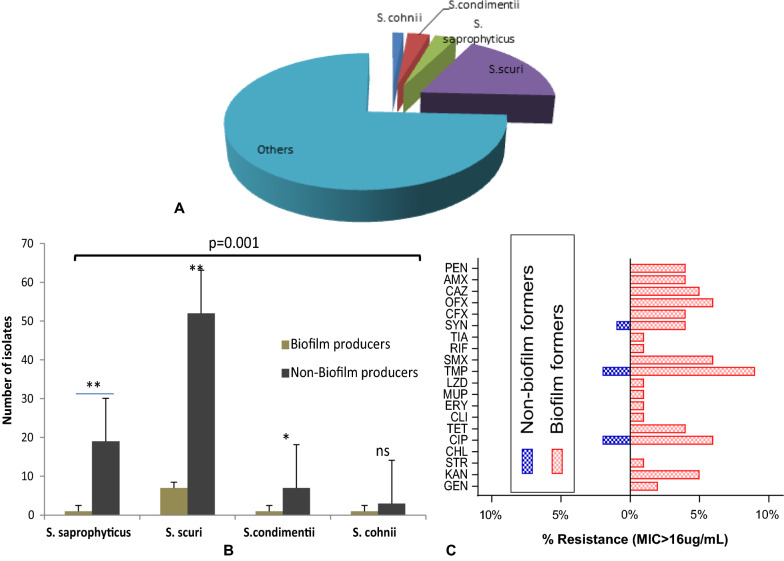
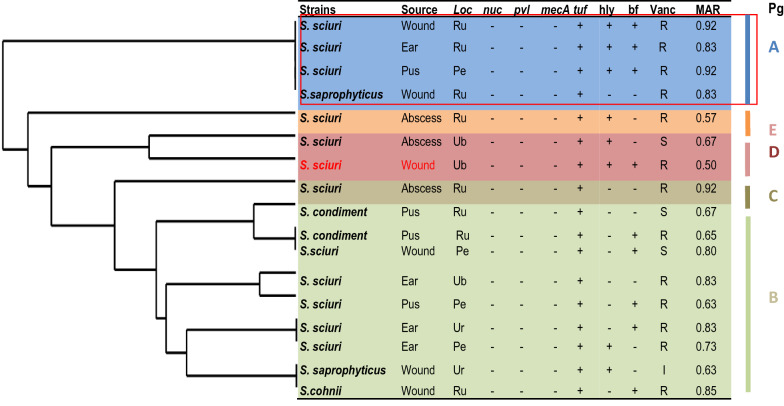
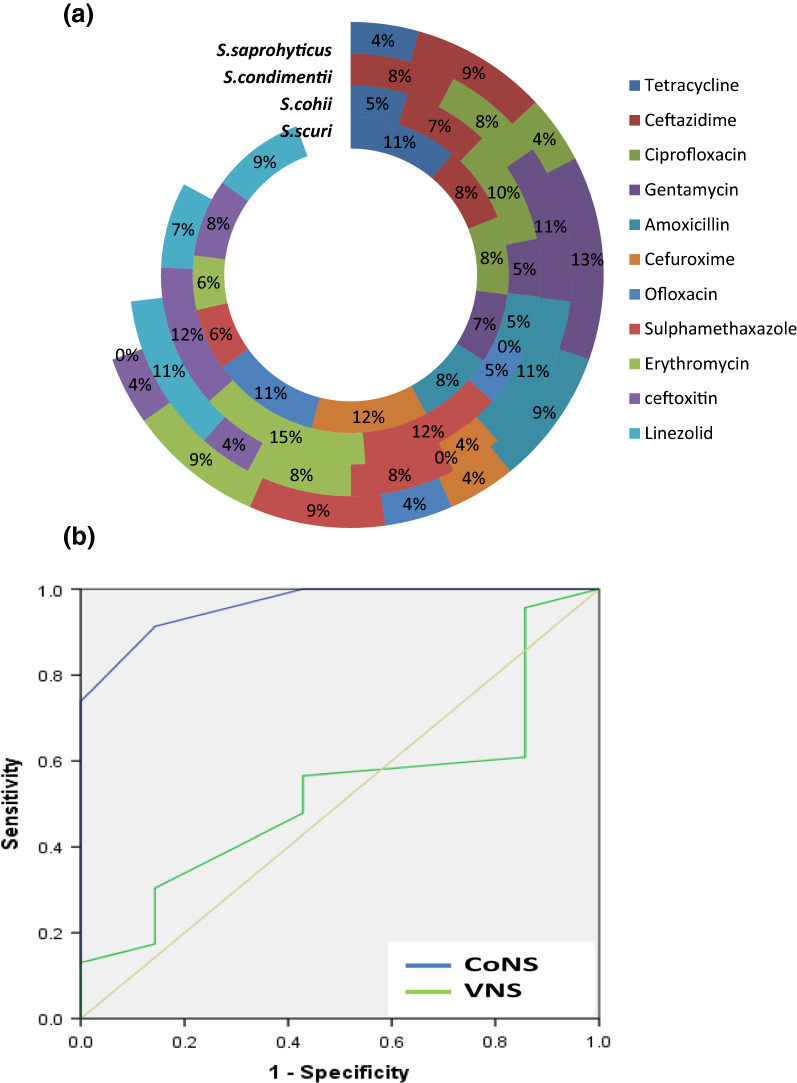
Of 91 CoNS isolates, S.cohnii (2.3%), S.condimentii (3.4%), S. saprophyticus (6.7%), and S.scuri (21.1%) were characterized with MALDI-TOF with significant detection rate (99.4%; CI 95, 0.775-0.997, positive predictive values, 90.2%) compared to lower biotyping detection rate (p = 0.001). Hemolytic VNS-CoNS lacked nuc, pvl and spa genes from wound, ear, and aspirates of more 0.83 MARI clustered into a separate phylo-diverse group and were widely distributed in urban and peri-urban locations. MALDI TOF-MS yielded a high discriminatory potential of AUC-ROC score of 0.963 with true-positivity prediction. VNS-CoNS of MIC ≥ 16 µg/mL were observed among all the ages with significant resistance at 25th and 75th quartiles. More than 10.5% of CoNS expressed multi-antibiotic resistance with more than 8 µg/mL vancomycin cut-off values (p < 0.05).
Antibiotic resistant CoNS should be considered significant pathogens rather than contaminant. Biofilm producing VNS-S. sciuri and S. condimentii are potential strains with high pathological tropism for skin, soft tissues and wound infections, and these strains require urgent surveillance in peri-urban and rural communities.
耐万古霉素凝固酶阴性葡萄球菌(VNS-CoNS)与皮肤和软组织感染相关,在城乡人群中逐渐出现,其临床表现逐渐加剧,严重并发症也逐渐增多。本研究采用基质辅助激光解吸电离飞行时间质谱(MALDI-TOF MS)对分离的 VNS-CoNS 进行种属鉴定和泛耐药模式分析。
从 256 例临床标本(包括脓液、脓肿、耳拭子、眼拭子和抽吸物)中分离出 91 株 CoNS,对其进行生物分型,并进一步采用 MALDI-TOF MS 进行鉴定。检测葡萄球菌标志物基因、万古霉素药敏性和生物膜形成。
91 株 CoNS 中,凝固酶阴性葡萄球菌(CoNS)(2.3%)、凝结酶阴性葡萄球菌(S.condimentii)(3.4%)、腐生葡萄球菌(S. saprophyticus)(6.7%)和松鼠葡萄球菌(S.scuri)(21.1%)经 MALDI-TOF 鉴定,其检出率显著高于生物分型(99.4%;95%CI,0.775-0.997;阳性预测值,90.2%)(p=0.001)。溶血 VNS-CoNS 缺乏来自伤口、耳朵和抽吸物的 nuc、pvl 和 spa 基因,0.83 MARI 聚类形成单独的、多样化的分支群,广泛分布于城乡地区。MALDI-TOF-MS 具有较高的鉴别能力,AUC-ROC 评分 0.963,真阳性预测率高。在所有年龄段中均观察到 MIC≥16μg/ml 的 VNS-CoNS,在 25%和 75%四分位数处表现出显著的耐药性。超过 10.5%的 CoNS 对多种抗生素表现出耐药性,万古霉素截断值超过 8μg/ml(p<0.05)。
抗生素耐药性 CoNS 应被视为重要的病原体,而非污染物。产生物膜的 VNS-松鼠葡萄球菌和凝结酶阴性葡萄球菌具有较高的皮肤、软组织和伤口感染的病理倾向,这些菌株需要在城乡社区进行紧急监测。