Manara Serena, Beghini Francesco, Masetti Giulia, Armanini Federica, Geat Davide, Galligioni Giulia, Segata Nicola, Farina Stefania, Cristofolini Mario
Laboratory of Computational Metagenomics, Department CIBIO, University of Trento, Via Sommarive 9, Povo, 38123, Trento, Italy.
Yale Institute for Network Science, Yale University, New Haven, CT, USA.
Dermatol Ther (Heidelb). 2023 Nov;13(11):2769-2783. doi: 10.1007/s13555-023-01036-5. Epub 2023 Sep 28.
Psoriasis is a systemic immune-mediated disease primarily manifesting as skin redness and inflammation. Balneotherapy proved to be a successful non-pharmacological option to reduce the skin areas affected by the disease, but the specific mechanisms underlying this effect have not been elucidated yet. Here we test the hypothesis that the effect of thermal treatments on psoriatic lesions could be partially mediated by changes in the resident microbial population, i.e., the microbiome.
In this study, we enrolled patients with psoriasis and monitored changes in their skin and gut microbiome after a 12-bath balneotherapy course with a combination of 16S rRNA amplicon sequencing and metagenomics. Changes in the resident microbiome were then correlated with thermal therapy outcomes evaluated as changes in Psoriasis Area and Severity Index (PASI) and Body Surface Area index (BSA).
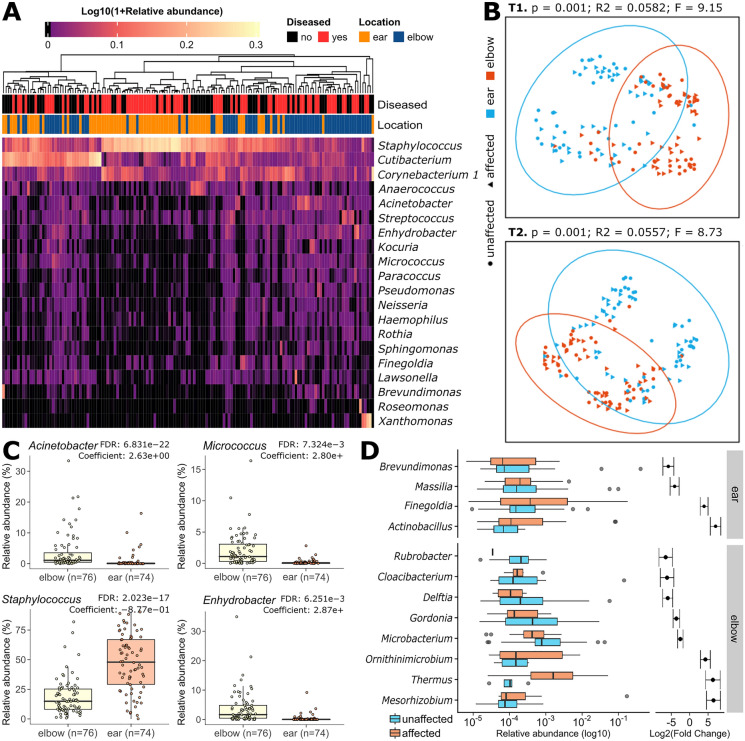
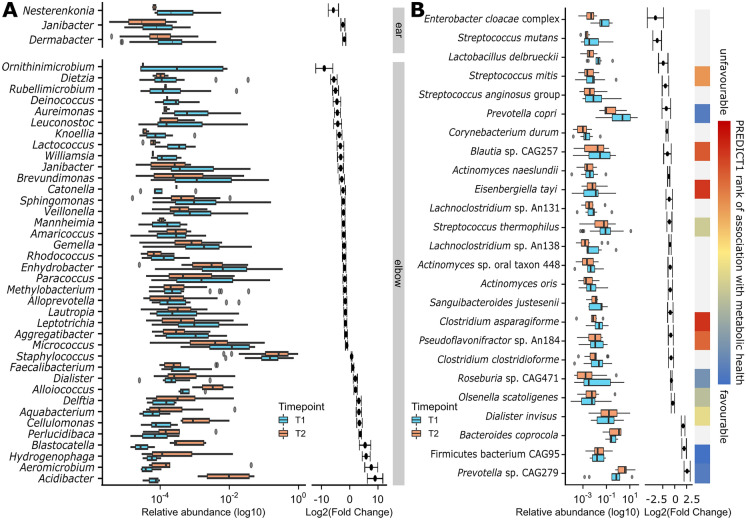
The amplicon sequencing analysis of the skin microbiome showed that after thermal treatment the microbiome composition of affected areas improved to approach that typical of unaffected skin. We moreover identified some low-abundance bacterial biomarkers indicative of disease status and treatment efficacy, and we showed via metagenomic sequencing that thermal treatments and thermal water drinking affect the fecal microbiome to host more species associated with favorable metabolic health.
Changes in lower-abundance microbial taxa presence and abundance could be the basis for the positive effect of thermal water treatment and drinking on the cutaneous and systemic symptomatology of psoriasis.
银屑病是一种主要表现为皮肤发红和炎症的全身性免疫介导疾病。温泉疗法被证明是一种成功的非药物治疗方法,可减少该病所累及的皮肤面积,但这种效果背后的具体机制尚未阐明。在此,我们检验这样一种假设,即热疗对银屑病皮损的影响可能部分是由常驻微生物群落(即微生物组)的变化介导的。
在本研究中,我们招募了银屑病患者,并通过16S rRNA扩增子测序和宏基因组学相结合的方法,在进行为期12次的温泉疗法疗程后,监测他们皮肤和肠道微生物组的变化。然后将常驻微生物组的变化与以银屑病面积和严重程度指数(PASI)及体表面积指数(BSA)变化评估的热疗结果相关联。
皮肤微生物组的扩增子测序分析表明,热疗后受累区域的微生物组组成得到改善,趋近于未受累皮肤的典型组成。此外,我们鉴定出了一些指示疾病状态和治疗效果的低丰度细菌生物标志物,并且通过宏基因组测序表明,热疗和饮用温泉水会影响粪便微生物组,使其拥有更多与良好代谢健康相关的物种。
低丰度微生物类群的存在和丰度变化可能是温泉水治疗和饮用对银屑病皮肤及全身症状产生积极影响的基础。