Li Minglei, Li Xiang, Jiang Yuchen, Zhang Jiusi, Luo Hao, Yin Shen
Department of Control Science and Engineering, Harbin Institute of Technology, Harbin, 150001, Heilongjiang, China.
Department of Mechanical and Industrial Engineering, Norwegian University of Science and Technology, Trondheim, 7034, Norway.
Knowl Based Syst. 2022 Sep 27;252:109278. doi: 10.1016/j.knosys.2022.109278. Epub 2022 Jun 27.
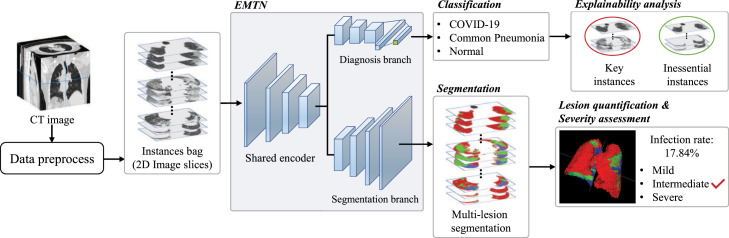
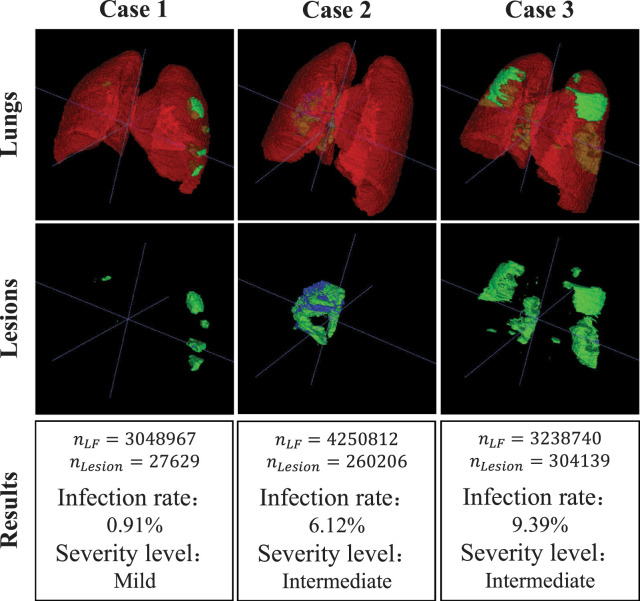
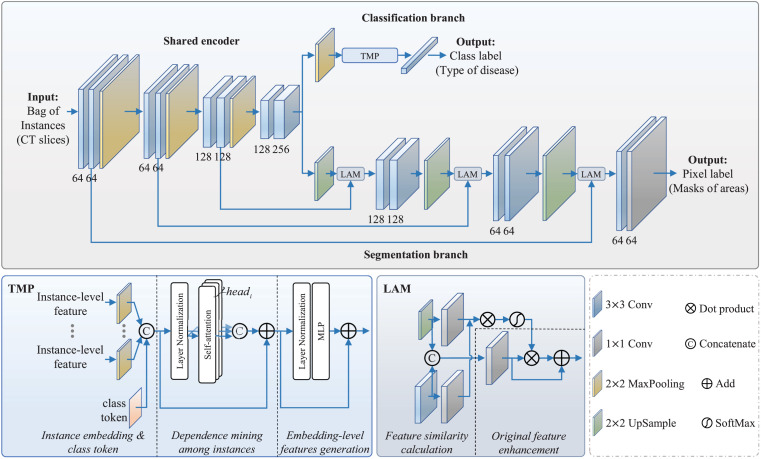
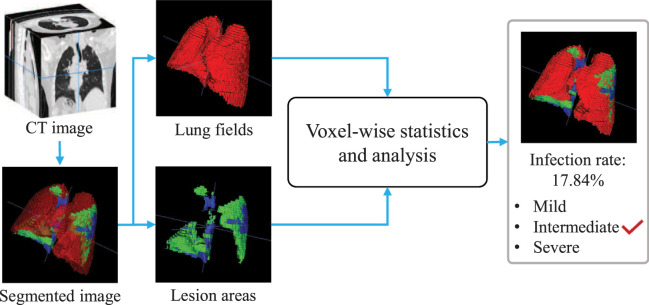
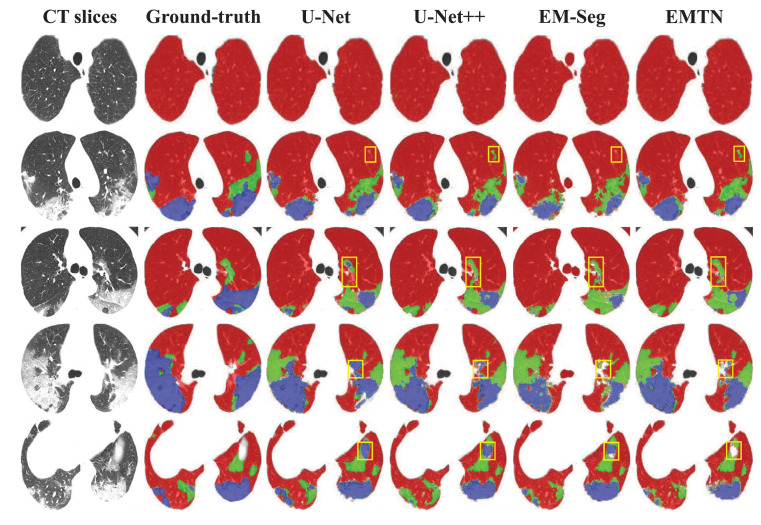
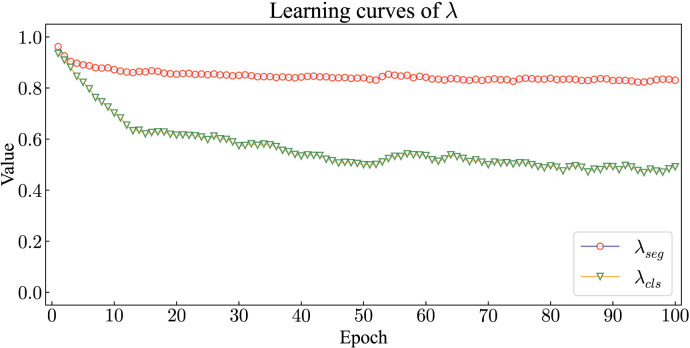
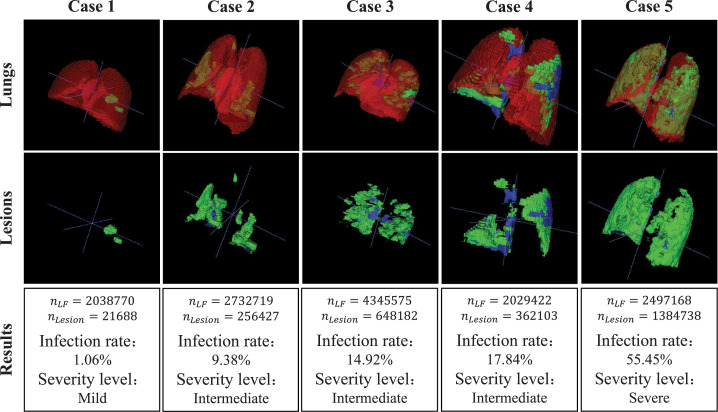
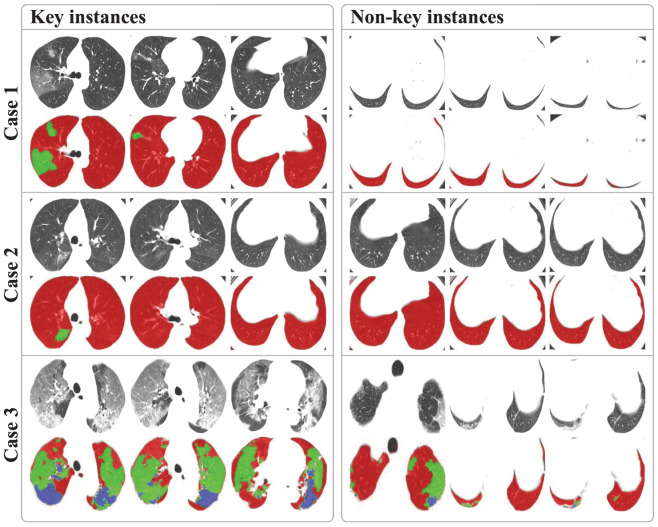
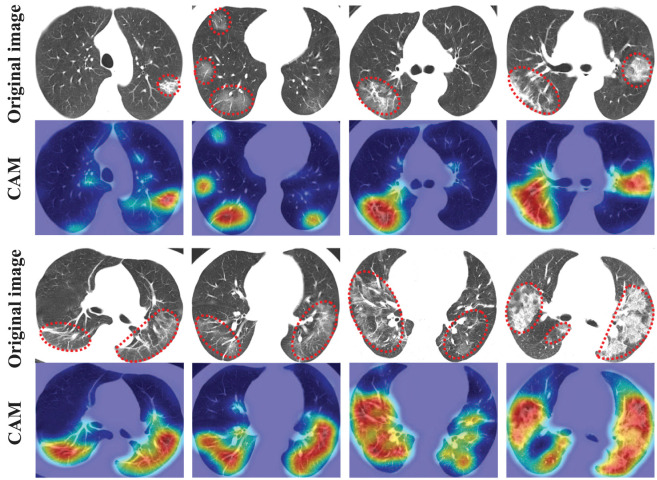
Coronavirus Disease 2019 (COVID-19) still presents a pandemic trend globally. Detecting infected individuals and analyzing their status can provide patients with proper healthcare while protecting the normal population. Chest CT (computed tomography) is an effective tool for screening of COVID-19. It displays detailed pathology-related information. To achieve automated COVID-19 diagnosis and lung CT image segmentation, convolutional neural networks (CNNs) have become mainstream methods. However, most of the previous works consider automated diagnosis and image segmentation as two independent tasks, in which some focus on lung fields segmentation and the others focus on single-lesion segmentation. Moreover, lack of clinical explainability is a common problem for CNN-based methods. In such context, we develop a multi-task learning framework in which the diagnosis of COVID-19 and multi-lesion recognition (segmentation of CT images) are achieved simultaneously. The core of the proposed framework is an explainable multi-instance multi-task network. The network learns task-related features adaptively with learnable weights, and gives explicable diagnosis results by suggesting local CT images with lesions as additional evidence. Then, severity assessment of COVID-19 and lesion quantification are performed to analyze patient status. Extensive experimental results on real-world datasets show that the proposed framework outperforms all the compared approaches for COVID-19 diagnosis and multi-lesion segmentation.
2019冠状病毒病(COVID-19)在全球范围内仍呈大流行趋势。检测感染者并分析他们的状况可以为患者提供适当的医疗护理,同时保护正常人群。胸部CT(计算机断层扫描)是筛查COVID-19的有效工具。它能显示详细的病理学相关信息。为了实现COVID-19的自动诊断和肺部CT图像分割,卷积神经网络(CNN)已成为主流方法。然而,以前的大多数工作将自动诊断和图像分割视为两个独立的任务,其中一些专注于肺野分割,另一些专注于单病灶分割。此外,缺乏临床可解释性是基于CNN的方法的一个常见问题。在此背景下,我们开发了一个多任务学习框架,在该框架中同时实现了COVID-19的诊断和多病灶识别(CT图像分割)。所提出框架的核心是一个可解释的多实例多任务网络。该网络通过可学习的权重自适应地学习与任务相关的特征,并通过将带有病灶的局部CT图像作为额外证据来给出可解释的诊断结果。然后,对COVID-19进行严重程度评估和病灶量化,以分析患者状况。在真实世界数据集上的大量实验结果表明,所提出的框架在COVID-19诊断和多病灶分割方面优于所有比较方法。