Shokouhi Navid, Khodakarami Hamid, Fernando Chathurini, Osborn Sarah, Horne Malcolm
Global Kinetics Pty Ltd., Melbourne, VIC, Australia.
Parkinson's Laboratory, Florey Institute of Neurosciences and Mental Health, Parkville, VIC, Australia.
Front Aging Neurosci. 2022 Jun 16;14:904895. doi: 10.3389/fnagi.2022.904895. eCollection 2022.
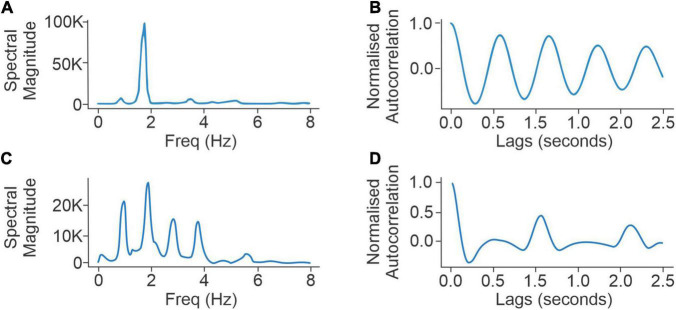
There are concerns regarding the accuracy of step count in Parkinson's disease (PD) when wearable sensors are used. In this study, it was predicted that providing the normal rhythmicity of walking was maintained, the autocorrelation function used to measure step count would provide relatively low errors in step count.
A total of 21 normal walkers (10 without PD) and 27 abnormal walkers were videoed while wearing a sensor [Parkinson's KinetiGraph (PKG)]. Median step count error rates were observed to be <3% in normal walkers but ≥3% in abnormal walkers. The simultaneous accelerometry data and data from a 6-day PKG were examined and revealed that the 5th percentile of the spectral entropy distribution, among 10-s walking epochs (obtained separately), predicted whether subjects had low error rate on step count with reference to the manual step count from the video recording. Subjects with low error rates had lower Movement Disorder Society Unified Parkinson's Disease Rating Scale (MDS-UPDRS III) scores and UPDRS III Q10-14 scores than the high error rate counterparts who also had high freezing of gait scores (i.e., freezing of gait questionnaire).
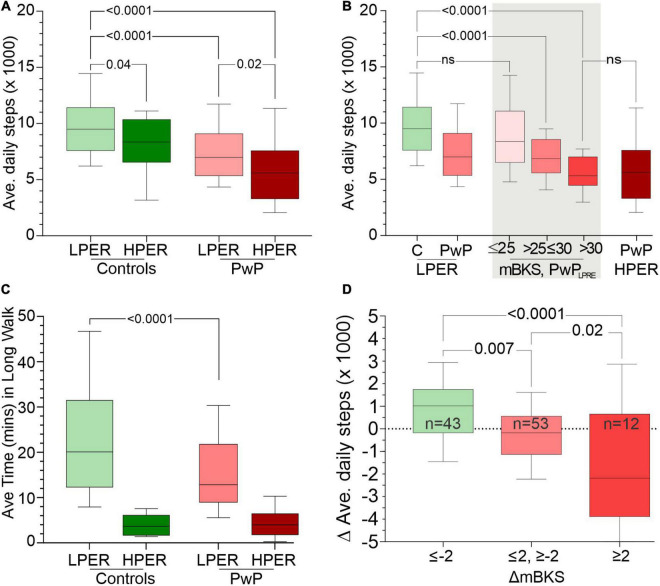
Periods when walking occurred were identified in a 6-day PKG from 190 non-PD subjects aged over 60, and 155 people with PD were examined and the 5th percentile of the spectral entropy distribution, among 10-s walking epochs, was extracted. A total of 84% of controls and 72% of people with PD had low predicted error rates. People with PD with low bradykinesia scores (measured by the PKG) had step counts similar to controls, whereas those with high bradykinesia scores had step counts similar to those with high error rates. On subsequent PKGs, step counts increased when bradykinesia was reduced by treatment and decreased when bradykinesia increased. Among both control and people with PD, low error rates were associated with those who spent considerable time making walks of more than 1-min duration.
Using a measure of the loss of rhythmicity in walking appears to be a useful method for detecting the likelihood of error in step count. Bradykinesia in subjects with low predicted error in their step count is related to overall step count but when the predicted error is high, the step count should be assessed with caution.
人们对使用可穿戴传感器时帕金森病(PD)步数计数的准确性存在担忧。在本研究中,预计如果步行的正常节律得以维持,用于测量步数的自相关函数在步数计数方面将产生相对较低的误差。
共有21名正常步行者(10名无PD)和27名异常步行者在佩戴传感器[帕金森运动记录仪(PKG)]时被拍摄视频。观察到正常步行者的中位数步数误差率<3%,而异常步行者的误差率≥3%。对同步加速度计数据和来自6天PKG的数据进行检查后发现,在10秒步行时段(分别获取)中,频谱熵分布的第5百分位数可预测受试者相对于视频记录中的手动步数计数是否具有低误差率。误差率低的受试者的运动障碍协会统一帕金森病评定量表(MDS-UPDRS III)得分和UPDRS III Q10-14得分低于误差率高的受试者,而后者的步态冻结得分(即步态冻结问卷得分)也较高。
从190名60岁以上的非PD受试者的6天PKG记录中识别出步行时段,并对155名PD患者进行检查,提取了10秒步行时段中频谱熵分布的第5百分位数。共有84%的对照组和72%的PD患者预测误差率较低。PKG测量的运动迟缓得分低的PD患者的步数与对照组相似,而运动迟缓得分高的患者的步数与误差率高的患者相似。在后续的PKG记录中,当通过治疗使运动迟缓减轻时,步数增加;当运动迟缓加重时,步数减少。在对照组和PD患者中,误差率低都与那些花费相当长时间进行超过1分钟步行的人有关。
使用一种衡量步行节律丧失的方法似乎是检测步数计数误差可能性的有用方法。步数计数预测误差低的受试者的运动迟缓与总步数有关,但当预测误差高时,应谨慎评估步数计数。