Acquah Aidan, Creagh Andrew, Hamy Valentin, Shreves Alaina, Zisou Charilaos, Harper Charlie, Van Duijvenboden Stefan, Antoniades Chrystalina, Bennett Derrick, Clifton David, Doherty Aiden
Nuffield Department of Population Health, University of Oxford, UK.
Big Data Institute, Li Ka Shing Centre for Health Information and Discovery, University of Oxford, UK.
medRxiv. 2024 Aug 14:2024.08.13.24311539. doi: 10.1101/2024.08.13.24311539.
Higher physical activity levels have been suggested as a potential modifiable risk factor for lowering the risk of incident Parkinson's disease (PD). This study uses objective measures of physical activity to investigate the role of reverse causation in the observed association.
To investigate the association between accelerometer-derived daily step count and incident PD, and to assess the impact of reverse causation on this association.
This prospective cohort study involved a follow-up period with a median duration of 7.9 years, with participants who wore wrist-worn accelerometers for up to 7 days.
The study was conducted within the UK Biobank, a large, population-based cohort.
The analysis included 94,696 participants aged 43-78 years (56% female) from the UK Biobank who provided valid accelerometer data and did not have prevalent PD.
Daily step counts were derived using machine learning models to determine the median daily step count over the monitoring period.
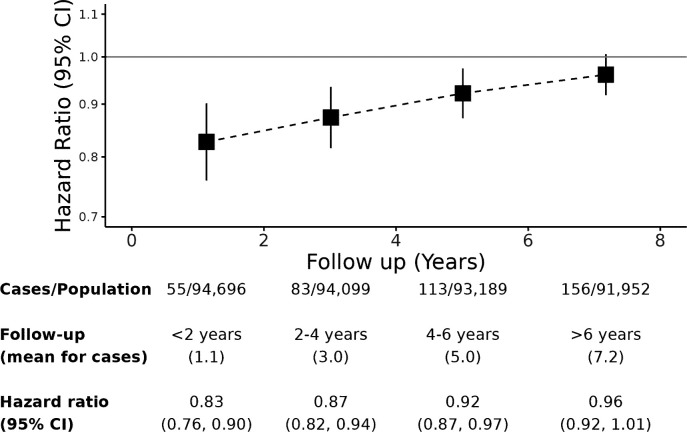
The primary outcome was incident PD, identified through hospital admission and death records. Cox proportional hazards regression models estimated hazard ratios (HR) and 95% confidence intervals (CI) for the association between daily step count and incident PD, with adjustments for various covariates and evaluation of reverse causation by splitting follow-up periods.
During a median follow-up of 7.9 years (IQR: 7.4-8.4), 407 incident PD cases were identified. An inverse linear association was observed between daily step count and incident PD. Participants in the highest quintile of daily steps (>12,369 steps) had an HR of 0.41 (95% CI 0.31-0.54) compared to the lowest quintile (<6,276 steps; HR 1.00; 95% CI 0.84-1.19). A per 1,000 step increase was associated with an HR of 0.92 (95% CI 0.89-0.94). However, after excluding the first six years of follow-up, the association was not significant (HR 0.96, 95% CI 0.92-1.01).
The observed association between higher daily step count and lower incident PD is likely influenced by reverse causation, suggesting changes in physical activity levels occur years before PD diagnosis. While step counts may serve as a predictor for PD, they may not represent a modifiable risk factor. Further research with extended follow-up periods is warranted to better understand this relationship and account for reverse causation.
较高的身体活动水平已被认为是降低帕金森病(PD)发病风险的一个潜在可改变风险因素。本研究使用身体活动的客观测量方法来调查反向因果关系在观察到的关联中的作用。
调查通过加速度计得出的每日步数与PD发病之间的关联,并评估反向因果关系对该关联的影响。
这项前瞻性队列研究的随访期中位数为7.9年,参与者佩戴腕部加速度计长达7天。
该研究在英国生物银行进行,这是一个基于人群的大型队列。
分析纳入了英国生物银行中94696名年龄在43 - 78岁之间(56%为女性)的参与者,他们提供了有效的加速度计数据且无PD病史。
使用机器学习模型得出每日步数,以确定监测期内的每日步数中位数。
主要结局是PD发病,通过住院和死亡记录确定。Cox比例风险回归模型估计每日步数与PD发病之间关联的风险比(HR)和95%置信区间(CI),对各种协变量进行调整,并通过划分随访期评估反向因果关系。
在中位数为7.9年的随访期间(四分位间距:7.4 - 8.4年),共确定了407例PD发病病例。观察到每日步数与PD发病之间存在负线性关联。每日步数最高五分位数组(>12369步)的参与者与最低五分位数组(<6276步;HR = 1.00;95% CI 0.84 - 1.19)相比,HR为0.41(95% CI 0.31 - 0.54)。每增加1000步,HR为0.92(95% CI 0.89 - 0.94)。然而,在排除随访的前六年之后,该关联不显著(HR = 0.96,95% CI 0.92 - 1.01)。
观察到的较高每日步数与较低PD发病之间的关联可能受到反向因果关系的影响,这表明身体活动水平的变化在PD诊断前数年就已发生。虽然步数可能可作为PD的预测指标,但它们可能并不代表一个可改变的风险因素。有必要进行更长随访期的进一步研究,以更好地理解这种关系并考虑反向因果关系。