Gao Chao, Smith Stephen, Lones Michael, Jamieson Stuart, Alty Jane, Cosgrove Jeremy, Zhang Pingchen, Liu Jin, Chen Yimeng, Du Juanjuan, Cui Shishuang, Zhou Haiyan, Chen Shengdi
1Department of Neurology, Ruijin Hospital, Shanghai Jiao Tong University School of Medicine, Shanghai, China.
2Department of Electronic Engineering, University of York, York, UK.
Transl Neurodegener. 2018 Aug 16;7:18. doi: 10.1186/s40035-018-0124-x. eCollection 2018.
There is an urgent need for developing objective, effective and convenient measurements to help clinicians accurately identify bradykinesia. The purpose of this study is to evaluate the accuracy of an objective approach assessing bradykinesia in finger tapping (FT) that uses evolutionary algorithms (EAs) and explore whether it can be used to identify early stage Parkinson's disease (PD).
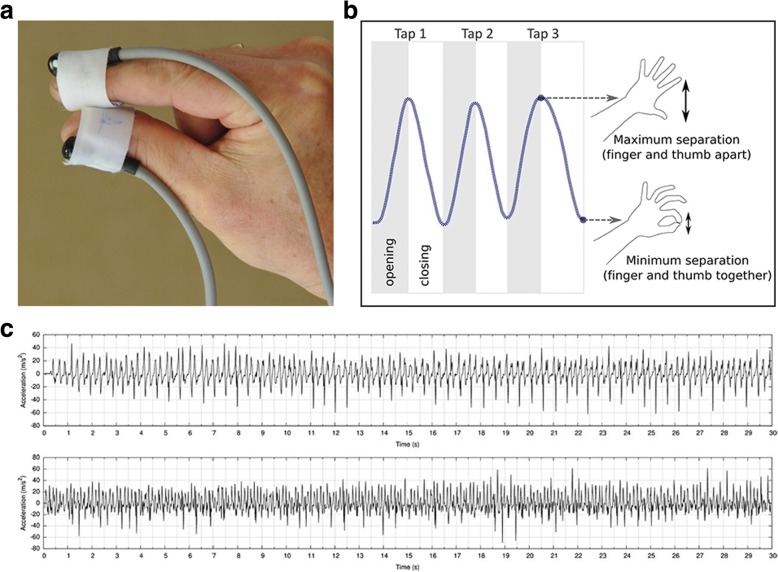
One hundred and seven PD, 41 essential tremor (ET) patients and 49 normal controls (NC) were recruited. Participants performed a standard FT task with two electromagnetic tracking sensors attached to the thumb and index finger. Readings from the sensors were transmitted to a tablet computer and subsequently analyzed by using EAs. The output from the device (referred to as "PD-Monitor") scaled from - 1 to + 1 (where higher scores indicate greater severity of bradykinesia). Meanwhile, the bradykinesia was rated clinically using the Movement Disorder Society-Sponsored Revision of the Unified Parkinson's Disease Rating Scale (MDS-UPDRS) FT item.
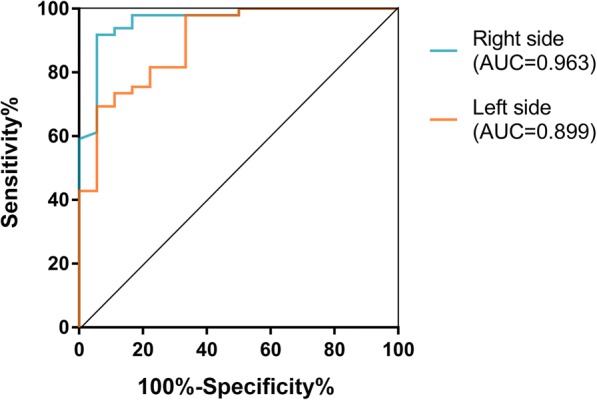
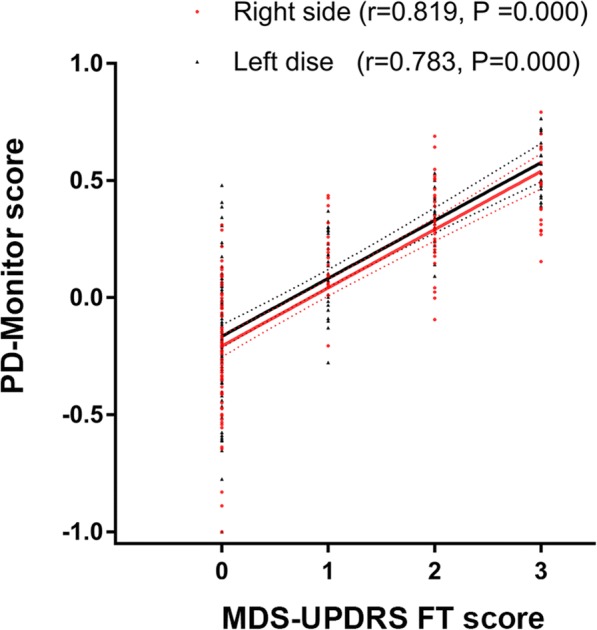
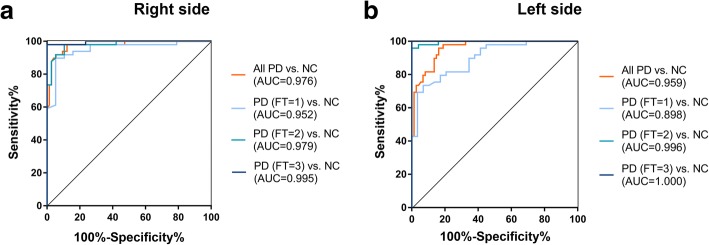
With an increasing MDS-UPDRS FT score, the PD-Monitor score from the same hand side increased correspondingly. PD-Monitor score correlated well with MDS-UPDRS FT score (right side: = 0.819, = 0.000; left side: = 0.783, = 0.000). Moreover, PD-Monitor scores in 97 PD patients with MDS-UPDRS FT bradykinesia and each PD subgroup (FT bradykinesia scored from 1 to 3) were all higher than that in NC. Receiver operating characteristic (ROC) curves revealed that PD-Monitor FT scores could detect different severity of bradykinesia with high accuracy (≥89.7%) in the right dominant hand. Furthermore, PD-Monitor scores could discriminate early stage PD from NC, with area under the ROC curve greater than or equal to 0.899. Additionally, ET without bradykinesia could be differentiated from PD by PD-Monitor scores. A positive correlation of PD-Monitor scores with modified Hoehn and Yahr stage was found in the left hand sides.
Our study demonstrated that a simple to use device employing classifiers derived from EAs could not only be used to accurately measure different severity of bradykinesia in PD, but also had the potential to differentiate early stage PD from normality.
迫切需要开发客观、有效且便捷的测量方法,以帮助临床医生准确识别运动迟缓。本研究的目的是评估一种使用进化算法(EA)评估手指敲击(FT)中运动迟缓的客观方法的准确性,并探讨其是否可用于识别早期帕金森病(PD)。
招募了107例PD患者、41例特发性震颤(ET)患者和49例正常对照(NC)。参与者使用两个附着在拇指和食指上的电磁跟踪传感器执行标准FT任务。传感器的读数被传输到平板电脑,随后使用EA进行分析。该设备(称为“PD监测仪”)的输出范围为-1至+1(分数越高表明运动迟缓越严重)。同时,使用运动障碍协会赞助的统一帕金森病评定量表(MDS-UPDRS)FT项目对运动迟缓进行临床评分。
随着MDS-UPDRS FT评分的增加,同一侧手的PD监测仪评分相应增加。PD监测仪评分与MDS-UPDRS FT评分相关性良好(右侧:=0.819,=0.0(此处原文有误,推测为0.000);左侧:=0.783,=0.0(此处原文有误,推测为0.000))。此外,97例有MDS-UPDRS FT运动迟缓的PD患者及每个PD亚组(FT运动迟缓评分为1至3)的PD监测仪评分均高于NC组。受试者工作特征(ROC)曲线显示,PD监测仪FT评分能够以较高的准确性(≥89.7%)检测右侧优势手不同严重程度的运动迟缓。此外,PD监测仪评分能够将早期PD与NC区分开来,ROC曲线下面积大于或等于0.899。此外,无运动迟缓的ET可通过PD监测仪评分与PD区分开来。在左侧发现PD监测仪评分与改良Hoehn和Yahr分期呈正相关。
我们的研究表明,一种使用从EA衍生的分类器的简单易用设备不仅可用于准确测量PD中不同严重程度的运动迟缓,而且有潜力将早期PD与正常情况区分开来。